See what John Deere’s AI approach teaches about precision farming—edge AI, targeted spraying, and practical steps growers can use in 2026.
AI Precision Farming: What John Deere Gets Right
Most companies trying to “add AI” to their product miss the point: the hard part isn’t the model. It’s the system—the sensors, data pipelines, edge computing, safety rules, and service operations that make AI dependable enough for the real world.
That’s why John Deere is such a useful case study for this series, “AI in Agriculture: Precision Farming for Modern Growers.” Deere sits at the intersection of machinery, software, and field operations. When AI works on a farm—dust, vibration, unreliable connectivity, changing light, and unforgiving timelines—it tends to work anywhere.
This post uses the “AI helps John Deere transform agriculture” story as a jumping-off point, then expands it into what growers, ag retailers, and U.S. digital service teams can actually learn: what AI is doing on modern equipment, why it’s hard, how teams make it safe, and how to apply the same playbook to your own digital transformation.
AI in agriculture isn’t a dashboard—it's automation you can trust
AI in agriculture becomes valuable when it turns data into action, not when it creates another report. The clearest ROI shows up in automation and decision support that reduce rework, labor pressure, and input waste.
On advanced farm equipment, the “AI stack” typically includes:
- Perception (computer vision): identifying crops vs. weeds, row lines, obstacles, residue, implement position
- Prediction: estimating yield, emergence, or equipment performance based on field conditions
- Control: steering, throttling, applying, or actuating precisely (and safely)
- Optimization: choosing the “best” action under constraints like speed, weather, label requirements, and cost
Deere’s transformation has been notable because it treats AI as part of an end-to-end product: sensors on the machine, models that run where the work happens, and software services that keep improving performance over time.
Why “edge AI” matters in precision farming
A lot of AI success stories assume stable internet and clean data. Farms rarely offer either.
Edge AI—running models directly on the machine—matters because it:
- Works with limited or intermittent connectivity
- Reduces latency (decisions in milliseconds can matter)
- Keeps sensitive data local when needed
- Improves reliability during peak windows like planting and spraying
For growers, the practical outcome is simple: your machine responds to what it sees right now, not what it uploaded later.
The John Deere playbook: computer vision, targeted action, measurable ROI
The most credible AI deployments in agriculture have three traits: (1) they’re narrow enough to be reliable, (2) they drive a physical outcome, and (3) they’re measurable.
For modern precision farming, that often means vision-guided operations such as:
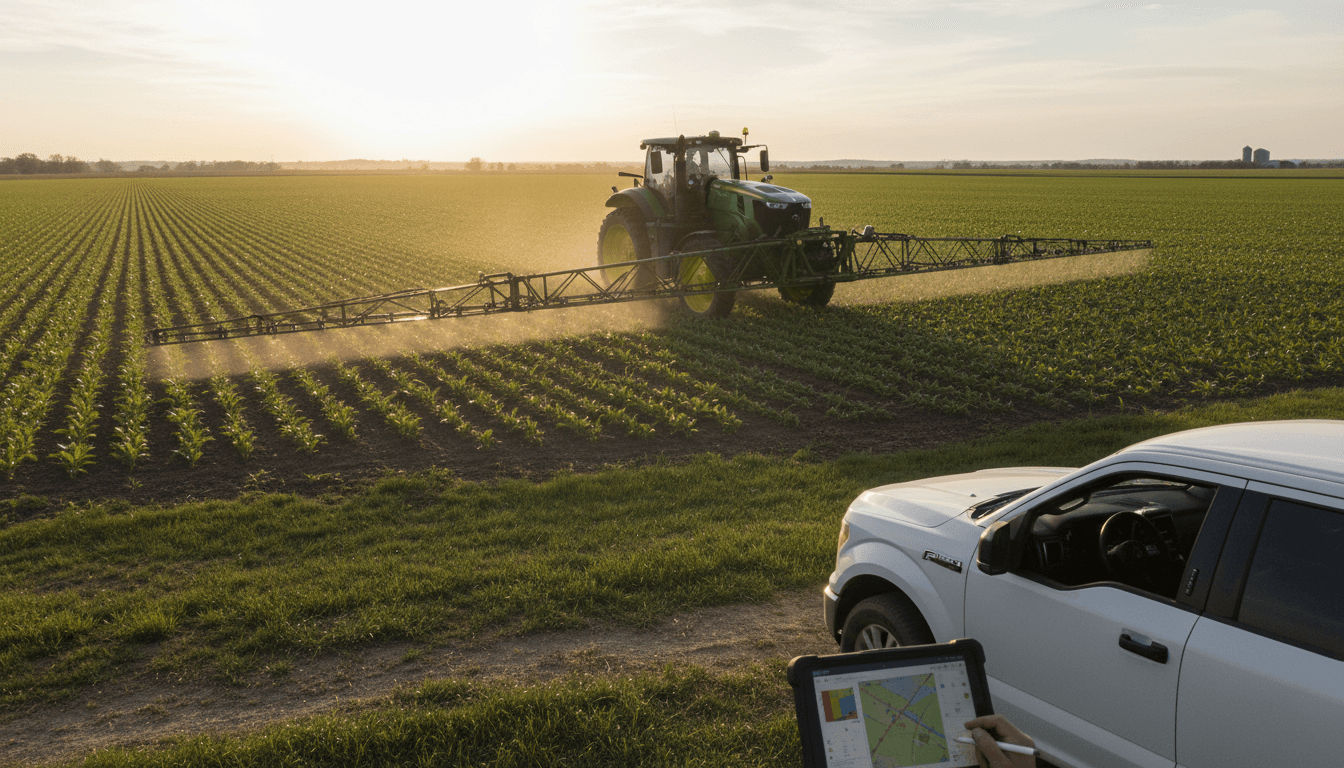
- Targeted spraying (spot-spraying weeds rather than blanket application)
- Row guidance and implement alignment (reducing overlap and missed passes)
- Obstacle detection and operator assistance (safer, less stressful operations)
Targeted spraying: where AI meets immediate economics
Targeted spraying is one of the cleanest examples of AI-powered agriculture. Here’s the mechanics:
- Cameras capture imagery at speed
- A vision model identifies weeds vs. crop/soil
- The system triggers nozzles only where needed
- Operators verify performance and adjust thresholds
Why it resonates in the U.S. market right now (December 2025) is straightforward: input costs stay high, resistance pressure keeps rising, and labor is tight.
A reliable way to explain the value: targeted spraying turns herbicide from a fixed cost into a variable cost tied to actual weed presence.
Even modest improvements can matter. If a farm reduces chemical use by 30% on acres where weed pressure is patchy, that’s not just cost savings—it can also mean fewer tender loads, less time refilling, and fewer logistics headaches during narrow weather windows.
Autonomy and operator assist: the “boring” wins add up
Fully autonomous farming grabs headlines, but the wins growers feel day-to-day often come from operator assist features:
- Keeping implements on-line reduces fatigue
- Minimizing overlap reduces wasted seed/fertilizer/fuel
- Automated turn sequencing reduces mistakes at 2 a.m. during crunch time
My take: these “boring” improvements are the ones that scale because they fit how farms actually operate—incremental capability that builds confidence season after season.
What makes farm AI hard (and how Deere-style teams handle it)
Agricultural AI isn’t hard because farms are “behind.” It’s hard because the environment is chaotic and the consequences are physical.
Here are the engineering realities that separate demos from dependable products.
Data reality: variability beats volume
More data helps, but variability matters more:
- Crop stage changes week to week
- Soil background changes field to field
- Light conditions swing wildly (dust, shadows, dawn/dusk)
- Residue, rocks, and moisture confuse perception
The practical approach is to build training datasets that deliberately cover edge cases and to track model performance across conditions. Strong teams also invest in:
- Data labeling standards (what counts as a weed at V2 vs. V6?)
- Active learning loops (prioritize the examples the model struggles with)
- Field validation protocols (not just test tracks)
Safety and control: AI must be bounded
On a farm machine, “the model guessed wrong” isn’t an acceptable explanation. The system has to be designed so AI operates within guardrails:
- Confidence thresholds that fall back to safe behavior
- Redundant sensors or cross-checks (where appropriate)
- Operator override and transparent alerts
- Conservative defaults when conditions drift out of spec
A snippet-worthy rule that holds up: If you can’t describe the fallback behavior, you don’t have a deployable automation feature.
MLOps for machinery: models are living components
In digital services, teams talk about MLOps. In ag equipment, the same idea applies, but with extra constraints:
- Updating models must respect uptime and busy seasons
- Diagnostics must work in low-connectivity regions
- Support teams need tooling to reproduce issues remotely
This is where John Deere’s example matters for the broader campaign: it’s not just AI adoption—it’s AI operations at enterprise scale.
From farm fields to digital platforms: why this case matters for U.S. services
This campaign is about how AI is powering technology and digital services in the United States. Agriculture might look “non-tech,” but Deere’s approach maps cleanly to SaaS and service businesses.
The shared pattern: capture → decide → act → learn
Whether you’re running a marketing automation platform or a sprayer, the loop is the same:
- Capture signals (customer behavior or field imagery)
- Decide with models (propensity or weed detection)
- Act through automation (send an offer or pulse a nozzle)
- Learn from outcomes (conversion or kill rate)
The difference is the tolerance for error. A bad recommendation engine is annoying. A bad actuation event wastes inputs or damages crop.
That’s why ag is a proving ground for AI discipline: if your team can ship robust automation here, you can usually ship it anywhere.
A practical comparison for digital leaders
If you lead a U.S.-based digital service team, here’s the Deere-style checklist worth stealing:
- Start with one high-frequency workflow where small improvements compound
- Instrument outcomes so you can measure performance without guessing
- Build feedback loops so real-world use improves the system
- Design fallbacks for low confidence and weird conditions
- Operationalize updates with clear seasonality and release windows
That’s digital transformation that doesn’t collapse under real-world constraints.
Actionable takeaways for growers adopting AI precision farming in 2026
AI in agriculture can feel like an all-or-nothing bet. It isn’t. The strongest results come from staged adoption with clear metrics.
1) Pick one operation and define “better” with numbers
Before you buy or enable features, decide what you’re optimizing:
- Herbicide gallons per acre (and refill frequency)
- Acres covered per hour at acceptable quality
- Overlap percentage
- Operator hours per day during peak windows
If you can’t measure the baseline, you can’t prove ROI.
2) Plan for calibration, not magic
Computer vision systems depend on practical setup:
- Camera cleanliness and placement
- Lighting assumptions
- Speed and boom height constraints
- Crop stage suitability
Treat the first season as a calibration season. You’re building trust.
3) Ask vendors (or your dealer) about edge cases
A useful set of questions:
- What happens when confidence is low?
- How does it behave with dust, residue, or wet leaves?
- How are updates delivered, and can you defer them during peak season?
- What operator training is required to avoid misuse?
4) Protect your data value
Even if data stays local, your operation generates insight. Have clarity on:
- What data is collected
- Who can access it n- How long it’s retained
- How it’s used to improve models
You don’t need paranoia here—you need governance.
People also ask: quick answers about AI in agriculture
Does AI precision farming work without internet? Yes, if the key models run on-device (edge AI). Connectivity helps with syncing, diagnostics, and updates, but core functions can operate offline.
Is targeted spraying only for certain crops? It’s most straightforward where weeds are visually distinct from soil/crop at the operating stage. Performance depends on crop canopy, lighting, residue, and growth stage.
What’s the biggest mistake when adopting AI on equipment? Assuming the feature is “set it and forget it.” The best outcomes come from training operators, calibrating in real field conditions, and measuring results.
Where AI in agriculture is headed next
The next chapter of AI in agriculture won’t be one monolithic “autonomous farm.” It’ll be a stack of reliable automations: smarter application, safer machine behavior, better field-level prediction, and tighter integration with farm management systems.
John Deere’s example matters because it shows what it takes to make AI real: not a lab demo, but a product that has to work during the busiest week of the year.
If you’re building in the U.S. digital economy—whether that’s farm tech, SaaS, or customer operations—this is the standard to aim for: AI that’s measurable, bounded, and operational. What would change in your business if your automation worked that reliably when conditions got messy?