AI-powered farm databases turn scattered field records into practical decisions—irrigation, pests, yield, and inputs. Build the data layer first.
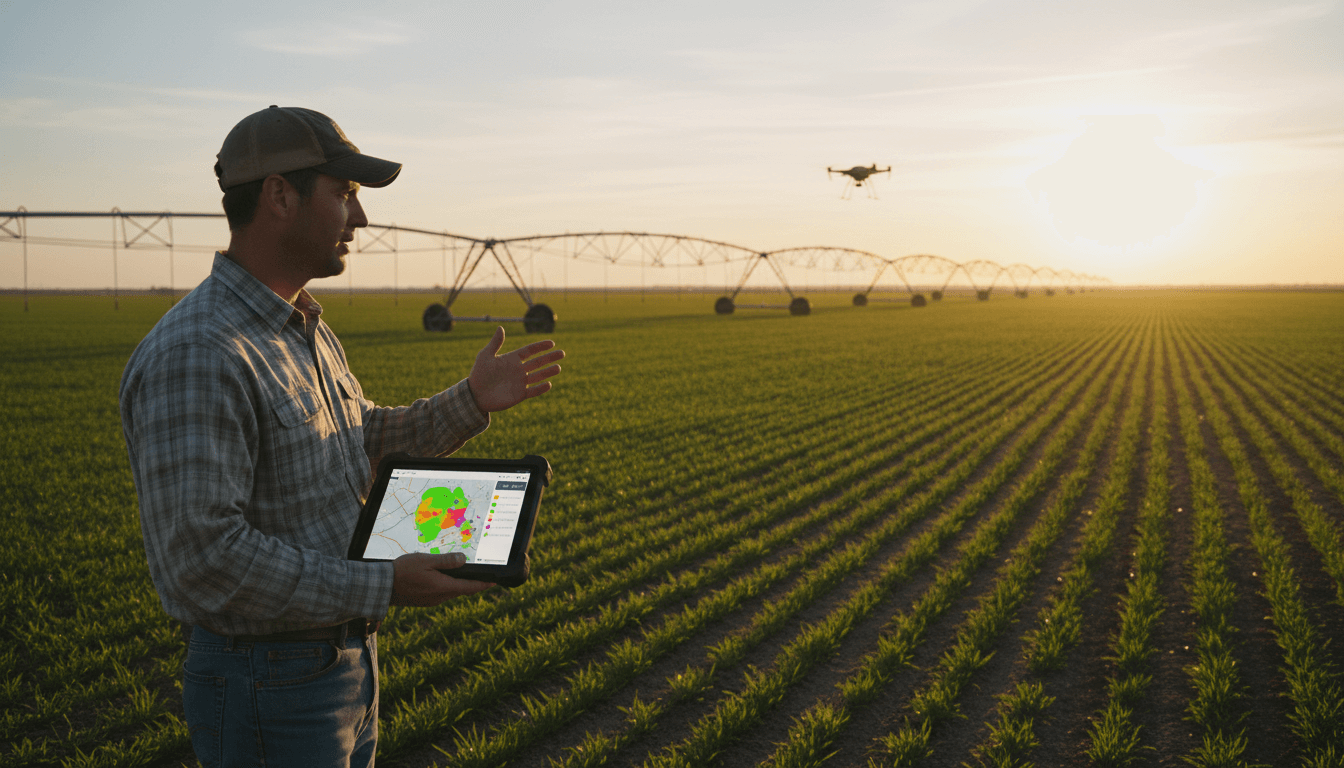
AI-Powered Farm Databases: Better Decisions, Faster
Most agricultural tech fails for one boring reason: the data isn’t organized enough to be useful on a Tuesday afternoon when something’s going wrong in the field.
A “database for farmers” sounds unglamorous, but it’s one of the highest-impact moves in precision agriculture. When weather, soil, pests, inputs, and market signals are captured consistently—and translated into plain-language recommendations—AI finally becomes practical instead of performative.
This post is part of our “AI in Agriculture: Precision Farming for Modern Growers” series. The focus here is a specific idea with outsized payoff: building an agricultural database that turns scattered farm information into actionable guidance. It’s also a real-world example of how U.S.-based AI innovation is powering digital services far beyond consumer apps.
Why farm databases are the backbone of precision agriculture
Answer first: Precision agriculture works when a farm has a reliable, queryable history of what happened, where it happened, and what the outcome was. That requires a database designed for farm realities, not a generic spreadsheet.
Many farms already have “data,” but it’s trapped in disconnected places: a notebook in the truck, a controller on a pivot, a PDF soil test, and an agronomist’s email thread. AI can’t help much if it can’t see the whole picture.
A modern agricultural database does three jobs at once:
- Collect: pull in field observations, equipment logs, remote sensing, input applications, and outcomes.
- Normalize: turn messy entries (“corn N pass, maybe 28%?”) into structured records.
- Serve decisions: provide alerts and recommendations at the right time (not after the season ends).
Here’s the stance I’ll take: If your “AI strategy” doesn’t start with a data model you trust, you don’t have an AI strategy. You have software subscriptions.
The hard part isn’t AI—it’s consistency
The reality? Farming creates uneven data. Some fields have years of yield maps; others have none. Some growers log every pass; others only track costs. A useful farm database has to tolerate gaps.
That’s where AI helps in a non-flashy way: it can infer structure, flag anomalies, and reduce manual entry. But the database still has to be intentionally designed.
What an AI-ready agricultural database actually contains
Answer first: An AI-ready agricultural database is organized around fields, time, and interventions, with enough context to link actions (what you did) to outcomes (what changed).
If you’re building (or buying) a system, look for these core layers.
1) Farm identity and field geometry
This is the foundation: farm, ranch, or operation identifiers; field boundaries; management zones; crop rotations.
If boundaries drift each season or zones aren’t versioned, you can’t compare year-to-year. A database should store:
- Field boundary versions (by season)
- Sub-field zones (soil type, productivity zones, irrigation blocks)
- Crop history per field and per zone
2) Observations (the “ground truth” layer)
AI is only as good as what it’s trained and validated against. On-farm observations matter because they anchor models to reality.
Examples of observation records:
- Scouting notes (weed pressure, pest counts, disease incidence)
- Emergence counts and stand assessments
- Tissue tests and soil tests
- Photos (with location and timestamp)
- Harvest notes (lodging, moisture issues, quality)
A practical requirement: the database should accept low-friction inputs (voice notes, quick forms, photo upload) and then use AI to extract structure later.
3) Interventions (what you changed)
This is where decision support becomes possible. An intervention record answers: What did we apply, where, when, how much, and why?
At minimum:
- Planting: hybrid/variety, population, depth, date
- Fertility: product, rate, timing, placement method
- Crop protection: active ingredient(s), rate, target, conditions
- Irrigation: duration, inches applied, schedule changes
When you connect interventions to outcomes, you get something far more valuable than a report: you get learning loops.
4) Environment and context (the “why it happened” layer)
Two farms can do the same thing and get different results. Context records explain the variance.
Common context inputs:
- Weather (historic and forecast)
- Soil moisture and temperature
- Growing degree days
- Irrigation system telemetry
- Satellite/NDVI and canopy metrics
When AI models miss, it’s often because the context layer is thin. A strong database doesn’t treat environment as a footnote.
How AI turns a farm database into decision support
Answer first: AI makes farm data useful by translating raw records into three outputs: predictions, recommendations, and early warnings.
A database alone is organized memory. AI makes it operational.
Predict: yield, disease risk, and irrigation needs
Prediction is the cleanest value proposition in AI for agriculture because it ties to planning.
- Yield forecasting improves storage, contracting, and logistics planning.
- Disease and pest risk models help time scouting and sprays.
- Irrigation optimization predicts when stress is approaching so you can water before yield loss happens.
You don’t need perfect accuracy for this to pay off. If a model reduces “surprise events” by even a handful per season, it saves real dollars and real sleep.
Recommend: what to do next (and what not to do)
Recommendations are where teams get nervous—and where good governance matters.
A trustworthy system doesn’t just output “apply fungicide.” It should output:
- The recommendation
- The confidence level
- The data it’s based on (fields, conditions, growth stage)
- The tradeoff (cost vs expected benefit)
I’ve found that farmers adopt recommendations faster when the system shows its work—even if it’s a simple explanation.
Warn: catch problems earlier than humans can
Early warning is often the highest ROI.
Examples:
- A sudden canopy drop in a zone suggests irrigation issues or disease onset.
- A fertilizer application logged at an unusual rate triggers a “verify” alert.
- A weather pattern plus crop stage signals higher mycotoxin risk.
These are database-driven guardrails. And they’re exactly the kind of digital service AI is good at scaling.
A practical case study pattern: “digital services for farmers”
Answer first: The most effective agricultural AI initiatives behave like service businesses: they standardize data intake, provide repeatable guidance, and improve with each season.
The RSS source hints at an initiative focused on building an agricultural database for farmers, and that’s the right starting point. When you build the database first, you can roll out digital services in phases instead of promising everything at once.
Here’s a pattern I’d follow (and I’ve seen it work across industries):
Phase 1: Make data capture cheaper than doing nothing
If logging a field pass takes five minutes, people won’t do it consistently.
Good systems reduce friction by:
- Auto-importing machine data where possible
- Allowing voice-to-text notes during scouting
- Turning photos into structured tags (crop stage, pest presence)
- Pre-filling common actions (same product, same rate, same field)
Phase 2: Deliver one decision tool that earns trust
Don’t start with “full farm optimization.” Pick one outcome and be excellent.
Examples that earn trust:
- Irrigation schedule recommendations for one crop
- Nitrogen side-dress timing alerts
- Pest risk alerts with scouting checklists
Phase 3: Expand across crops, fields, and regions
Once the system learns local patterns, it can scale—especially when the data model is consistent.
This is where U.S. AI innovation shows up in a useful way: building platforms that can support different geographies, different crops, and different operational styles without forcing everyone into the same workflow.
A farm database isn’t “storage.” It’s the operating system for precision farming.
What U.S. agriculture teams should look for in a farm data platform
Answer first: If you’re evaluating an AI-ready farm database, prioritize interoperability, explainability, and governance over flashy dashboards.
Plenty of tools look great in demos. Fewer survive a full season.
A quick evaluation checklist
Use this to pressure-test vendors or internal builds:
- Data portability: Can you export your data cleanly, field-by-field and season-by-season?
- Interoperability: Does it ingest equipment logs, imagery, and tests without custom work every time?
- Versioning: Does it track boundary changes, zone changes, and practice changes over time?
- Audit trails: Can you see who edited a record and when?
- Explainability: Do recommendations include the “why,” not just the “what”?
- Offline resilience: Can scouting and logging work with weak connectivity?
- Role-based access: Can you separate agronomist notes, employee permissions, and owner visibility?
Data governance: the quiet requirement that prevents disasters
If AI is making suggestions that affect chemical applications, worker safety, and compliance, governance can’t be an afterthought.
A solid approach includes:
- Clear ownership terms for farm data
- Permission controls by role
- Retention policies (what’s kept, what’s deleted)
- Model monitoring (does performance degrade in drought years or unusual seasons?)
This matters even more in late December, when teams review the past season and set budgets. If your data isn’t dependable now, it won’t magically improve when spring work starts.
“People also ask”: common questions about agricultural databases
How is an agricultural database different from farm management software?
Farm management software often focuses on planning, compliance, and recordkeeping. An agricultural database is the structured layer underneath that makes analytics and AI decision support reliable.
Can small and mid-sized farms benefit from AI farm databases?
Yes—if the setup is light and the first tool solves a real pain point (irrigation timing, scouting prioritization, or input tracking). The win isn’t “big data.” It’s fewer avoidable mistakes.
What data should a farm collect first?
Start with what you can collect consistently:
- Field boundaries and crop history
- Planting details
- Input applications (product, rate, date, field)
- Basic scouting observations
- Harvest outcomes (yield, moisture, quality)
Add sensors and imagery after the fundamentals are stable.
Where this is heading in 2026: AI that works like a farm assistant
Farmers don’t need more charts. They need timely answers: what’s changing, what’s at risk, and what action pays off.
A well-built agricultural database is the prerequisite for that future. It lets AI systems deliver precision agriculture capabilities—yield prediction, pest detection, irrigation optimization, and soil health monitoring—in a way that fits day-to-day operations.
If you’re planning for next season, here’s a practical next step: pick one farm workflow you want to improve (scouting, irrigation scheduling, or nitrogen timing), then audit whether your current data setup can support it. If it can’t, the fix probably isn’t “more AI.” It’s a better database.
What would change on your operation if every field decision came with a clear explanation, a confidence score, and a record you could learn from next year?