Texas is scaling battery storage fast. The winners will be teams that pair BESS with AI for forecasting, dispatch, and predictive maintenance.
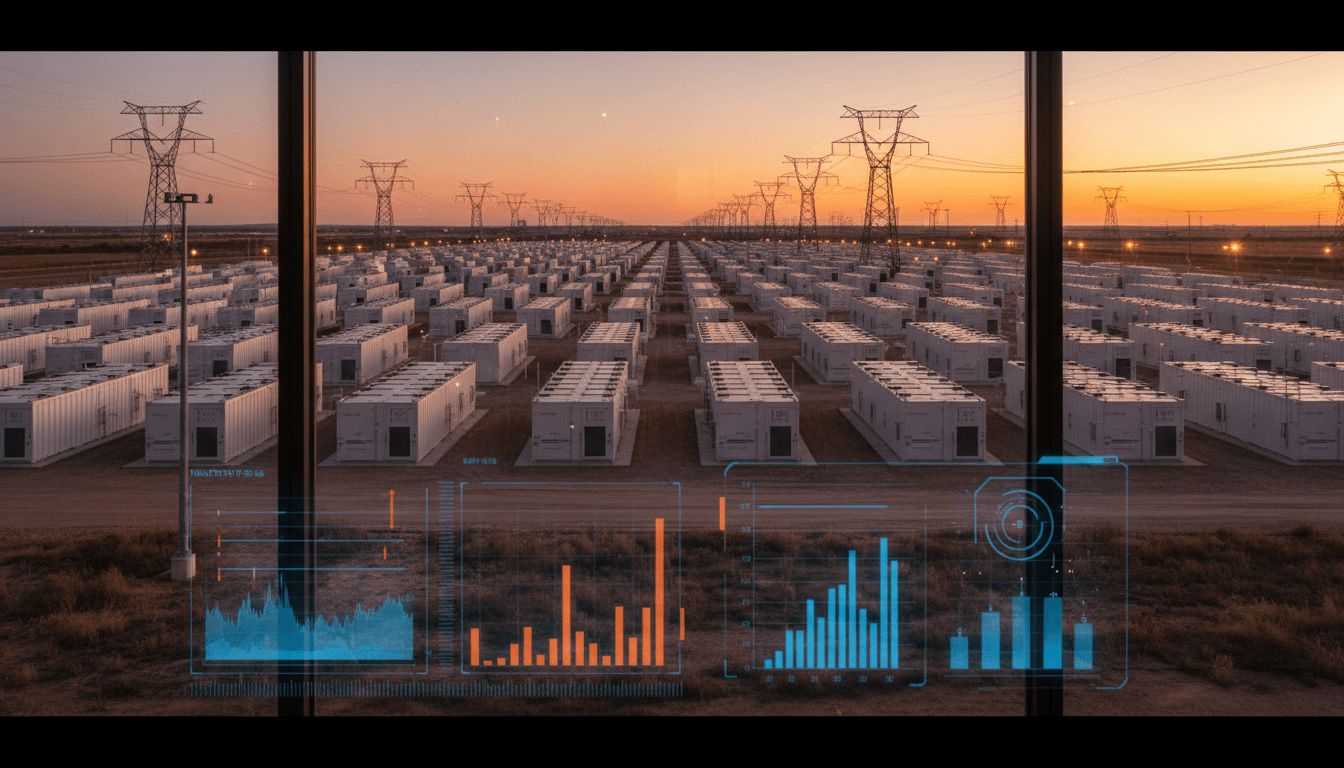
Texas Energy Storage Boom: The AI Layer Most Teams Miss
Texas didn’t just “add some batteries” lately. The state added about 6.4 GW of energy storage capacity in 2024, and more than 12 GW of storage has been deployed on ERCOT to date. State officials are even projecting storage could reach ~30% of Texas grid capacity by 2030. Those numbers are big enough to change how the grid behaves.
Two newly announced projects make the trend tangible: Peregrine Energy Solutions’ 250 MW / 500 MWh Mallard Energy Storage near Dallas–Fort Worth, and GridStor’s 150 MW / 300 MWh Gunnar Reliability Project in Hidalgo County, expected online by year-end 2026. Both are backed by tolling agreements with undisclosed Fortune 500 counterparties—an important signal that large customers and energy buyers are paying for reliability, not just electrons.
Here’s the part most companies get wrong: they treat battery energy storage systems (BESS) like a standalone asset class—containers, inverters, interconnection, done. In ERCOT’s reality (volatile prices, fast ramps, congestion, weather risk), the competitive advantage is the AI layer: forecasting, bidding, dispatch optimization, and predictive maintenance that turn a BESS into a grid-responsive machine.
What these Texas BESS announcements really signal
Answer first: These projects signal that Texas is shifting from “build megawatts” to “operate flexibility,” and that contracts are increasingly structured around performance.
Mallard (Peregrine) and Gunnar (GridStor) are both utility-scale batteries sized for real grid work:
- Mallard Energy Storage: 250 MW / 500 MWh, about 30 miles northeast of Dallas. Technology partner: Wärtsilä, using its Quantum2 system. Construction partner: WHC Energy Services.
- Gunnar Reliability Project: 150 MW / 300 MWh in Hidalgo County. GridStor signed a tolling agreement, construction underway, COD targeted by end of 2026.
In plain terms, these are 2-hour batteries (power-to-energy ratio) built to do a mix of:
- Peak shaving when demand spikes
- Renewable smoothing as solar output drops late afternoon
- Ancillary services (fast response reliability products)
- Congestion and nodal price arbitrage in a complex transmission footprint
The non-obvious signal is the tolling structure. A tolling agreement often means a counterparty pays for the right to “use” the battery’s capacity under agreed terms—like buying reliability as a service. That’s a reliability market maturing.
Why “more batteries” doesn’t automatically mean “more reliability”
Answer first: Reliability improves when storage is coordinated, not merely installed, and coordination is increasingly an AI problem.
A battery can respond in milliseconds, but ERCOT reliability events rarely come from one slow-moving issue. They’re stacks of problems:
- A temperature forecast misses by 4–6°F, load comes in high
- Cloud cover or dust reduces solar more than expected
- A transmission constraint appears, nodal prices decouple
- A gas plant trips and reserves tighten
- Operators react late because alarms are noisy and data is fragmented
BESS helps, but only if it’s dispatched at the right time, in the right location, for the right service. Otherwise you get the classic failure mode: the battery empties too early chasing price spikes and isn’t available when the grid actually needs it.
This is where AI for grid optimization becomes practical—not theoretical. The battery’s value is fundamentally a control problem: maximize revenue and reliability contribution subject to constraints.
The ERCOT “flexibility premium” is operational, not structural
Texas is a prime proving ground because ERCOT has:
- High renewables penetration in specific zones
- Strong load growth (including industrial expansion and data center power demand)
- Frequent congestion and nodal volatility
That creates a flexibility premium. But capturing it requires decision-making that can’t be done well in spreadsheets or manual playbooks.
The AI layer for modern BESS: four use cases that actually matter
Answer first: The highest ROI AI use cases for utility-scale storage are forecasting, dispatch optimization, predictive maintenance, and risk controls.
If you’re building, owning, operating, or contracting for BESS capacity in Texas, focus on these four.
1) Price, load, and renewable forecasting that’s fit for operations
A useful forecast isn’t “tomorrow’s average price.” Operators need probability distributions:
- 5-minute and 15-minute price ranges
- Ramp risk in the 4–9 p.m. window
- Congestion likelihood by node
- Weather-driven error bands
AI forecasting models (especially ensembles) are good at learning non-linear relationships between weather, grid conditions, outages, and prices. The point isn’t perfect prediction. The point is better decisions under uncertainty.
A practical win I’ve seen repeatedly: moving from a single deterministic forecast to a probabilistic forecast can reduce “empty too early” events, because the dispatch optimizer keeps energy in reserve when risk is high.
2) Dispatch optimization: co-optimizing services, not chasing one number
BESS earns (and supports reliability) across stacked value streams. In ERCOT that might include:
- Real-time energy
- Ancillary services
- Local congestion opportunities
- Contractual obligations (like tolling schedules)
AI-enabled optimization solves the real-world version of the problem:
- State of charge constraints
- Degradation cost (cycling isn’t free)
- Round-trip efficiency
- Interconnection limits
- Market rules and bid caps
- Must-run or reserved reliability commitments
A simple but powerful stance: treat degradation as a first-class cost in the objective function. Many operators still don’t. They optimize revenue, then wonder why capacity fades faster than expected.
3) Predictive maintenance that prevents forced outages (and derates)
A battery project’s economics can be wrecked by a few weeks of poor availability during high-value months.
Predictive maintenance for BESS is not just “monitor temperature.” It’s multi-layered:
- Cell and rack health (voltage drift, impedance growth)
- Thermal system performance (fans, coolant loops, hotspots)
- Inverter behavior (harmonics, fault signatures)
- Protection events and nuisance trips
AI-based anomaly detection shines here because failures are rare and messy. You’re looking for subtle shifts that precede a derate.
If you operate fleets (or plan to), also prioritize root-cause clustering across sites. The first time you catch “the same firmware + ambient conditions = nuisance trip” across multiple projects, the business case pays for itself.
4) Risk controls: guardrails for extreme weather and market stress
Texas in late December is a good reminder: winter peaks can happen, and they can be brutal. Summer is obvious; winter is the surprise.
AI can help by automating conservative operating modes when risk indicators spike:
- Maintain minimum state of charge during forecast uncertainty
- Restrict cycling when thermal margins are thin
- Switch bidding strategy based on reserve scarcity signals
- Detect data quality issues (bad weather feeds, telemetry gaps) before the optimizer makes bad calls
The goal is boring reliability. Boring is good.
What tolling agreements mean for AI adoption (and why buyers should care)
Answer first: Tolling agreements turn BESS into a performance-backed service, which makes AI-enabled monitoring and reporting non-negotiable.
Both Peregrine and GridStor reported tolling agreements with undisclosed Fortune 500 counterparties. If you’re on the buyer side of these deals—industrial, data center, retailer, manufacturer—AI becomes your friend in three ways:
- Verification: Did the battery deliver the contracted availability and response? You need clean data, baselines, and event logs.
- Transparency: If performance missed, was it a dispatch decision, an equipment derate, a market constraint, or an interconnection issue?
- Shared optimization: Some tolling structures benefit from collaborative scheduling—your load shape and the battery’s strategy can be aligned.
If you’re selling tolling-backed capacity, expect counterparties to ask for more than monthly spreadsheets. They’ll want operational dashboards, near-real-time alerts, and auditable reporting.
A practical checklist: building an “AI-ready” storage operation in ERCOT
Answer first: Start with data foundations and decision ownership; the models come after.
Here’s a field-tested checklist that keeps teams out of trouble:
- Telemetry you trust: validate timestamps, missing data handling, and sensor calibration. If you don’t trust the inputs, you won’t trust automation.
- Single source of truth for asset state: state of charge, availability, derates, warranties, and maintenance events in one system.
- Forecast-to-decision workflow: define who owns the forecast, who owns bids, who owns overrides, and how exceptions are handled.
- Degradation accounting: include cycle counting, temperature exposure, and equivalent full cycles in your KPI set.
- Model governance: version control, backtesting, drift monitoring, and an approval process for model changes.
- Cybersecurity and access control: batteries are grid assets with remote control pathways—treat them that way.
If your organization is early in AI for energy, do steps 1–3 before chasing fancy models.
Where this fits in grid modernization (and what happens next)
Answer first: Texas is building the hardware for grid modernization; AI determines whether the grid actually gets the benefits.
In the broader “AI for Energy & Utilities: Grid Modernization” series, these Texas announcements are a clean example of a wider shift: utilities and developers are scaling flexible assets faster than they’re scaling operational intelligence.
The next phase won’t be won by whoever installs the most containers. It’ll be won by the teams that can:
- Forecast volatility better
- Dispatch across multiple value streams without reliability trade-offs
- Keep availability high with predictive maintenance
- Prove performance to counterparties with auditable data
If you’re planning storage in ERCOT (or contracting for it), the best time to define your AI strategy is before commissioning—when data architecture, controls, and reporting are still easy to standardize.
Grid batteries are being built at industrial scale in Texas. The open question is whether most operators will run them like static infrastructure—or like intelligent, adaptive grid assets.