Hitachi Energy’s $30M CAD Ontario expansion signals a shift: AI grid modernization only works when service capacity can execute maintenance fast.
AI-Ready Grid Modernization: Why Service Capacity Wins
A $30 million CAD investment doesn’t sound like a moonshot in power-grid terms. But when it’s aimed at service operations for large power transformers, it’s a signal flare: utilities are entering a phase where keeping assets running matters as much as building new ones.
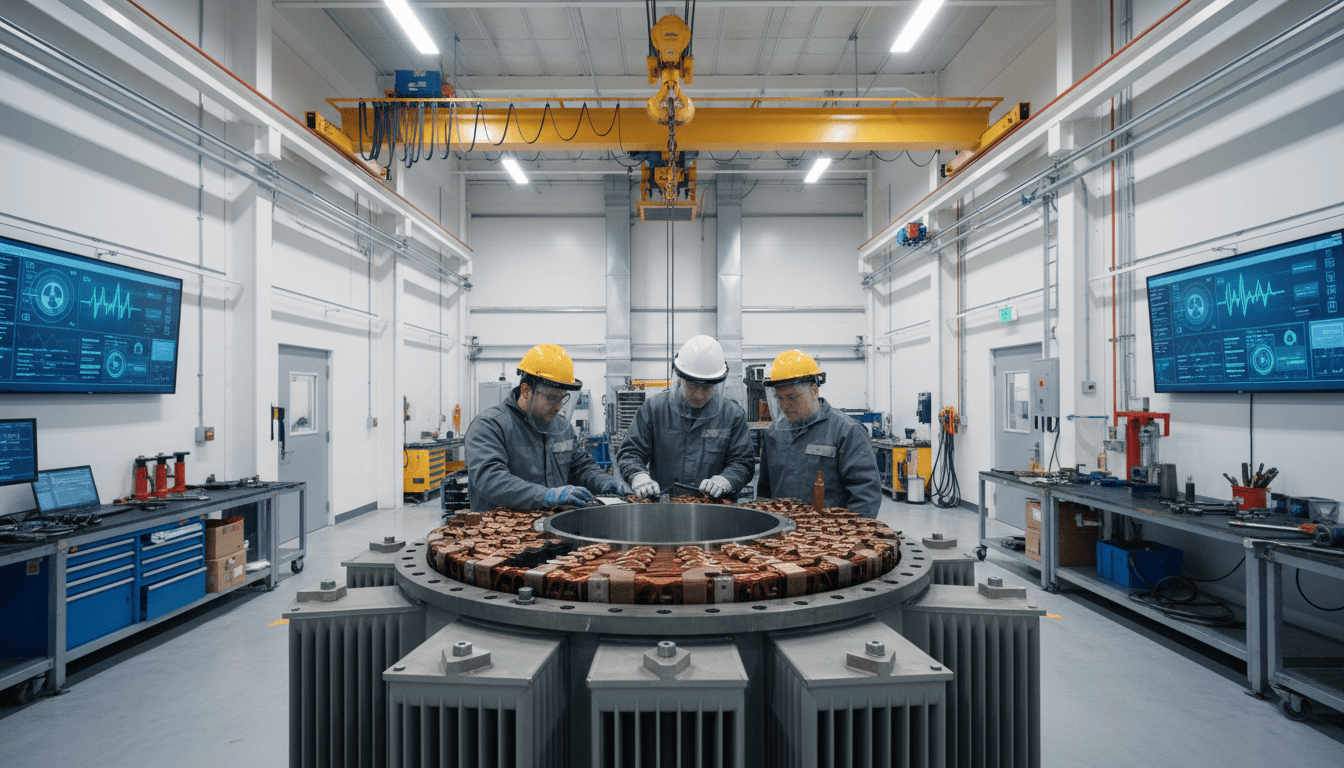
Hitachi Energy’s decision to expand and modernize its Ontario service footprint—upgrading its Stoney Creek facility and adding a new field service hub in Cambridge—lands at the exact intersection where grid modernization and AI in energy start paying off. AI can optimize maintenance, predict failures, and reduce outage time, but it can’t replace a missing spare, an unavailable crew, or a transformer stuck in a months-long repair queue.
This post is part of our “AI for Energy & Utilities: Grid Modernization” series, where we focus on practical moves utilities and grid operators can make right now. Here’s the stance I’ll take: the next competitive advantage in grid reliability won’t come from one more dashboard—it’ll come from pairing AI with real-world service capacity.
Why transformer service capacity is the grid’s real bottleneck
The fastest way to slow electrification isn’t permitting delays or interconnection queues. It’s equipment that can’t get repaired fast enough.
Canada’s electricity demand is rising due to population growth, industrial electrification, data growth, and clean energy buildout. At the same time, utilities across North America are dealing with aging grid infrastructure. Replacing major assets like large power transformers can take years, and when a unit goes down unexpectedly, the operational impact can be brutal: load transfers, constrained imports/exports, delayed connections for new customers, and a higher chance of customer interruptions during peak conditions.
Hitachi Energy’s Ontario expansion is focused on a specific pressure point:
- Stoney Creek is Canada’s only facility dedicated to upgrading and extending life of medium- and large-power transformers up to 765 kV.
- The site refurbishes dozens of units annually for utility and industrial customers across Canada and the U.S.
- Planned upgrades are designed to shorten turnaround times, getting critical assets back in service faster.
Here’s the key insight for AI leaders: AI-driven grid modernization is constrained by physical throughput. If repair and refurbishment capacity is limited, your best predictive maintenance model will simply predict a problem you can’t fix in time.
Refurbishment is also a decarbonization lever (not a compromise)
One detail from the announcement deserves more attention than it usually gets: refurbishing transformers can cut emissions by up to 70% versus manufacturing new equipment, because major components are reused.
That matters because many net-zero grid plans quietly assume a steady flow of new equipment. The reality? Supply chains are tight, lead times are long, and the “build everything new” approach often collides with cost and schedule.
A strong refurbishment program gives utilities a practical option:
- Extend asset life where condition supports it
- Reduce embodied carbon for major components
- Free up capital for targeted modernization (automation, sensors, communications)
That’s not nostalgia for legacy infrastructure. It’s portfolio optimization—and AI can help decide where refurbishment is the smart bet.
The AI connection: service expansion makes predictive maintenance real
Most utilities are already sold on the concept of predictive maintenance. The miss is execution: organizations invest in analytics before they invest in the operational system that turns predictions into outcomes.
Hitachi Energy’s additional field service center in Cambridge is positioned as a hub for on-site maintenance and rapid response. This kind of expansion is the missing “last mile” for AI-based asset management:
- AI detects a rising risk signature
- Work is prioritized with grid constraints in mind
- A crew, parts, and procedures are available fast enough to matter
When that chain is intact, AI stops being a science project and becomes an availability engine.
What “AI-ready maintenance” looks like in practice
If you’re building an AI roadmap for grid reliability, focus on this sequence:
- Instrument what actually fails: transformer bushings, tap changers, cooling systems, dissolved gas analysis (DGA) indicators, partial discharge trends.
- Standardize data pipelines: SCADA, historian, lab results, maintenance work orders, inspection photos, and OEM service notes.
- Model risk in operational terms: not “probability of failure,” but “risk during peak winter load,” “risk under N-1,” or “risk to critical feeders.”
- Close the loop: integrate recommendations into outage planning, switching plans, and procurement.
Service capacity is step 5 that many teams forget:
- Make sure the work can be executed: qualified crews, test equipment, refurbishment slots, and parts availability.
Hitachi Energy is investing in step 5. That’s why this announcement is more than a local expansion story—it’s a blueprint for making AI adoption stick.
Grid modernization in Ontario: why this move is strategically timed
Ontario is in the middle of a major electricity buildout. Provincial leadership has pointed to a large, long-term increase in demand, and utilities like Hydro One have reiterated they’ll be investing in equipment and Ontario-based operations to enable growth across homes, businesses, farms, manufacturers, and mines.
Two things make timing especially relevant in December 2025:
- Winter reliability pressure is top-of-mind right now. Cold-weather peaks amplify consequences of equipment outages, especially for transmission-constrained regions.
- Electrification schedules don’t wait for perfect infrastructure. Load growth from industrial projects and digital infrastructure comes with timelines, and utilities are expected to keep reliability steady while connecting more.
Hitachi Energy’s approach—modernize service operations plus increase field response capability—targets the part of the grid transition that rarely gets headlines: keeping existing assets available while the new grid is still under construction.
Myth: “Grid modernization is mostly about new build”
Most companies get this wrong. They treat modernization as a capital program—new lines, new stations, new gear—and they underinvest in the operational backbone that keeps today’s grid stable.
The reality? A modernization program that can’t sustain existing critical assets will fall behind, because outages and emergency replacements absorb budget, staff time, and political goodwill.
Service modernization is modernization.
Three ways infrastructure expansion supports smarter energy systems
If you’re leading reliability, asset management, or digital strategy, there are three direct ways a service expansion like this makes your AI efforts more effective.
1) Better data, because service work generates the truth
The most valuable asset data often comes from:
- teardowns
- inspections
- oil sampling and lab results
- field diagnostics
- component refurb findings
When service capacity increases, you get more of that “ground truth.” That improves AI models by reducing reliance on sparse or biased failure histories.
Practical move: treat service operations as a data-producing function, not just a cost center. Build a feedback loop where refurbishment findings update your asset health indices and risk models.
2) Faster cycle times, which is where AI actually saves money
AI value is frequently framed as “avoid failures.” That’s real, but the more repeatable savings often come from reducing time-to-repair and avoiding unnecessary replacements.
If facility upgrades shorten turnaround times, utilities gain:
- fewer days of constrained system operation
- less reliance on temporary switching configurations
- reduced need for expensive contingency rentals
Practical move: define a KPI that combines AI and operations, such as “risk-weighted outage days avoided” or “days of constraint avoided per refurbished unit.” That’s a metric executives understand.
3) Renewable integration depends on transmission reliability
Wind and solar growth pushes more power over long-distance corridors. That increases the importance of large power transformers and high-voltage assets—exactly the equipment Stoney Creek services up to 765 kV.
AI helps integrate renewables by:
- forecasting net load and ramps
- optimizing congestion management
- improving dynamic line ratings and operational limits
But if transformer availability is fragile, renewable integration gets capped by reliability concerns.
Practical move: prioritize AI models that connect asset health to grid operations—asset-to-constraint analytics—so you can quantify how maintenance increases usable transfer capability.
What utilities should do next: a practical checklist
If you’re trying to turn “AI for grid modernization” into a program that survives budgeting and operational realities, here’s what works.
Build a transformer-focused AI use case that operations will trust
Pick one high-impact asset class—large power transformers are ideal—and commit to an end-to-end workflow:
- Ingest: DGA, loading, temperature, moisture, maintenance logs
- Detect: anomaly + trend models for known failure modes
- Decide: prioritization based on system criticality (N-1, peak, corridor constraints)
- Do: work packaging + crew scheduling + outage planning
- Learn: capture findings and close the loop into model retraining
Align service partners early (before the model is “done”)
If your plan depends on refurbishment slots, field crews, or specialized testing, treat those as capacity planning inputs, not downstream details.
That’s why expansions like Cambridge matter: they create the operational bandwidth for AI-driven planning to translate into faster action.
Don’t chase perfect data; chase actionable confidence
I’ve found that teams get stuck trying to make asset data pristine. The better goal is actionable confidence—a model that reliably identifies the top 5–10% of assets where intervention has the highest risk reduction.
A “good enough” model paired with strong service execution beats a perfect model that can’t be operationalized.
Where this points in 2026: AI + lifecycle services become one strategy
Hitachi Energy framed its Cambridge expansion as part of a broader $1 billion commitment to expand its global Service business. That’s consistent with where the industry is headed: utilities are treating service capability, lifecycle analytics, and grid reliability as a single strategic lane.
The forward-looking bet is simple: as electrification accelerates, the winners will be the organizations that can keep critical grid equipment in service while modernizing in parallel. AI helps you see problems earlier and plan smarter. Service capacity lets you act before “manageable risk” becomes “public outage.”
If you’re working on grid modernization planning for 2026, ask yourself one uncomfortable question: when your AI model flags the next critical transformer risk, do you have the operational capacity to respond in weeks—not quarters?