Hitachi Energy’s $30M CAD Ontario expansion highlights a grid truth: service capacity plus AI drives reliability, faster repairs, and better ROI.
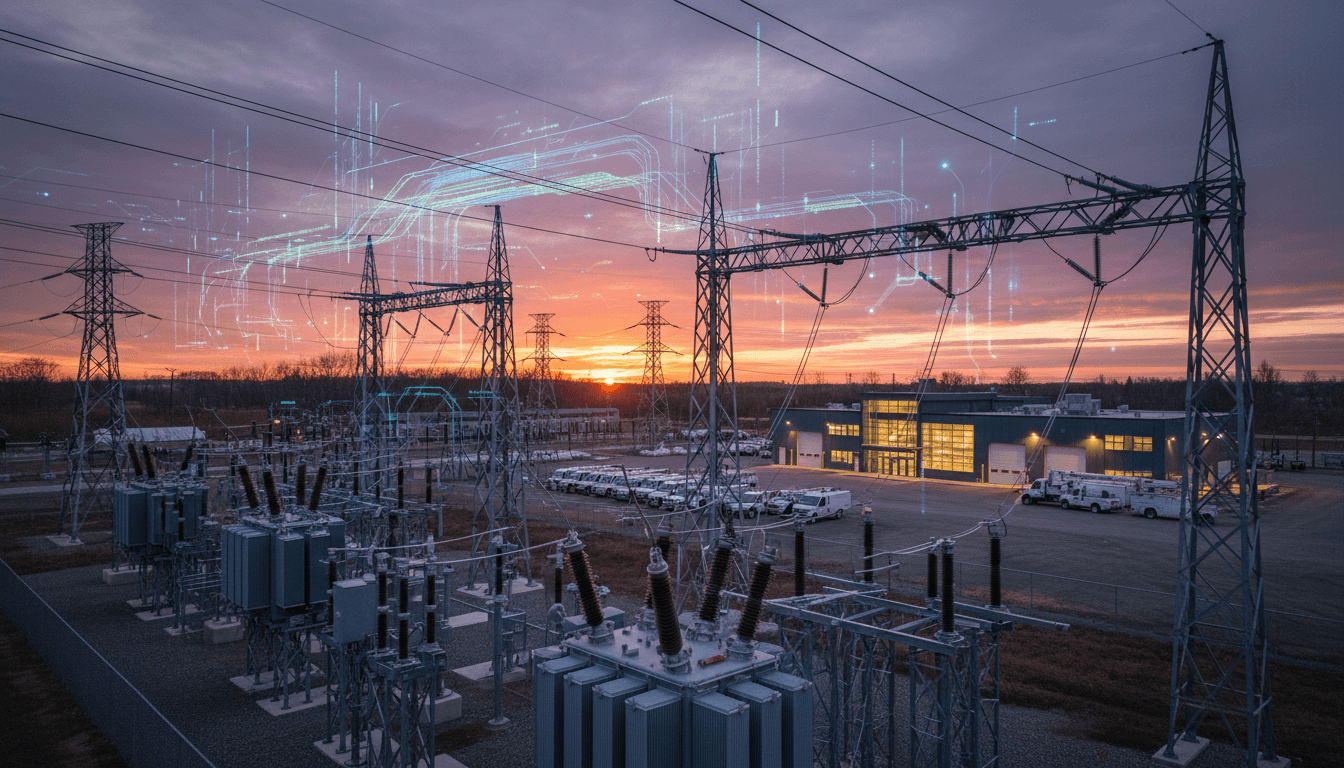
AI-Powered Grid Services: Why Canada’s $30M Move Matters
A $30 million CAD investment doesn’t sound like a “big grid story” until you look at where it’s going: transformer life-extension, refurbishment capacity, and field service response. That’s the part of the electricity system that quietly determines whether electrification targets are realistic—or whether you’re stuck with multi-year backlogs and risk you can’t insure away.
Hitachi Energy’s newly announced $30 million CAD expansion and modernization of its Ontario service operations (Stoney Creek plus a new field service hub in Cambridge) is a strong signal that grid modernization in Canada is shifting from planning to execution. I also think it’s a signal that AI in energy and utilities is moving past dashboards and pilots, and into the physical “keep the lights on” layer: asset health, outage response, and lifecycle services.
The short version: more service capacity is good, but service capacity paired with AI is how you get reliability, speed, and ROI at the same time.
Why service capacity is the grid modernization bottleneck
Answer first: Canada can build new generation and transmission, but the system will still struggle if critical assets—especially large power transformers—can’t be repaired, refurbished, and returned to service fast.
Canada’s electricity demand is rising, driven by electrification, industrial growth, and load growth from digitalization. At the same time, the grid is aging, and utilities are under pressure to keep existing equipment running while replacement timelines stretch.
Transformers are a special kind of problem:
- They’re high-impact, low-volume assets: one failure can constrain an entire region.
- Lead times for new units can run long because global manufacturing is constrained.
- Failure isn’t binary; it’s often a slow degradation story that shows up first in oil chemistry, partial discharge, vibration, or temperature behavior.
Hitachi Energy’s Stoney Creek site is positioned as Canada’s only facility dedicated to upgrading and extending the life of medium- and large-power transformers up to 765 kV, refurbishing dozens of units annually. The company says planned upgrades will shorten turnaround times—exactly what utilities need when electrification is accelerating.
This matters because grid modernization isn’t just new lines and shiny tech. It’s also keeping critical equipment in service during a once-in-a-generation load transition.
Why refurbishment beats replacement (and where AI fits)
Answer first: Refurbishing large power transformers is one of the fastest ways to increase grid capacity and reliability, and AI makes refurbishment decisions more accurate and defensible.
One detail in the announcement is easy to miss but strategically important: refurbishing transformers can cut emissions by up to 70% versus manufacturing new equipment, by reusing major components. That’s not only a sustainability story; it’s a schedule story. Refurbishment can be the difference between a planned outage window and an emergency, open-ended constraint.
The decision utilities keep getting stuck on
Utilities face an uncomfortable choice:
- Replace a transformer early “just to be safe” (capital-heavy, slow, often politically visible)
- Sweat the asset longer (operational risk, reliability risk, potentially catastrophic failure)
Most companies get this wrong by treating it as a purely engineering judgment call or a purely financial one.
A better way is to treat transformer lifecycle decisions as a portfolio optimization problem, where each asset has:
- A probability-of-failure curve over time
- A consequence-of-failure score (load served, critical customers, restoration complexity)
- A set of intervention options (oil processing, bushing replacement, on-site drying, refurbishment, replacement)
- A realistic timeline and supply-chain risk factor
That’s exactly where AI earns its keep.
Practical AI use cases that pair with refurbishment programs
If you’re running a transformer refurbishment pipeline (or trying to scale one), these are the AI capabilities that consistently pay off:
-
Predictive maintenance for transformers
- ML models that combine dissolved gas analysis (DGA), loading history, temperatures, moisture estimates, and maintenance records to predict risk of failure.
- The win isn’t “predicting the future.” It’s ranking assets so scarce crews and shop slots go to the right units.
-
Condition-based work scoping
- AI-assisted diagnostics can suggest whether you need a full teardown or a targeted intervention.
- This reduces “surprise work” mid-refurbishment—the thing that blows up turnaround times.
-
Turnaround time forecasting
- Predict shop duration based on unit type, known issues, historical work orders, and parts availability.
- When outages are coordinated across a region, a more accurate schedule is worth real money.
-
Quality control analytics
- Pattern detection across test results (e.g., impulse tests, power factor, leakage reactance changes) to catch early indicators of workmanship or systemic issues.
When Hitachi Energy says the Stoney Creek upgrades will shorten turnaround times, AI is the obvious accelerant. Faster isn’t only about more floor space—it’s about better decisions before the unit arrives, and fewer rework loops once it’s in the bay.
The Cambridge field service hub: reliability is a response-time problem
Answer first: A dedicated field service center improves reliability because many grid failures are avoided (or contained) by fast, expert intervention—especially during peak seasons.
The second half of the investment is the acquisition of a new field service center in Cambridge. This isn’t glamorous, but it’s exactly what utilities feel in their operational gut: when something starts to go wrong, how quickly can qualified specialists get on site with the right parts and the right plan?
December 2025 is a fitting moment to talk about this. Winter operations expose weak points:
- Cold-weather loading patterns stress certain assets
- Switching events and contingencies stack up during storms
- Restoration windows are shorter and more expensive
A field service hub helps with the obvious (more crews, more coverage). AI helps with the less obvious: showing up prepared.
AI in field service: what actually helps crews
The most useful AI features in field service tend to be unflashy:
- Triage copilots that summarize asset history, prior outages, last test results, and known quirks in one brief.
- Parts prediction based on failure modes and site conditions, reducing “second trip” delays.
- Work-package generation from standards and previous similar jobs—so experienced engineers aren’t rewriting the same plans.
- Computer vision to spot connector overheating, corrosion, or mechanical damage from inspection photos.
Pair those with a hub like Cambridge and you get a compounding effect: the hub increases capacity, and AI increases effective capacity by cutting wasted time.
Investment is nice. Maximizing ROI requires AI.
Answer first: Grid investments deliver the best ROI when AI reduces unplanned outages, improves asset utilization, and shortens maintenance cycles—without adding operational complexity.
Hitachi Energy frames this investment as part of a broader $1 billion global commitment to expand its Service business. That’s a strong read of the market: utilities don’t just need new equipment; they need lifecycle services that keep equipment productive as electrification accelerates.
If you’re a utility, a large industrial energy user, or even a grid-adjacent investor, the key question is not “who is building facilities?” It’s “who can keep assets online?”
Here’s what ROI looks like in practice when you bring AI into the service layer:
- Fewer forced outages: Predict failures early enough to schedule maintenance in planned windows.
- Higher transformer utilization: Confidently run assets closer to their true capability when risk is quantified.
- Shorter mean time to repair (MTTR): Better triage and fewer “unknown unknowns” during repair.
- Lower lifecycle cost: Refurbish the right units at the right time, rather than replacing everything early.
The KPI set that makes AI real (not a science project)
I’ve found that AI programs in utilities succeed when they’re tied to a small, operational KPI set. For transformer service and refurbishment, that set is usually:
SAIDI/SAIFIimpact attributed to transformer events- Forced outage rate for transformer classes (by kV level and age)
- Refurbishment turnaround time (planned vs actual)
- Repeat-work rate within 12 months post-service
- Spares strategy effectiveness (how often spares are available and compatible)
If your AI initiative can’t move at least two of these in 6–12 months, it’s probably not connected tightly enough to operations.
What this means for Canada’s net-zero grid plans
Answer first: Canada’s net-zero electricity goals depend on reliability upgrades as much as clean generation, and AI is one of the few tools that improves reliability and integration at the same time.
Hitachi Energy explicitly ties this investment to helping Canada progress toward a net-zero electricity grid by 2050, largely by expanding transformer refurbishment and maintenance capacity. That’s sensible: the clean grid isn’t just wind, solar, hydro, nuclear, and storage—it’s also the transmission backbone and the equipment that makes variable resources dependable.
As renewable penetration rises, grid operators need:
- Better visibility into constraints
- Faster interconnection and commissioning
- More dynamic operations (switching, voltage management, reactive power planning)
Transformer health becomes even more consequential in that world because transformers sit at the seams: generation tie-ins, transmission corridors, substation step-down points, and large load interconnects.
Where AI ties reliability to renewable integration
This is the bridge many organizations miss: the same AI foundation that supports predictive maintenance also supports renewable integration.
- AI-driven demand forecasting improves planning for transformer loading and substation upgrades.
- Grid optimization models help reduce congestion and avoid stressing specific assets.
- DER and load forecasting reduces uncertainty, which reduces the temptation to overbuild “just in case.”
If Ontario is, as policymakers say, in one of the largest buildouts on the continent, then the winners will be the ones who can keep schedules credible and operations stable.
A practical playbook: how utilities can benefit right now
Answer first: Treat service expansion as the moment to modernize your data, workflows, and decision rights—so AI can improve outcomes within one maintenance cycle.
If you’re a utility or large energy user watching this announcement and thinking “good for them, what does it mean for me?”, here’s a pragmatic path that doesn’t require a multi-year overhaul.
1) Build a transformer “single record” before you build models
Pull together the minimum viable dataset:
- Asset registry data (nameplate, kV class, manufacturer, install date)
- DGA results and sampling frequency
- Loading history and ambient conditions
- Maintenance and failure work orders
- Test results (power factor, sweep frequency response if available)
If these live in five systems, that’s normal. Start by mapping and standardizing, not replacing.
2) Start with ranking, not perfect prediction
Most value comes from prioritization:
- Which units should go to refurbishment first?
- Which substations are one transformer failure away from major customer impact?
- Which units need online monitoring now?
A simple risk score that the field trusts beats an advanced model nobody uses.
3) Tie AI outputs to real operational decisions
Define in advance what happens when the model flags risk:
- Does it trigger an inspection?
- Does it reserve a shop slot?
- Does it change loading limits or switching plans?
If you don’t define the decision, you’ll end up with “insights” and no results.
4) Treat service providers as data partners
With expanded service capacity (like Stoney Creek and Cambridge), service providers can be a key source of labeled data: failure modes, teardown findings, parts replaced, and test outcomes. That feedback loop is how predictive maintenance models improve quickly.
Where grid modernization is headed next
This investment is a reminder that grid modernization is physical work: bays, cranes, technicians, and logistics. But physical work scales best when it’s guided by strong forecasting, risk analytics, and decision automation.
For the broader AI for Energy & Utilities: Grid Modernization series, this is the pattern I’d bet on in 2026: the most impactful AI programs will sit directly on top of lifecycle services—predictive maintenance, outage response, refurbishment planning, and capacity management.
If you’re planning your 2026 roadmap, a useful question to ask internally is: Are we investing more in new assets—or in the intelligence that keeps our existing assets reliable during electrification? The grid needs both, but only one of them pays back every day.