Texas is scaling utility BESS fast. See what Mallard and Gunnar signal—and how AI improves dispatch, reliability, and storage operations in ERCOT.
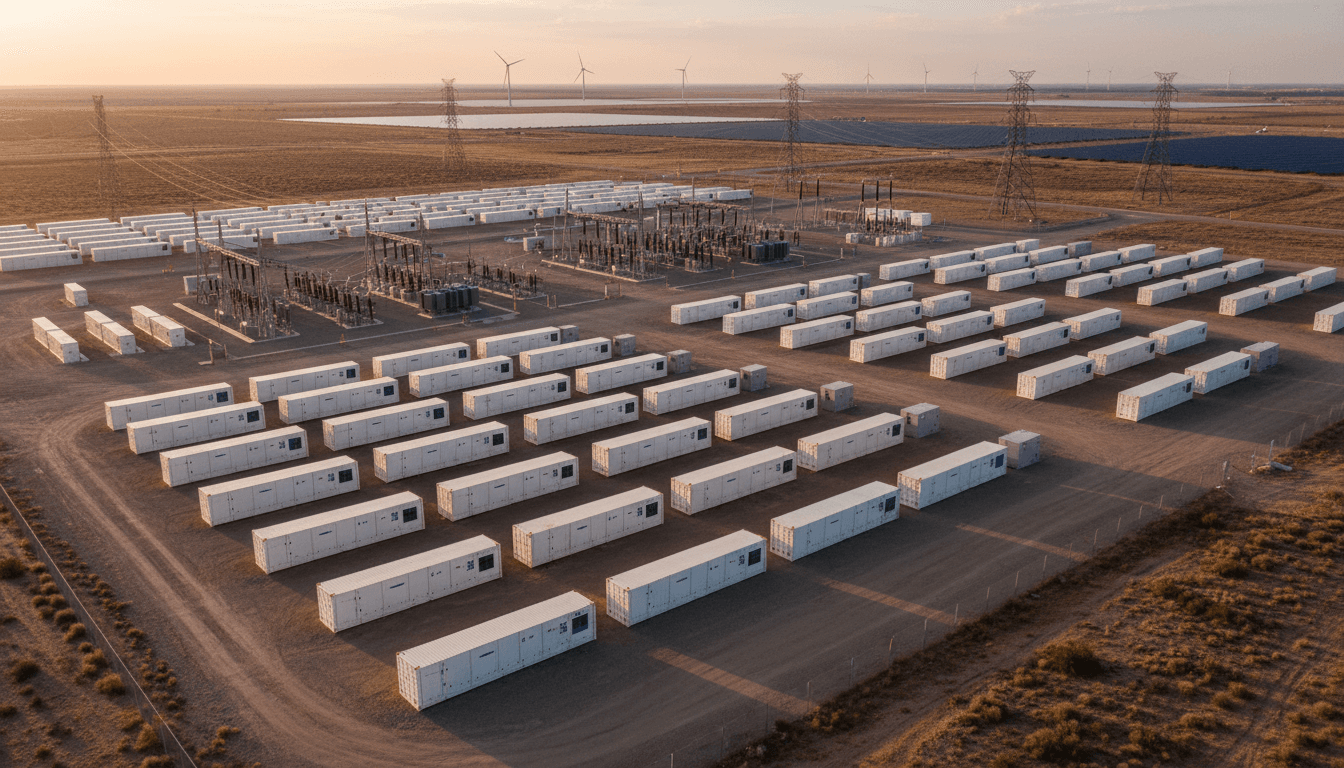
AI-Ready Storage: What Texas BESS Deals Signal
Texas isn’t “considering” battery energy storage anymore—it’s building it at a pace that forces utilities, retailers, and large loads to get serious about operations. The state added about 6.4 GW of storage capacity in 2024, and more than 12 GW has been deployed on the ERCOT system to date. State officials have also projected storage could represent around 30% of Texas grid capacity by 2030. Those aren’t vibes. That’s infrastructure.
Two newly announced projects make that momentum feel tangible: Peregrine Energy Solutions’ 250 MW / 500 MWh Mallard Energy Storage near Dallas–Fort Worth and GridStor’s 150 MW / 300 MWh Gunnar Reliability Project in Hidalgo County. Both include tolling agreements with unnamed Fortune 500 counterparties—an important signal that sophisticated buyers want predictable performance and controllable risk.
Here’s my take as part of the “AI for Energy & Utilities: Grid Modernization” series: these projects aren’t just about adding megawatt-hours. They’re about building AI-ready grid assets—systems that can be dispatched, maintained, and monetized intelligently in one of the world’s most dynamic power markets.
Texas BESS is scaling fast—operations will decide winners
Texas is becoming the proving ground for utility-scale battery energy storage systems (BESS) because ERCOT’s market design rewards flexibility. When demand spikes, renewables swing, or congestion hits, batteries can respond in minutes—or seconds. But a battery that’s physically installed and a battery that’s profitably and reliably operated are two different things.
At 250 MW / 500 MWh, Mallard is a classic 2-hour system. Gunnar at 150 MW / 300 MWh is also 2-hour. Two-hour systems are often framed as “energy shifting” assets, but in ERCOT they’re also tools for:
- Real-time price response (arbitrage is the headline, but not the whole story)
- Reliability support during ramps and local constraints
- Ancillary services participation, depending on market conditions and system configuration
The operational challenge is that these revenue streams can conflict. One bad dispatch strategy can reduce revenue, increase degradation, and even raise compliance risk.
AI is the difference between a battery that participates in the market and a battery that performs as grid infrastructure.
Why these specific announcements matter
From the RSS source:
- Peregrine + Wärtsilä + WHC Energy Services are advancing Mallard Energy Storage about 30 miles northeast of Dallas. The project will use Wärtsilä’s Quantum2 energy storage system.
- GridStor executed a tolling agreement for its Gunnar Reliability Project in Hidalgo County, with commercial operation expected by year-end 2026. GridStor is also building a broader Texas footprint, including the Hidden Lakes Reliability Project (220 MW / 440 MWh) already online.
Two themes jump out:
- Counterparties want controllability. Tolling agreements generally push operational responsibility to the asset owner/operator, with the buyer paying for the right to dispatch under agreed terms.
- Execution risk is being priced in. At this scale, the operational model—maintenance, forecasting, control logic, and safety—matters as much as capex.
Tolling agreements raise the bar for “dispatch quality”
A lot of storage coverage stops at “they signed a tolling agreement.” What’s more interesting is what that implies for day-to-day performance.
A tolling structure (simplifying a bit) means the buyer is paying for available capacity and predictable response, not just occasional market upside. That shifts attention to what I call dispatch quality:
- Did the system respond within the required time window?
- Was the battery available when called (and if not, why not)?
- Were outages planned well and communicated?
- Did controls avoid unnecessary cycling that accelerates degradation?
This is where AI in energy shows up in practical ways.
Where AI fits in a tolled BESS
For a tolled battery, AI isn’t a shiny add-on. It’s a set of capabilities that prevent performance erosion.
High-impact AI applications include:
- Availability forecasting: Predicting when components (inverters, HVAC, strings) are likely to degrade enough to threaten contractual availability.
- Constraint-aware dispatch: Optimizing dispatch while respecting temperature limits, state-of-charge (SOC) boundaries, warranty constraints, and grid interconnection limits.
- Degradation-aware control: Choosing operating points that meet the dispatch request while minimizing long-term capacity fade.
- Automated event classification: Turning alarms into diagnoses (nuisance vs. actionable) so operators don’t drown in alerts.
One sentence that tends to resonate with operators: “Every avoidable cycle is money you don’t get back.” AI helps you avoid the cycles you don’t need.
The hidden complexity: congestion, volatility, and renewable swings
ERCOT is famous for volatility, but volatility isn’t just “prices go up.” It’s volatility across:
- Nodes vs. hubs (basis risk)
- Local congestion events
- Renewable ramps (especially when wind or solar output changes quickly)
- Load surprises, increasingly driven by fast-growing industrial load and data center development
That means a storage asset’s value depends on decisions made at multiple horizons:
- Seconds to minutes: frequency response and fast dispatch
- 15-minute to hourly: real-time trading and congestion management
- Day-ahead to week-ahead: outage planning, maintenance scheduling, and risk controls
AI performs best when it’s used across those horizons with a consistent operational model.
A practical example: a “good” day vs. a “bad” day for a 2-hour battery
A 2-hour battery can easily waste value if it’s charged at the wrong time, in the wrong place, or for the wrong reason.
- On a good day, forecasting and optimization line up charging with low prices (often midday solar), preserve headroom for evening peaks, and avoid charging into congestion.
- On a bad day, the battery charges because “it’s cheap,” only to discover nodal congestion, an unexpected weather shift, or a thermal limit that forces derating during the actual peak.
The bad day isn’t bad luck—it’s usually missing inputs or weak control logic.
Predictive maintenance is becoming the storage operator’s edge
At this scale, BESS reliability is less about heroics and more about systems: ticket hygiene, spare parts strategy, thermal performance, and strong vendor coordination.
Peregrine’s choice to partner with experienced EPC support (WHC) and established OEM technology (Wärtsilä Quantum2) is one part of reducing execution risk. The other part is what happens after COD.
Predictive maintenance is where AI can pay for itself quickly, especially in climates like Texas where heat stress is real.
What predictive maintenance for BESS should actually cover
Teams often focus only on cell health. That’s a mistake. The fastest way to lose availability is often through balance-of-plant issues.
A solid AI-based predictive maintenance program for utility-scale storage tracks:
- HVAC performance drift (a leading indicator of thermal problems)
- Inverter anomalies (harmonics, temperature, switching behavior)
- String-level imbalance (early warning for cell issues)
- Protection and controls events (misoperations, nuisance trips)
- Site conditions (ambient temperature, dust, humidity) correlated with faults
If you want one metric to rally around: forced outage rate. AI helps reduce it by catching problems before they trip the system.
Grid modernization means treating BESS like software-defined infrastructure
Most companies still run storage like a physical plant: periodic inspections, manual decisions, and reactive maintenance.
That approach doesn’t match what’s happening in Texas. When storage becomes a material share of capacity—again, the state projection is ~30% by 2030—the grid starts to behave differently. Operators need storage fleets that act consistently, safely, and predictably.
What “AI-ready” looks like for batteries
If you’re building, buying, or tolling BESS capacity, here’s the checklist I’ve found works in real projects:
- Data foundation
- High-resolution telemetry (not just 5-minute averages)
- Clean tag naming and asset hierarchy
- Time sync and event logs that can be trusted
- Operational analytics
- Degradation and thermal models tied to real operating conditions
- Warranty-aware reporting (so you don’t accidentally void coverage)
- Control + optimization
- Constraint-aware dispatch (SOC, thermal, interconnection)
- Scenario testing for congestion and weather uncertainty
- Reliability workflows
- Automated alarm triage
- Maintenance prioritization based on availability risk
- Spares strategy informed by failure probabilities
Notice what’s missing: buzzwords. You don’t need “more AI.” You need better operations backed by models you trust.
What utilities, retailers, and large loads should do next
Texas storage announcements are exciting, but the bigger lesson is operational: as BESS fleets grow, everyone interacting with the grid needs stronger forecasting and control.
If you’re a utility or grid operator
Prioritize tools that improve visibility and response:
- Use AI-driven forecasting to anticipate net load ramps and local constraints
- Build operational playbooks that incorporate storage response during high-risk intervals
- Standardize performance metrics for storage availability and response time
If you’re a retailer or Fortune 500 offtaker signing tolls
Treat the contract like an operations program, not paperwork:
- Define dispatch rights and constraints clearly (SOC bands, cycling limits)
- Require transparent availability reporting and root-cause analysis for outages
- Ask how the operator manages degradation and thermal derating during summer peaks
If you’re a storage developer or owner
Win on execution and lifecycle economics:
- Invest early in data pipelines and controls integration (before COD)
- Use AI to reduce forced outages and avoid unnecessary cycling
- Plan for year 3 and year 7 performance, not just the first summer
The real signal from Mallard and Gunnar: storage is becoming dispatchable capacity
Mallard (250 MW / 500 MWh) and Gunnar (150 MW / 300 MWh) are big projects, but their most important feature is what they represent: storage in Texas is moving from “renewables support” to core reliability capacity that sophisticated buyers are willing to toll.
As ERCOT’s storage footprint expands past 12 GW deployed and heads toward that 2030 horizon, the market will reward the operators who can do three things consistently: forecast better, dispatch smarter, and maintain proactively.
That’s exactly where AI supports grid modernization—not as a slogan, but as the practical machinery behind a battery that’s available when it’s needed and profitable when it’s not.
If you’re planning a storage buildout or evaluating a tolling strategy for 2026–2028, what would change in your results if you treated your BESS fleet like software-defined infrastructure from day one?