Wheeled mobile manipulators are practical for logistics: stable, efficient, and AI-ready. See where they fit, what to ask vendors, and how to pilot for ROI.
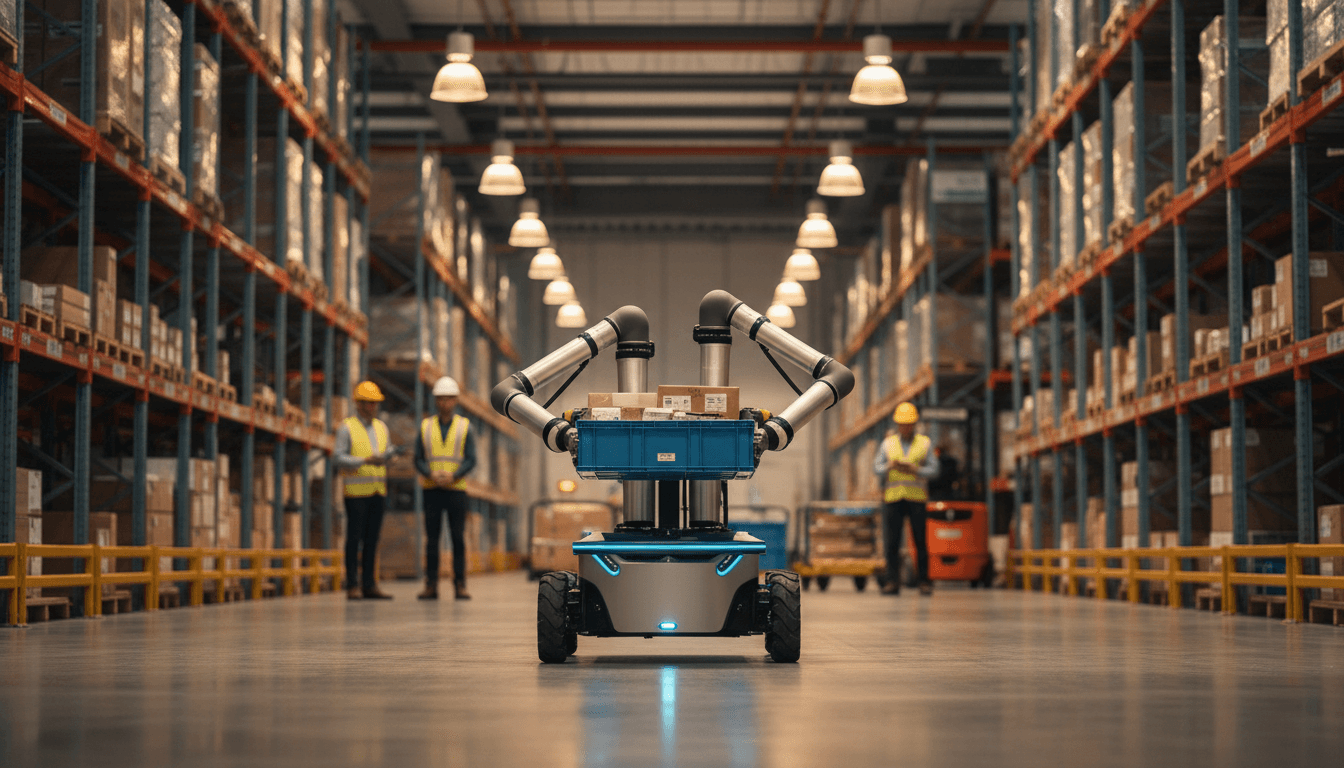
Wheeled Mobile Manipulators: Real ROI in Logistics
Wheeled mobile manipulators are quietly becoming the most practical “humanoid-adjacent” robots in warehouses and distribution centers—and the numbers back it up. One market estimate puts wheeled humanoid-like systems at 65% of a $1.6B humanoid-robot market. That’s not a popularity contest. It’s a signal: buyers are paying for reliability, uptime, and predictable operating costs.
Most logistics leaders don’t need a robot that can do parkour. They need a robot that can move to work, pick up or handle items, operate safely near people, and keep going for a full shift window without turning every day into a battery-management project. That’s why platforms like Richtech Robotics’ Dex—a wheeled base with dual arms—matter. Not because they look futuristic, but because they align with how warehouses actually run.
What follows is the practical lens: where wheeled mobile manipulators fit into transportation and logistics, what AI capabilities actually change day-to-day operations, and how to evaluate these systems so you can build a business case that survives procurement.
Why wheels are winning (and it’s not about “wow” factor)
Answer first: Wheels win in most logistics environments because they maximize uptime per kWh, simplify safety and control, and reduce the mechanical complexity that drives maintenance.
The source article highlights a key point from Richtech: bipedal robots burn energy maintaining balance and coordinating many moving subsystems. In a warehouse, that complexity shows up as downtime risk. Every additional actuator, joint, and cable harness is another failure mode—meaning more spares, more training, and more “we’ll need a technician on-site.”
A wheeled platform shifts the engineering tradeoff toward what operations teams care about:
- Battery life and duty cycle: A wheeled mobile manipulator can often sustain multi-hour continuous operation (Dex is positioned for 4+ hours), which maps better to real workflows than short bursts.
- Stability and safety near people: A stable base reduces the probability of tip-over scenarios during arm extension or payload shifts.
- Payload efficiency: Wheels generally allow heavier loads with less power draw than legs.
Here’s the stance I’ll take: If your building has flat floors, marked lanes, and standardized storage, legs are a tax you probably don’t need to pay.
The hidden logistics constraint: “time-to-intervention”
In December, peak shipping pressure is fresh in everyone’s mind—returns spike, labor schedules get stretched, and every “small exception” becomes a queue. The most expensive robot isn’t the one with the highest price tag; it’s the one that needs frequent human rescue.
Wheeled mobile manipulators reduce the frequency and severity of interventions because navigation is simpler, stability is higher, and edge compute can handle many decisions locally (more on that below). That’s not glamorous. It’s profitable.
What a wheeled mobile manipulator actually changes in a warehouse
Answer first: The big shift isn’t “automation of picking” in the abstract—it’s automation of the in-between work: the walking, fetching, staging, and repetitive handling that quietly eats labor hours.
Traditional AMRs are excellent at moving totes and carts from A to B. The missing link has been handling: opening a door, picking a tote from a shelf, moving a carton onto a conveyor, loading a pack station, clearing a jam area, or restocking consumables. A mobile manipulator combines navigation with the ability to interact with the environment.
Think of it as turning:
- “Transport-only AMR” → into “transport + light manipulation”
- Fixed cobot cell → into “cobot cell that can walk itself to the next station”
Where dual-arm systems fit best
Dual arms (as positioned with Dex) are most useful when the robot needs bimanual control or stability while handling:
- Holding a bag/carton with one arm while adjusting orientation with the other
- Two-point grabs for irregular items
- Managing dunnage, liners, or packaging materials
- Basic kitting where parts need to be placed in a predictable arrangement
Dual-arm capability is also valuable in human environments because it supports “assistive” patterns—handing, receiving, holding, and repositioning.
Practical workflow examples that pencil out
If you’re looking for near-term ROI, start with workflows that have three characteristics: high repetition, low variance, and clear handoffs.
- Pack-station replenishment
- Move packaging materials (tape, labels, mailers) from a replenishment area to pack stations
- Manipulation: place items on a shelf/bin, remove empties
- Returns triage staging
- Move return bins to inspection points and place items in a “needs review” tote
- Manipulation: simple pick-and-place with vision confirmation
- Line-side feeding in light manufacturing/assembly
- Bring kits to workcells and retrieve completed subassemblies
- Manipulation: handle standardized totes and fixtures
These aren’t moonshots. They’re the “keep-the-line-moving” tasks that cause real pain during seasonal surges.
The AI stack that makes mobile manipulation commercially viable
Answer first: Mobile manipulation becomes viable when AI perception, navigation, and decision-making run reliably at the edge—and when simulation reduces deployment risk.
Richtech’s Dex is described as integrating an NVIDIA Jetson Thor processor, lidar-based SLAM, obstacle detection, and natural language interaction. The brand names matter less than the architecture: perception + navigation + manipulation + policy needs to run fast and locally.
Edge AI beats cloud dependence in warehouses
Warehouses aren’t friendly to always-on connectivity. You’ll have dead zones, interference, and IT policies that make “just stream everything to the cloud” unrealistic.
Edge AI matters because it enables:
- Millisecond-level obstacle reaction without round trips
- Local safety behaviors (stop zones, speed limits, human proximity)
- Graceful degradation when Wi‑Fi drops (keep working, don’t freeze)
Cloud still has a role—fleet analytics, model updates, workflow orchestration—but real-time autonomy belongs at the edge.
Simulation isn’t optional anymore
The article mentions simulation workflows (like Isaac Sim). This is where I see many logistics buyers underestimating the value.
Simulation accelerates:
- Facility mapping and route testing before hardware arrives
- Reachability checks (can the arm actually access shelf levels and bin depths?)
- Safety validation for mixed pedestrian environments
- Cycle-time estimates for business-case modeling
A simple, quotable rule: If your vendor can’t show your workflow in simulation, you’re buying a prototype experience.
Buying criteria: what to ask before you deploy a wheeled mobile manipulator
Answer first: The purchase decision should be driven by measurable throughput impact, intervention rate, and integration effort—not by arm count or demo polish.
Here’s a checklist I’ve found separates “cool pilot” from “scaled deployment.” Use it in demos, RFPs, and site walks.
1) Intervention rate and recovery behaviors
Ask for:
- Average interventions per shift in a comparable environment
- Recovery behaviors: what happens after a failed grasp, blocked aisle, or mislocalization?
- Remote assist capabilities: can one operator support 5–10 robots?
2) Manipulation realism: don’t let the demo hide variance
Have the robot handle:
- Glossy packaging and crinkly polybags
- Slightly misaligned items
- Different lighting (warehouse LEDs, shadows)
- Mixed placements (bins at varying heights)
If the vendor needs perfectly staged items every time, plan on staffing someone to stage items—meaning you didn’t actually remove labor.
3) Integration with WMS/WES and station hardware
Mobile manipulators don’t live in isolation. Ask how they integrate with:
- Work release logic (WMS/WES)
- Label printers, scanners, and pack-station devices
- Doorways, elevators, automatic gates (if relevant)
Integration effort is where timelines slip.
4) Safety and compliance in mixed environments
Look for:
- Documented safety approach (speed/zone control, E-stop design, human detection)
- Clear policies for operating near temps, spills, and changing floor conditions
Stability from wheels helps, but safety is a system property.
RaaS vs direct purchase: the decision that affects ROI more than the robot
Answer first: In logistics, robot-as-a-service (RaaS) usually wins early because it reduces risk and aligns costs with realized value—especially for emerging categories like mobile manipulation.
Richtech emphasizes RaaS while supporting direct sales. For many warehouses, that’s the right mix:
- RaaS is ideal when performance data is uncertain, workflows are evolving, or capital budgets are tight.
- Direct purchase can make sense when you have stable processes, internal robotics ops maturity, and high utilization.
If you’re serious about scaling, negotiate around the metrics that matter:
- Uptime guarantees
- Response time for service
- Replacement unit policy
- Pricing tied to utilization or completed tasks (where possible)
Most companies get this wrong by focusing on monthly price instead of cost per completed, verified task.
The next competitive frontier: fleet data as an advantage
Answer first: The best long-term advantage in mobile manipulation will come from real-world operational data—failures included.
Richtech’s stated interest in data-centric models reflects a broader reality: physical AI improves when it sees more edge cases—different SKUs, lighting, layouts, human behaviors, and exceptions.
For logistics operators, this cuts both ways:
- You benefit when your vendor’s fleet learns faster.
- You take on new governance questions: data ownership, privacy, and operational sensitivity.
A practical stance: Treat robot data clauses like you treat carrier contracts—negotiable, specific, and tied to outcomes.
What to do next (if you’re considering mobile manipulation)
Wheeled mobile manipulators are the most realistic path to “humanoid-like” capability in logistics right now because they prioritize uptime, stability, and energy efficiency. Platforms like Richtech’s Dex underline the direction of travel: dual-arm manipulation on an AMR base, edge AI for real-time autonomy, and simulation-driven deployment.
If you’re exploring this category, start with one workflow you can measure in 30 days:
- Pick a process with a clear bottleneck (pack replenishment, staging, line-side feeding).
- Define three metrics: tasks/hour, interventions/shift, cost per task.
- Run a pilot with a scaling plan baked in (training, service, integration).
If you’re ready to pressure-test wheeled mobile manipulators in your facility, the most useful first step is a workflow assessment: which tasks are “robot-ready,” what integration points matter, and what ROI looks like with conservative assumptions.
The question worth asking going into 2026 planning cycles: Which parts of your operation are still paying humans to walk—and what would happen if walking stopped being a job requirement?