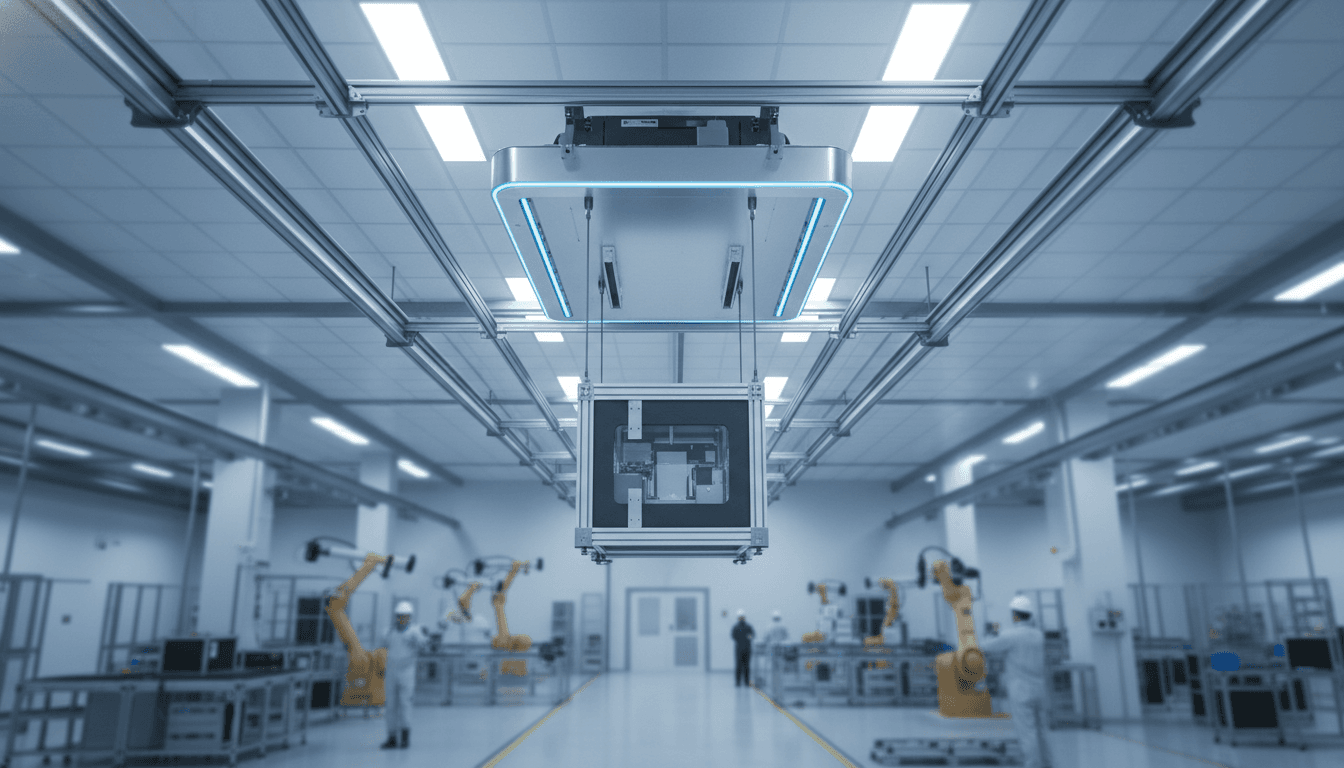
Omnidirectional overhead cranes like the InifnityCrane Skyrunner bring robot-like motion to lifting—improving flexibility, safety, and flow in modern factories.
Omnidirectional Overhead Cranes: A Smarter Factory Move
Most factories are still designed around a constraint that’s easy to miss: overhead lifting only works where the beams let it work. If your gantry crane can’t reach a station, you route parts around the building. If it can reach but not turn tightly, you widen aisles and sacrifice floor space. If you need another bay, you brace for structural steel, downtime, and a budget fight.
That’s why CeiliX’s InifnityCrane Skyrunner (an omnidirectional overhead crane mechanism highlighted in Joe Salas’s RSS piece) is so interesting. It suggests a different mental model: what if your overhead crane moved more like a mobile robot—able to translate in any direction and position loads with a kind of “oddly satisfying” precision?
This matters because the pressure is real in late 2025: manufacturers are chasing shorter lead times, higher mix, and tighter labor availability all at once. Flexibility isn’t a nice-to-have anymore; it’s the difference between meeting demand and missing it.
Omnidirectional overhead cranes fix a real layout problem
Answer first: An omnidirectional overhead crane reduces “layout penalty” by letting lifting capacity move where your process needs it, not where your beams happen to be.
Traditional overhead cranes are usually tied to I-beams or gantry rails. They’re great at what they were built for—moving heavy loads along predefined paths—but they enforce rigidity:
- Cells must align to crane travel axes.
- Expansion often means structural changes.
- Material flow becomes a routing puzzle.
An omnidirectional mechanism like the Skyrunner points to a different approach: a ceiling-mounted system that can reposition laterally and longitudinally without the same rail-bound assumptions. Even if you keep most of your legacy lifting, a flexible overhead “robotic mover” can become the missing link between islands of automation.
Why factories feel “cramped” even when there’s space
Answer first: The bottleneck is rarely square footage—it’s clearance, turning radius, and safe human-robot separation.
I’ve seen facilities with plenty of floor area still behave like they’re overcrowded. The reason is that material movement needs buffers: staging lanes, wide forklift aisles, and no-go zones around lifts. Overhead automation helps because it decouples transport from floor traffic.
If omnidirectional motion lets you shorten routes and approach stations from more angles, you can often:
- Reduce forklift interactions (and the safety procedures they require)
- Tighten staging areas
- Keep work-in-process closer to the value-added steps
The Skyrunner idea: make overhead motion behave like a robot
Answer first: The real innovation isn’t “a crane that moves”—it’s robot-like controllability applied to lifting and positioning at the ceiling.
The RSS summary frames it well: we expect ceiling cranes to be massive, industrial, beam-heavy systems. CeiliX is pitching something more elegant: an omnidirectional system that feels engineered for precision motion, not just brute-force lifting.
Even without full technical specifications in the RSS snippet, the direction is clear: treat overhead handling as a mechatronic system—one that can be controlled, modeled, and optimized.
What “oddly satisfying” usually means in industrial motion
Answer first: When motion looks satisfying, it’s usually because the system has tight control loops, predictable dynamics, and smooth path planning.
That smoothness isn’t cosmetic. In factories, it translates to:
- Less load swing
- Lower peak forces on mounts and structures
- Better placement accuracy
- Faster “settle time” at the destination
Smooth motion is often the first visible sign that the control stack is mature.
Where AI fits: overhead cranes are turning into adaptive systems
Answer first: AI adds value when the crane can perceive, predict, and adapt—not when it’s just following pre-programmed coordinates.
The campaign context here is AI in robotics and automation, and overhead handling is quietly becoming a strong use case. A modern omnidirectional crane system becomes far more useful when it can respond to real-world variability:
- A pallet isn’t perfectly centered.
- A fixture is slightly out of position.
- A human walks into the shared zone.
- A load’s center of gravity changes between batches.
AI isn’t magic, but it is practical in three places.
1) Perception: knowing what’s actually happening
Answer first: Vision and sensor fusion let a crane locate targets and validate safe lift conditions automatically.
In a smart overhead crane setup, you’ll often see combinations of:
- 2D/3D cameras for pose estimation
- Load cells for weight verification
- IMUs to measure swing and vibration
- Safety-rated scanners for human presence
AI-powered perception can help the system identify the “pick” and “place” features even when there’s variance—critical in high-mix operations.
2) Motion planning: moving fast without making a pendulum
Answer first: The fastest crane is the one that arrives and settles quickly—AI-assisted planning minimizes sway and wasted time.
Any overhead lift creates a pendulum. The old solution is slow acceleration and slow braking. The better solution is to plan trajectories that minimize oscillation while staying within force and safety limits.
In practice, this can include:
- Model-based anti-sway control (classic control theory)
- Learned adjustments for different load types
- Continuous optimization as routes and priorities change
If omnidirectional motion increases the number of possible paths, it also increases the need for smarter planning. That’s where AI and robotics techniques shine.
3) Scheduling and orchestration: treating handling as a service
Answer first: The real productivity gain comes when overhead handling is scheduled like a fleet resource, not requested by yelling across the bay.
Once overhead movement becomes software-defined, you can integrate it with MES/WMS/ERP logic:
- Prioritize hot jobs
- Reduce queueing at shared stations
- Coordinate with AMRs on the floor
- Automatically reroute around blocked zones
This is where lead generation often starts in real life: teams realize the hardware is only half the story, and they need an integration plan.
High-impact use cases (manufacturing, logistics, construction)
Answer first: Omnidirectional overhead crane systems are most valuable where you have heavy parts, tight space, and frequent changeovers.
The RSS tags call out manufacturing, robotic construction, and factory robotics. Here’s where I’d place this kind of system first.
Manufacturing: high-mix assembly and machine tending
Answer first: If product mix changes weekly, rigid crane rails become a tax—you pay it in rework and rerouting.
Good fits include:
- Moving dies, molds, or fixtures between prep and press
- Feeding CNC cells with heavy billets or castings
- Handling weldments into positioners
- Staging subassemblies over shared work zones
The win isn’t only speed; it’s layout freedom. If you can reconfigure a cell without rebuilding crane infrastructure, you shorten the time from “new product” to “first good unit.”
Logistics: overhead buffering where floor space is scarce
Answer first: Overhead movement can replace some forklift travel and reduce floor congestion.
For end-of-line and shipping, overhead systems can:
- Buffer finished goods above lanes
- Move pallets across choke points without blocking aisles
- Support safer human workflows by reducing vehicle interactions
In peak season operations (and December is exactly when many facilities feel the strain), congestion costs more than labor—it costs shipment performance.
Construction and prefab: precise placement beats raw lifting
Answer first: In prefab environments, precision handling reduces damage, rework, and alignment time.
Robotic construction isn’t just on-site. Many firms are moving work into controlled prefab settings where large panels, MEP racks, or modules need careful positioning. Omnidirectional overhead handling can support that “factory for buildings” model.
What to evaluate before you spec an omnidirectional overhead crane
Answer first: Success depends on structural integration, safety design, and software interfaces—not just load rating.
If you’re considering an omnidirectional overhead crane mechanism like the InifnityCrane Skyrunner, use a checklist that forces the right conversations early.
Mechanical and facility questions
- Load envelope: What’s the max weight, and what’s the typical weight? Design for both.
- Duty cycle: How many picks per hour? Continuous vs intermittent use changes everything.
- Ceiling structure: Can your building handle point loads, or do you need load-spreading frames?
- Workspace coverage: Where do you need reach today, and where might you need it in 18 months?
Safety and compliance questions
- Human interaction model: Is it a shared workspace or fenced zones?
- Safety functions: Emergency stop, safe speed, safe torque off, safe zones.
- Load integrity: How do you detect a bad pick, a shifted CG, or an overload?
A crane that moves “like a robot” should be treated like one from a safety standpoint.
Software and integration questions
- Interface: Do you need an API, PLC integration, or higher-level task commands?
- Scheduling: Who arbitrates priorities—operators, MES, or a supervisor layer?
- Data: Are you logging pick counts, cycle times, faults, and near-misses?
A practical rule: if the vendor can’t explain how the system behaves when sensors disagree, you’re not buying automation—you’re buying a demo.
People also ask: practical questions you’ll get internally
“Is an omnidirectional overhead crane overkill for us?”
Answer first: It’s overkill if your process is stable and your crane paths never change; it’s a strong fit if you’re constantly rearranging cells or fighting congestion.
If your facility has been “temporary” for five years and every new product requires another workaround, flexibility pays for itself.
“Will this replace forklifts or AMRs?”
Answer first: It usually complements them.
Overhead handling is great for heavy, awkward, or high-traffic moves. AMRs shine for distributed small loads. Many facilities end up with a hybrid where the overhead system handles the hardest moves and AMRs clean up everything else.
“What’s the ROI logic?”
Answer first: ROI is usually a combination of throughput, labor risk reduction, and avoided building modifications.
Look for measurable drivers like:
- Reduced move time and fewer waits at shared stations
- Lower damage rates (parts and fixtures)
- Reduced forklift travel (and incidents)
- Avoided downtime from reconfiguring rails/steel
Next steps: turning “cool mechanism” into real throughput
Omnidirectional overhead cranes like the InifnityCrane Skyrunner are compelling because they hint at a future where material handling behaves like software-controlled robotics, not fixed infrastructure. The mechanism is the hook—but the value comes from pairing it with sensing, intelligent motion control, and integration into your production and logistics systems.
If you’re exploring AI-driven automation in 2026 planning cycles, start with a map of your worst internal moves: the heavy transfers, the awkward routes, the stations that always wait. Those are the places where an omnidirectional overhead crane can turn “we’ve always done it this way” into a measurable throughput gain.
What would change in your facility if overhead handling could move with the freedom of a robot—and your layout stopped being dictated by steel beams?