Is AI hype fueling a humanoid robotics bubble? Learn how to separate demos from deployable ROI with a revenue-first evaluation playbook.
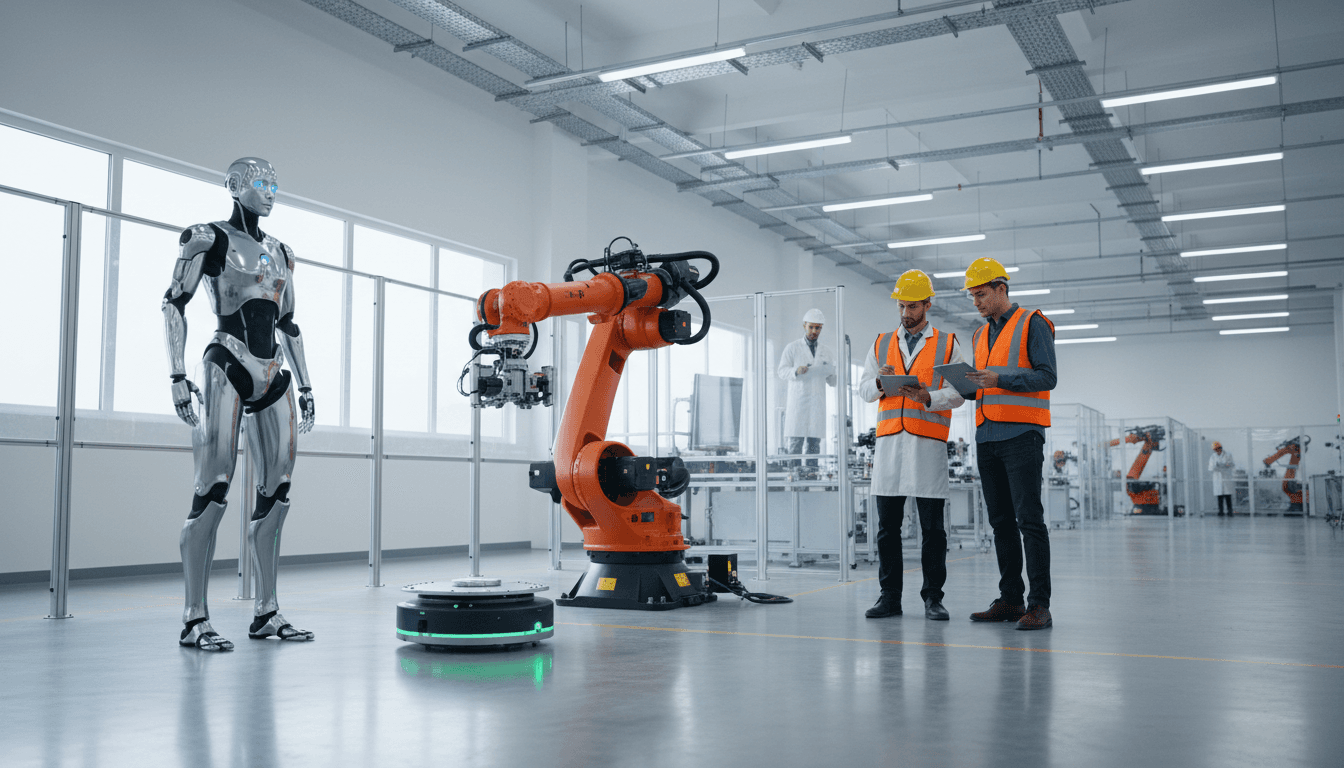
Humanoid Robotics Bubble? How to Invest and Deploy Wisely
A single stat explains why “humanoid robotics” is suddenly on every investor’s slide deck: industrial humanoid robotics logged 17 venture deals last quarter, the most of any tracked AI category. That’s not a slow build. That’s a rush.
And rushes create two things at once: real progress and expensive mistakes. The problem isn’t that humanoid robots are fake. It’s that the market is pricing them like they’re already reliable, affordable, and deployable at scale—when most teams are still fighting fundamentals like uptime, safety, dexterity, and unit economics.
If you’re a robotics founder, an automation leader, or an investor trying to make smart bets in 2026 planning season, here’s the stance I’ll defend: AI is making robots more capable, but it’s also making bad robotics business cases easier to pitch. The path forward is “revenue-first” and use-case-first—especially for humanoids.
Why AI hype concentrates in humanoid robots (and why that’s risky)
Answer first: AI hype clusters around humanoids because they’re visually convincing, story-friendly, and promise a universal worker—yet they’re among the hardest robots to productize.
Humanoids are the perfect demo machine. A biped running, boxing, or doing a tidy pick-and-place looks like the future. That visual punch matters in fundraising because it compresses a complicated engineering story into a 20-second clip.
But commercial robotics doesn’t pay for “impressive.” It pays for repeatable outcomes: cycle time, scrap reduction, safe operation, predictable maintenance, and a cost curve that gets better with scale.
The “general-purpose worker” narrative breaks unit economics
Humanoids are often sold as adaptable labor: one robot that can do many tasks across many environments. The catch is brutal:
- General-purpose is expensive. More degrees of freedom, more sensors, more compute, more failure modes.
- Factories pay for certainty. A robot that can do 50 tasks poorly is less valuable than a robot that does 2 tasks flawlessly.
- Integration is the hidden bill. If every site needs custom workflows, fixtures, safety sign-off, and exception handling, your “one robot” becomes a bespoke services company.
That’s why investors in the source report are waving a flag: commercial evidence matters more than prototype capability.
AI doesn’t remove physics—it changes where the pain shows up
Modern perception and policy learning can reduce hard-coded automation, but it doesn’t erase physical constraints:
- Contact is unforgiving. Grasping soft goods, inserting connectors, or handling reflective parts still requires precision, compliance, and tactile feedback.
- Latency shows up as risk. Real-time inference in dynamic environments isn’t optional when humans are nearby.
- Reliability is the product. The customer experience is uptime, not a demo.
AI can help a humanoid “understand” a messy scene. It can’t magically make motors cooler, batteries lighter, or gearboxes maintenance-free.
What investors are actually warning about: cost, reliability, and proof
Answer first: The bubble risk isn’t “too much AI,” it’s too much capital chasing too few validated deployments—especially when core constraints won’t be solved quickly.
The source article highlights the core blockers investors keep repeating: inference, dexterity, reliability, and cost. Those four are connected.
Reliability is the real moat (and it’s slow to earn)
Humanoid startups often talk about model capability. Buyers talk about failure.
Reliability in industrial settings means:
- predictable performance across shifts and operators
- graceful degradation (what happens when a sensor fails?)
- maintainability (MTTR: mean time to repair)
- spare parts and service readiness
Most companies underprice how long it takes to earn trust on a shop floor. It’s months of pilot, then more months of “boring fixes.” This is why I’m skeptical of timelines that assume a fast jump from prototype to fleet.
Cost isn’t just BOM—it’s total deployed cost
A humanoid that costs $X to build might cost 2–5× $X to deploy when you include:
- site mapping and safety assessment
- workcell redesign (yes, even for “human-shaped” robots)
- training, monitoring, and exception handling
- ongoing maintenance, upgrades, and incident response
If your ROI requires perfect performance from day one, your ROI isn’t real.
Commercial proof beats category momentum
The report notes broader AI investment is still dominant, and attention is shifting toward humanoids. That attention creates a dangerous shortcut: category-level excitement replacing company-level evidence.
The simplest filter I’ve found is this: Can the company show paid, repeatable deployments where the robot runs the same task for weeks, not minutes? If not, treat the valuation like an option, not a sure thing.
The better comparison: humanoids vs proven industrial automation
Answer first: Industrial and logistics robots win today because they’re scoped, constrained, and already ROI-positive—humanoids will have to earn that same discipline.
A lot of people lump “robotics” into one bucket. That’s a mistake. The source article draws the line clearly: industrial and logistics robots already generate revenue and measurable results, while humanoids often can’t yet prove commercial value.
Why “boring robots” keep winning
If you’re running operations, you already know the pattern:
- AMRs move predictable loads on predictable routes.
- Cobots do constrained tasks with clear safety boundaries.
- Vision systems inspect the same part family repeatedly.
These solutions aren’t glamorous. They’re profitable. They also fit how factories buy: incremental deployments tied to measurable KPIs.
Humanoids will succeed when they adopt the same mindset—starting with narrow tasks where the human form factor is actually useful.
Where humanoids can make sense early
Humanoids have a shot when they reduce changeover or infrastructure changes. The best early environments share traits:
- highly repetitive “human-native” stations (designed around people, not robot arms)
- controlled variability (limited SKU and packaging diversity)
- safety-manageable layouts (clear separation or low-speed collaboration)
Examples that tend to be more plausible than “do everything”:
- tote handling and staging in a structured warehouse zone
- simple kitting where parts are standardized and bins are consistent
- night-shift tasks where labor is scarce and supervision is minimal
If your use case needs fine wiring, delicate insertion, or high-speed cycle times, a humanoid is probably the wrong first choice.
A revenue-first playbook for humanoid robotics (founders + buyers)
Answer first: The safest path is to sell outcomes, constrain the task, and design for serviceability—then expand capability only after you’ve earned uptime.
The source article quotes investors pushing a “revenue-first philosophy.” I agree, and I’d make it more specific: revenue-first means proving a repeatable deployment unit, not just collecting pilot fees.
For founders: what “revenue-first” looks like in practice
If you’re building humanoids, here’s the checklist I’d use before scaling sales:
- Start with one task family. Not “warehouse work.” Name the task, the objects, the success criteria, and the exceptions.
- Instrument everything. Log failures by category (perception, grasp, navigation, safety stop, comms, hardware). If you can’t quantify failure, you can’t fix it.
- Design for maintainability. Tool-less access, modular joints, clear diagnostics. Service speed is your margin.
- Price like a product, not a science project. If every deal is custom engineering, your growth will be capped by headcount.
- Pick a business model that matches trust. Early on, buyers prefer risk-sharing:
- robotics-as-a-service (monthly)
- performance-based components (bonus for throughput/uptime)
- phased contracts (pilot → limited fleet → scale)
A blunt truth: If you can’t explain your path to gross margin, you don’t have a robotics business yet.
For automation leaders: how to evaluate humanoid pilots without regret
If you’re considering a humanoid pilot in 2026, don’t ask for a magic demo. Ask for operational evidence.
Use these questions:
- What’s the uptime target and how is it measured? Get a number (e.g., 95% during staffed hours) and define downtime.
- What’s the intervention rate? “One human babysitter per robot” is not automation.
- What are the safety assumptions? Speed limits, exclusion zones, emergency stop behavior, and incident reporting.
- What’s the path from pilot to fleet? If the answer is “we’ll fine-tune,” press on timelines, costs, and responsibility.
- What does failure look like? A credible vendor can describe failure modes calmly and show mitigation.
I’ve found the best pilots are structured like procurement, not like R&D: clear acceptance criteria, staged expansion, and exit clauses.
Bubble or build? What 2026 will reward
Answer first: 2026 will reward companies that ship reliable automation—humanoid or not—and punish narratives that can’t survive a customer site visit.
The source report references concerns that today’s AI-driven boom resembles the dotcom era, with expectations of a shakeout in the next few years. Whether you call it a bubble or a reset, the direction is the same: money will move from “possibility” to “proof.”
Here’s what I expect to hold up when hype cools:
- robots tied to a single measurable KPI (throughput, defects, injuries, labor hours)
- deployments that can be repeated with minimal site customization
- vendors who treat support and service as core product features
- honest roadmaps: capability expansion earned by reliability milestones
The most valuable stance you can take right now is disciplined curiosity. Be open to humanoids, but don’t suspend basic math.
If you want to explore AI in robotics without getting pulled into speculative purchases, start by mapping your workflows to tasks that are (1) measurable, (2) repeatable, and (3) painful enough to justify automation. Then evaluate solutions—humanoid, fixed automation, AMR, or cobot—based on total deployed cost and sustained uptime.
What would change your mind about humanoids: a better demo, or a six-month dataset showing they ran the night shift with minimal intervention?