Electronic skin helps soft robots feel pressure and shear, enabling safer AI control for prosthetics and automation. See where e-skin pays off first.
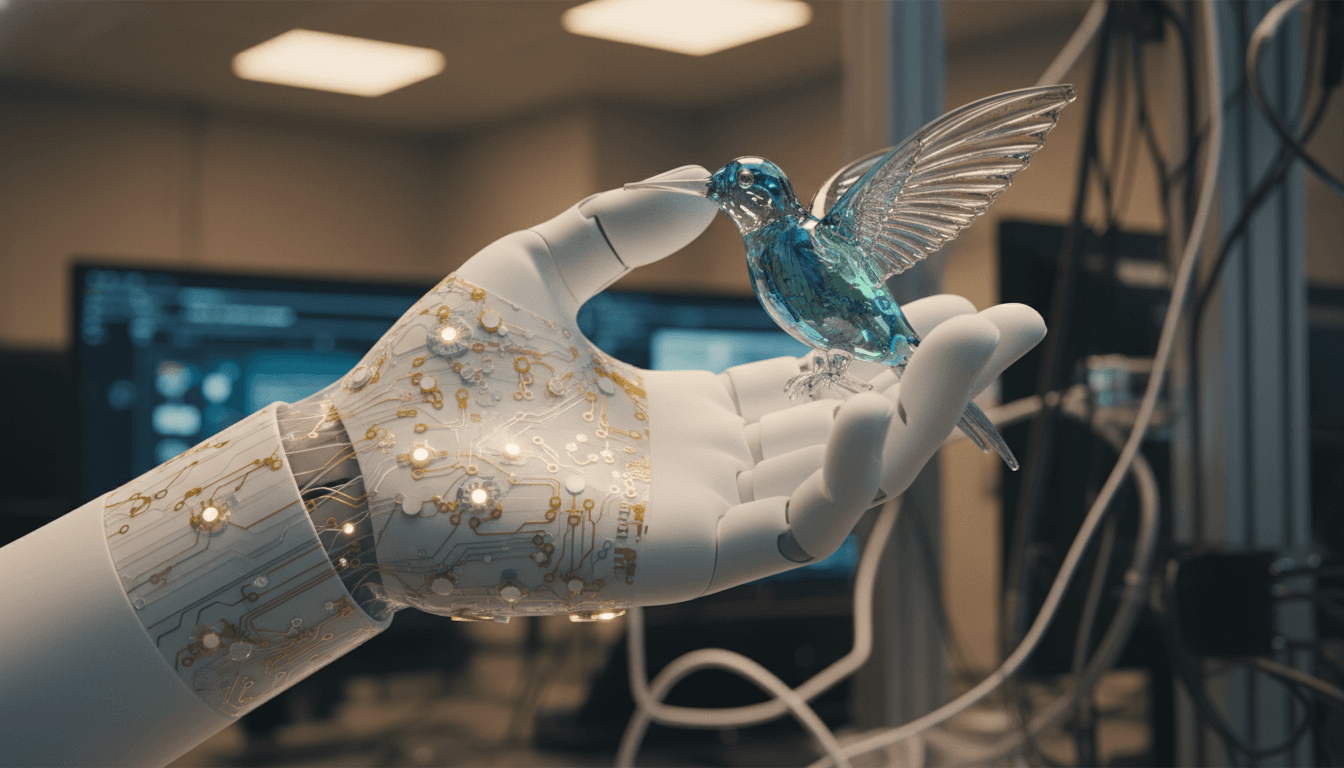
Electronic Skin for Soft Robots: Safer, Smarter Touch
A hard truth in robotics: most automation still “feels” almost nothing. We’ve built robots that can place components within fractions of a millimeter, but when it comes to contact—brushing a sleeve, gripping a fragile part, supporting a human limb—many systems are effectively numb.
That’s why the conversation Claire had with Miranda Lowther (University of Bristol / Bristol Robotics Laboratory) on soft robotics and electronic skin (e-skin) matters beyond prosthetics. The same ingredients—compliant materials, dense tactile sensing, and intelligence that adapts in real time—are exactly what modern factories, warehouses, and healthcare devices need as we push toward safer human-robot collaboration.
Here’s the stance I’ll take: the next big leap in AI-enabled robotics won’t come from stronger motors or faster cameras. It’ll come from touch—especially touch that’s built into the robot’s body.
Soft robotics is the fastest path to safer physical AI
Answer first: Soft robotics improves safety and adaptability because the material absorbs uncertainty that software would otherwise have to predict.
Traditional industrial robots are rigid for a reason: rigidity makes control easier. You model the arm, command torques, and the end-effector goes where you expect. But the moment you introduce real-world contact—misaligned parts, deformable packaging, human bodies—rigidity becomes a liability. It transfers forces quickly, amplifies collisions, and makes “gentle” behavior a control problem.
Soft robotics flips the approach. By using compliant structures (silicones, elastomers, textiles, pneumatic networks, tendon-driven soft actuators), the robot’s body physically conforms to what it touches. That compliance provides three benefits you can bank on:
- Intrinsic safety: Lower peak forces during impact because the body deforms.
- Better grasping under uncertainty: Conformity increases contact area and friction.
- Simpler handling of variability: The material “solves” part of the alignment problem.
In practice, this matters because most automation failures aren’t about perfect trajectories. They’re about messy contact: a box that dents, a cable that snags, a human who steps too close, or a prosthetic socket that rubs after three hours of wear.
Why “soft” needs “smart”
Soft alone isn’t enough. A compliant gripper that can’t sense slip is still going to drop parts. A soft prosthetic interface that can’t detect pressure hotspots will still cause skin breakdown.
Soft robotics becomes commercially reliable when you pair it with sensing + AI control that can interpret contact and adapt behavior.
That’s where electronic skin comes in.
Electronic skin gives robots the missing sense: rich, continuous touch
Answer first: Electronic skin turns contact into data—pressure, shear, temperature, sometimes strain—so AI can manage physical interaction instead of guessing it.
Electronic skin (e-skin) is a family of flexible sensor systems designed to cover curved surfaces and survive repeated deformation. Think of it as a distributed network of “tactile pixels” spread across a robot hand, forearm, or a prosthetic socket liner.
Depending on the sensor technology, e-skin can measure:
- Normal pressure (how hard you’re pressing)
- Shear (lateral rubbing forces—a big deal for comfort and slip detection)
- Strain/deformation (how the surface stretches)
- Temperature (useful for safety and some clinical monitoring)
- Contact location and area (where touch happens, and how spread out it is)
Miranda Lowther’s focus—soft, sensitive e-skins for prosthetic limbs—is a perfect “stress test” use case. Prosthetics sit at the intersection of high consequence and daily variability: users sweat, tissue changes shape over the day, gait changes with fatigue, and small pressure issues can become medical problems.
A useful way to say it: If your robot touches people, you need tactile feedback the way autonomous cars need cameras.
The underrated metric: shear, not just pressure
A lot of teams obsess over pressure maps. Pressure is important, but shear is often the real villain—it’s what causes rubbing, blisters, and skin irritation in wearable devices, and it’s what precedes slip in grasping.
If you’re building AI control around tactile sensing, you’ll typically want both:
- Pressure to manage load and safety limits
- Shear to manage comfort (prosthetics) or grip stability (manipulation)
This is also where design decisions show up fast. A sensor that performs well on a flat test coupon may behave poorly on a curved, sweaty, moving surface. Prosthetic interfaces force engineers to care about that reality.
Morphological computation: the body doing part of the “thinking”
Answer first: Morphological computation means you design shape, compliance, and materials so the physical system naturally produces useful behavior—reducing the burden on AI.
Lowther’s work highlights morphological computation, a concept that tends to be misunderstood as academic jargon. The practical version is straightforward:
- If your system needs complex control just to avoid hurting someone, the hardware is fighting you.
- If the hardware naturally limits harmful forces and stabilizes contact, the controller gets simpler and more reliable.
Examples you can recognize immediately:
- A soft gripper that wraps around objects without precise pose estimation
- A prosthetic socket interface that distributes load through compliant geometry
- A robot arm with series elastic elements that damp sudden impacts
The win isn’t just elegance. It’s robustness.
How this changes your AI stack
When the body carries part of the intelligence, the AI stack can shift from “perfect prediction” to “fast adaptation.” Concretely:
- You spend less time building brittle contact models.
- You rely more on closed-loop tactile feedback.
- You can use learning approaches (imitation learning, reinforcement learning, or supervised learning on tactile events) without requiring the policy to handle every edge case in software.
A sentence I keep coming back to: good tactile design turns impossible control problems into manageable sensing problems.
From prosthetics to automation: where e-skin pays off first
Answer first: The earliest ROI for e-skin and soft robotics will show up in tasks where contact uncertainty is costly—fragile handling, human collaboration, and high-mix assembly.
It’s tempting to keep e-skin boxed into healthcare, but the commercial trajectory is broader. The same capabilities that make a prosthetic interface safer and more comfortable also make industrial systems more reliable.
1) Human-robot collaboration without safety theater
Collaborative robots are often deployed with conservative speed limits and oversized safety buffers. That can make deployments feel like “safety theater”: safe, but not that productive.
Add distributed touch sensing (not just a single force-torque sensor at the wrist) and you get:
- Faster detection of incidental contact
- Better localization of where contact occurred
- More nuanced responses (stop vs. slow vs. retract)
This is especially relevant for end-of-year production surges—like the Q4 fulfillment crunch—when temporary staff and reconfigured workcells raise the risk of human-robot proximity incidents.
2) Handling deformable, variable products
Food, apparel, flexible packaging, medical supplies—these are notoriously hard for rigid automation. Vision helps, but vision doesn’t tell you what the object is doing under your fingers.
E-skin enables AI behaviors like:
- Slip prediction and grip adjustment
- Detecting when an object is caught or folded
- Confirming successful insertion or seating
3) High-mix assembly and kitting
In high-mix environments, the enemy is variation. If your robot can feel whether a part is aligned, you don’t need perfect fixtures for everything.
Tactile signals can support:
- “Search” behaviors (micro-motions guided by contact)
- Automatic force limiting during insertion
- Detecting cross-threading or interference early
Implementation reality: what teams get wrong about e-skin
Answer first: Most teams underestimate integration: calibration, durability, data pipelines, and how tactile signals change with temperature, wear, and mounting.
If you’re evaluating e-skin for a robotics product, the technical demo is the easy part. The hard part is making it work on a real system, for months.
Here’s what tends to break projects:
Durability and maintainability
Soft sensors live a hard life: abrasion, oils, cleaning chemicals, repeated bending, and impacts.
Practical questions to ask vendors or research partners:
- What’s the expected lifespan under your duty cycle?
- How does the sensor fail—gradually drifting or suddenly dying?
- Can a technician replace sections quickly?
Calibration drift and domain shift
Tactile readings can drift with:
- Temperature changes
- Material aging
- Mounting tension changes
- Moisture and sweat (for wearables)
Plan for ongoing calibration and model updates. If you’re using machine learning on tactile data, assume you’ll need periodic re-training or at least re-normalization.
Data architecture (you’ll need more than a CSV)
Dense tactile arrays can produce high-rate streams. Treat tactile like any other serious sensor modality:
- Time synchronization with vision and joint states
- Robust filtering and outlier handling
- Event-based representations (contact/no-contact, slip onset) to simplify control
A clean approach I’ve found effective is splitting the stack:
- Low-level tactile processing: converts raw taxels into stable features (contact patches, total force, shear vectors)
- High-level policy: uses those features for decisions (adjust grip, slow down, re-seat, stop)
A practical roadmap for adopting soft robotics + e-skin
Answer first: Start with a narrow contact-driven use case, instrument it heavily, and measure outcomes that matter—injury risk, scrap rate, downtime, and user comfort.
Whether you’re building prosthetics, cobots, or service robots, a staged rollout beats a “big bang” redesign.
- Pick a contact problem with clear pain
- Examples: dropped items, damaged products, pinching risk, discomfort hotspots
- Instrument before you optimize
- Add tactile sensing where contact is highest, not everywhere
- Define success metrics in numbers
- Scrap rate reduction, fewer safety stops, lower peak contact force, fewer user-reported discomfort events
- Add adaptive control next
- Start with simple closed-loop rules (thresholds, PID on force)
- Then graduate to learning policies if the data supports it
- Design for serviceability
- Modular skin panels, protective over-layers, quick diagnostics
For prosthetics specifically, the near-term win is compelling: use e-skin to detect sustained pressure and shear hotspots and adjust fit, stiffness, or user guidance before a small issue becomes an injury.
What this signals about the future of AI in robotics
Answer first: AI in robotics is shifting from “seeing and planning” to “feeling and adapting,” and e-skin is the sensor platform that makes that shift real.
The robotics industry has spent a decade stacking more perception on top of rigid bodies, trying to predict contact before it happens. The approach works—until it doesn’t. Touch is the missing feedback loop.
Lowther’s focus on soft e-skins and morphological computation points to a better direction: design robots that tolerate uncertainty, then use AI to personalize and adapt their behavior.
If you’re exploring AI-enabled automation for 2026 planning—especially in healthcare, logistics, or high-mix manufacturing—this is a strong filter for where to invest: systems that can sense touch across surfaces and respond intelligently will outperform systems that only “know” touch at the wrist.
Where do you see the biggest unmet need for tactile intelligence: safer cobots on the factory floor, more reliable picking in warehouses, or comfort-first wearable robotics in healthcare?