Edge AI vision boxes are becoming logistics infrastructure. Here’s what Darsi Pro signals—and how to evaluate and deploy edge vision for warehouses and transport.
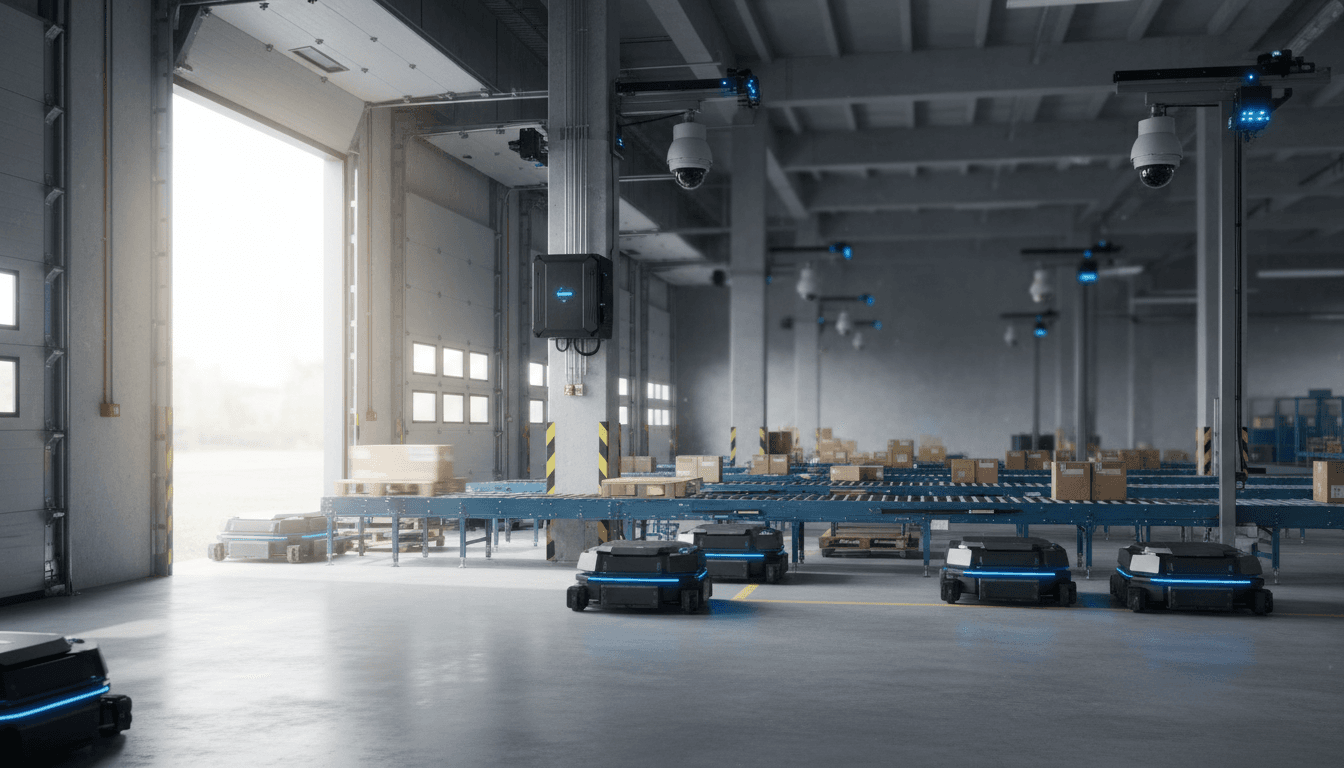
Edge AI Vision Boxes for Logistics: What Changes Now
Peak shipping season has a way of exposing weak spots: missed scans at the dock, pallets that “disappear” between zones, mis-sorted parcels, and robots that slow down because their perception stack can’t keep up. When operations teams talk about “automation,” what they usually mean is reliability at speed—and that’s exactly where edge AI vision is starting to matter more than shiny new robots.
This week’s news that e-con Systems is launching Darsi Pro, an edge AI vision box powered by NVIDIA Jetson (announced ahead of CES 2026), is a good signal of where the market is headed: fewer one-off prototypes, more production-ready vision compute you can actually deploy across facilities and fleets.
Here’s the real story for transportation and logistics leaders: vision is becoming a packaged infrastructure layer—not a science project. And once vision becomes “infrastructure,” it changes how quickly you can roll out AMRs, automated inspection, and intelligent transportation systems.
Why logistics automation is bottlenecked by perception (not robots)
Most companies get this wrong: they buy mobility first and treat vision as an add-on. In warehouses and yards, that usually backfires because perception is where the edge cases live.
Logistics environments are brutal for cameras and models:
- Lighting swings (dock doors, sunlight, reflective shrink wrap, dim mezzanines)
- High visual clutter (mixed SKU shapes, crushed cartons, overhangs)
- Fast motion (conveyors, sorters, forklifts cutting across lanes)
- Messy labels (wrinkled barcodes, angled QR codes, partial occlusions)
When perception lags, everything else degrades:
- AMRs slow down or stop because obstacle confidence drops.
- Misreads create downstream exceptions (manual rework, customer complaints).
- Computer vision analytics become “nice dashboards” instead of operational control.
An edge AI vision box is a practical response to that bottleneck: it puts enough compute close to the cameras to run detection, tracking, OCR/ALPR, and sensor fusion with low latency and fewer network dependencies.
What Darsi Pro signals: vision + compute + operations tooling in one box
The headline feature from e-con Systems is straightforward: up to 100 TOPS of AI performance on NVIDIA Jetson, packaged as a rugged “vision box” designed for physical AI deployments.
But the part that matters for logistics isn’t just TOPS. It’s the packaging decisions that remove friction from deployment:
Multi-camera and multi-sensor support is now table stakes
Darsi Pro’s GMSL variant supports up to eight synchronized GMSL cameras and is designed to fuse inputs from cameras, lidar, radar, IMUs, and more—using Precision Time Protocol (PTP) for synchronization.
Why this matters in the real world:
- Eight cameras is the difference between “single viewpoint demo” and “full coverage robot/vehicle perception.” Think: 360° coverage plus upward-facing cameras for shelf or trailer detection.
- Time synchronization is what makes sensor fusion stable. If your camera frames and IMU timestamps drift, you get jittery tracking and inconsistent depth/velocity estimates.
Put simply: PTP-backed synchronization is one of those boring features that decides whether an autonomous system feels confident or nervous.
Cloud device management is the hidden deployment multiplier
e-con Systems also emphasizes cloud-based device management via its platform (CloVis Central): OTA updates, remote configuration, and health monitoring.
If you’ve ever tried to manage AI perception across multiple sites, you know why this matters:
- You don’t want “Model v12” on half the fleet and “Model v10” on the other half.
- You need rollback when a new build fails in one lighting condition.
- You need telemetry that’s operationally useful (camera disconnects, thermal throttling, storage pressure, inference latency).
In logistics, fleet-scale vision is an IT+OT problem, not just a data science problem. Cloud management is how you stop turning every site rollout into a bespoke project.
Industrial reliability isn’t a spec sheet—it’s uptime
Darsi Pro is positioned as ruggedized for wide temperature ranges and field durability. That’s not glamorous, but for yards, cross-docks, and outdoor gates it’s essential.
I’m opinionated here: If your vision compute can’t survive vibration, dust, and temperature swings, you don’t have automation—you have a pilot.
Where edge AI vision boxes fit in transportation and logistics
An edge AI vision box becomes valuable when it’s tied to a business process. Below are the use cases where I’d expect packaged Jetson-based systems like Darsi Pro to show ROI first.
1) Faster, more accurate receiving and shipping verification
Answer first: Edge vision improves dock accuracy by validating what moved, when it moved, and where it went—without waiting on the network.
Practical workflows:
- Carton/pallet detection and tracking as goods cross a threshold
- Damage detection (crushed corners, torn stretch wrap) before putaway
- Dimensioning validation (catching overhangs that create rack hazards)
The payoff is fewer exceptions. Exceptions are expensive because they interrupt flow and pull in supervisors.
2) AMR perception that holds up at production speed
Answer first: Edge compute near the cameras reduces perception latency, which directly affects safe robot speed and throughput.
In AMR deployments, teams often underestimate how much “robot performance” is actually “perception performance.” If your detection pipeline adds 150–300 ms of delay under load, robots compensate by slowing.
A dedicated vision box can:
- Run multi-camera perception locally
- Fuse IMU for smoother motion estimates
- Keep critical decisions local even when Wi‑Fi is noisy
3) Yard and gate automation (ALPR, trailer ID, safety)
The original announcement mentions real-world demos like automated license plate recognition (ALPR)—a strong transportation fit.
Answer first: Edge ALPR works because it’s latency-sensitive and privacy-sensitive.
At gates, you typically want:
- Plate read + vehicle classification (tractor, box truck, passenger)
- Timestamping and lane assignment
- Integration to yard management or appointment systems
Running this at the edge reduces bandwidth and avoids sending raw video upstream unless needed for audits.
4) Intelligent transportation systems (ITS) at the edge
Answer first: Edge vision enables real-time traffic intelligence when you can’t rely on constant backhaul.
For ports, depots, and city logistics corridors, edge AI can support:
- Near-miss detection and safety analytics
- Queue length estimation and congestion alerts
- Incident detection (stopped vehicle, wrong-way movement)
The key is that inference happens locally, while summaries/events get sent to central systems.
What to look for when evaluating an edge AI vision box
If you’re considering Darsi Pro or any similar Jetson-based edge AI box for logistics automation, here’s the checklist I use to keep teams honest.
Performance: TOPS is not throughput
Answer first: TOPS tells you theoretical compute, not whether your pipeline meets latency under real camera loads.
Ask vendors for:
- End-to-end latency (camera → inference → decision output)
- FPS per camera at target resolution
- Concurrent model performance (detection + tracking + OCR)
- Thermal behavior under sustained load (no “burst-only” results)
Camera ecosystem and ISP tuning
e-con Systems’ differentiator is its camera portfolio and ISP tuning experience (GMSL2/FPD-Link/Ethernet and more).
Answer first: Good ISP tuning is often the difference between “works in the lab” and “works on night shift.”
In warehouses, ultra-low-light and HDR behavior matters. Overexposed shrink wrap and underexposed aisle ends are constant failure modes.
Time synchronization and sensor fusion
If you plan to fuse camera + lidar + IMU, treat synchronization as a core requirement.
- Does it support PTP end-to-end?
- Are cameras hardware-synced?
- How is timestamping handled in the software stack?
Operations: updates, monitoring, and audit trails
Answer first: If you can’t update and monitor devices remotely, you can’t scale beyond one facility.
Minimum expectations:
- OTA updates with staged rollouts and rollback
- Device health dashboards (thermals, storage, camera status)
- Logging that supports incident review (what the model saw and decided)
Integration: outputs that your systems can use
Ask how the box publishes events:
- Can it emit structured events (JSON-style payloads) for WMS/TMS?
- Does it support industrial interfaces you already run (CAN, GPIO, Ethernet)?
- How do you handle buffering when the network drops?
A practical rollout plan (that avoids the usual traps)
Edge AI deployments fail less because of “bad models” and more because teams skip operational groundwork. Here’s a rollout sequence that consistently works.
- Pick one measurable process (gate ALPR accuracy, mis-sort reduction, dock cycle time)
- Instrument first (collect baseline error rates and exception counts for 2–4 weeks)
- Deploy in one lane/zone (not whole-building) and harden the pipeline
- Lock the interface contract (events, timestamps, IDs, retry logic)
- Scale with fleet management (version control, staged OTA, monitoring)
If you can’t explain what happens when a camera fails at 2 a.m., you’re not ready to scale.
What CES 2026 will likely validate
e-con Systems plans to show Darsi Pro powering ALPR, delivery robotics, and inventory robot navigation and shelf analytics at CES 2026.
Answer first: The most useful signal from CES won’t be the demo—it’ll be how “production” the platform feels.
Look for:
- Stable multi-camera performance over long demo runs
- Clear device management workflows (not just a slide)
- Evidence of integrations with real customer systems
- How they handle low light, glare, and motion blur live
Those are the conditions your facilities deal with every day.
Next step: treat edge vision as infrastructure
Edge AI vision boxes like Darsi Pro point to a shift logistics has been waiting for: standardized, rugged vision compute that’s easier to deploy, manage, and scale across robots, docks, gates, and transportation corridors.
If you’re planning warehouse automation or last-mile delivery expansion in 2026, make perception a first-class workstream. Budget for it. Staff for it. Manage it like infrastructure.
If you’re evaluating edge AI vision for logistics automation and want a second set of eyes on requirements (camera layout, model scope, device management, integration points), what would you rather optimize first: throughput, accuracy, or uptime?