A co-operative robotics game from SAMS offers a surprisingly practical way to think about AI-driven multi-robot missions for algal bloom monitoring.
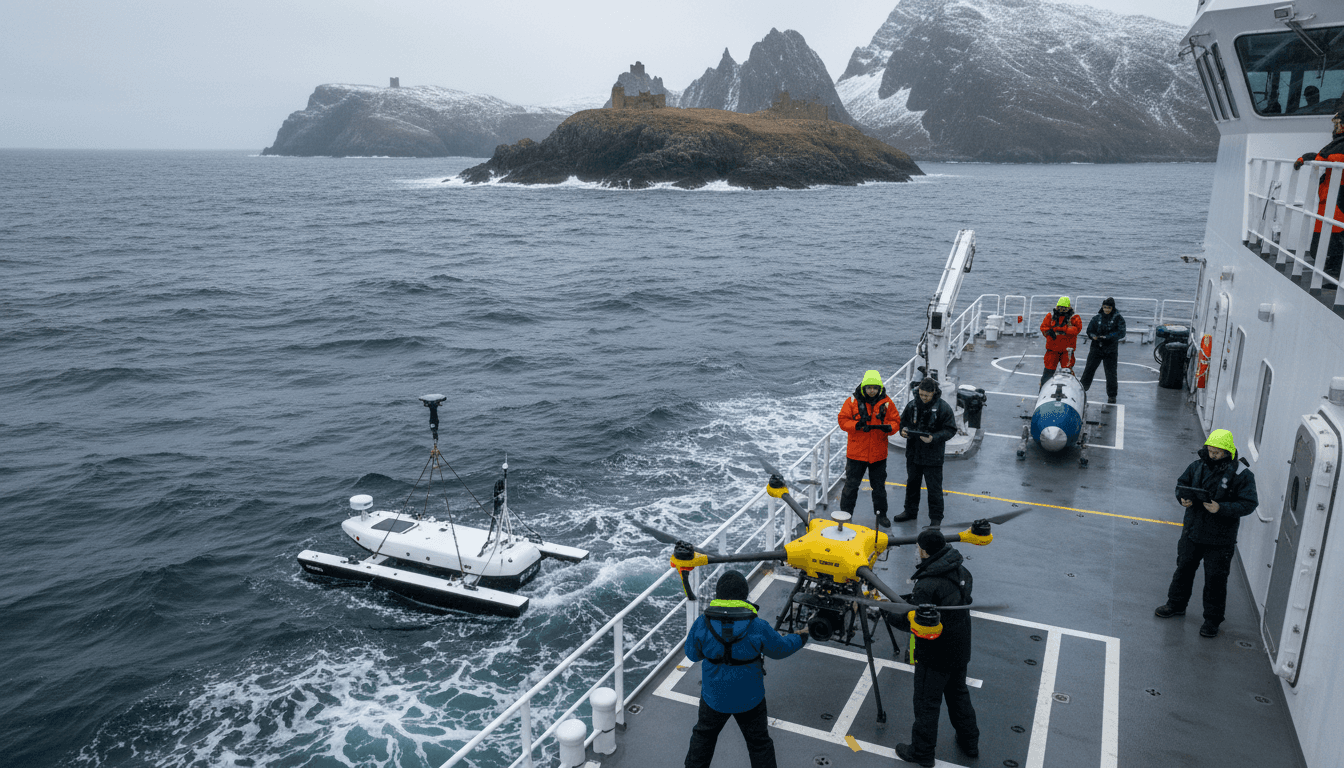
AI Robotics Strategy Game for Algal Bloom Missions
A harmful algal bloom can shut down shellfish harvesting, stress fish farms, and trigger public health warnings—fast. The hard part isn’t only detecting the bloom. It’s coordinating the right robots, in the right order, with the right data before the situation changes.
That’s why I like the premise behind Drones and Droids, a co‑operative strategy game created at the Scottish Association for Marine Science (SAMS). The setup is simple and vivid: you and four teammates are on the deck of the research vessel Seol Mara, deploying a small fleet of robots to investigate an algal bloom near Lismore. It’s “just a game,” but the underlying lesson is real: AI in robotics succeeds or fails based on coordination, constraints, and decision-making under uncertainty.
If you work in robotics, automation, environmental monitoring, or R&D leadership, this is more than a fun curiosity. It’s a compact, memorable way to think about multi-robot operations—how autonomy, sensing, communications, and human teamwork have to fit together when the ocean doesn’t wait.
Why a co-operative robot game mirrors real field robotics
Co-operative gameplay is a close match for modern robotics programs because real missions rarely have a single objective and a single robot. Environmental monitoring is a systems problem.
When a research team responds to an algal bloom, they’re juggling several goals at once:
- Confirm presence and extent (where is the bloom, and how big is it?)
- Characterize the water column (temperature, salinity, chlorophyll fluorescence, dissolved oxygen)
- Identify species/toxins (is this bloom harmful, and what’s the risk?)
- Report quickly (so decisions can be made while the data is still actionable)
A co-operative strategy game forces the same mental model: you win together by sequencing actions, sharing limited resources, and managing risk. Competitive play can be fun, but it’s less aligned with how robotics programs actually operate—where the “opponent” is uncertainty, time, weather windows, and battery life.
The most realistic constraint: you can’t do everything
Most companies get this wrong at the prototype stage. They design autonomy assuming perfect conditions—then wonder why pilot deployments stall.
A game like Drones and Droids naturally teaches the operational reality:
- Sensors conflict with one another (or compete for power)
- Comms drop, so robots can’t always “phone home”
- The team must decide what not to measure
- A late decision costs more than an imperfect early decision
That’s not pessimism. It’s how you build systems that survive outside the lab.
What “six robots on a vessel” really implies (and why AI matters)
A fleet of six robots isn’t just redundancy—it’s specialization. In field robotics, the fastest path to reliable results is usually a heterogeneous robot team, not one “do-everything” machine.
Here’s a practical mapping between common marine robotics platforms and the kinds of roles a strategy game can represent:
- Aerial drones (UAVs): rapid surface mapping, locating discoloration, spotting slicks, scouting safe launch zones
- Surface vehicles (USVs): persistent survey patterns, acting as comms relay, towing instruments
- Underwater vehicles (AUVs/ROVs): profiling below the surface, collecting targeted samples, imaging or sensing at depth
- Fixed or drifting sensors: time-series monitoring, early warning, background baselines
AI ties these pieces together by turning “many instruments” into “one mission.” In practice, that means:
- Task allocation: deciding which robot does what next
- Adaptive sampling: changing the plan as new data arrives
- Data fusion: merging imperfect measurements into a coherent picture
- Anomaly detection: flagging patterns that deserve attention before humans would notice
A co-operative board game is a surprisingly effective way to make these ideas stick, because it forces trade-offs you can’t hand-wave away.
AI-driven decision-making: autonomy is mostly prioritization
When people hear “AI robotics,” they often imagine a robot thinking like a scientist. The reality? Most operational autonomy is prioritization under constraints.
For an algal bloom mission, prioritization might look like:
- If chlorophyll fluorescence spikes in a transect, tighten the search grid.
- If dissolved oxygen drops below a threshold, prioritize depth profiling.
- If wind increases and UAV flight time drops, switch to surface assets.
That’s not glamorous. It’s also exactly where missions succeed.
The real-world algal bloom workflow the game hints at
The key point: bloom response is a time-sensitive pipeline, not a single measurement.
A realistic workflow (and a useful way to interpret the game’s “mission”) looks like this:
1) Detect and triage
Detection often starts with a report, a routine monitoring station, or remote sensing. The first robotics goal isn’t perfection—it’s triage: confirm whether it’s a true bloom event and whether it’s moving.
- UAVs can provide immediate surface context.
- Surface vehicles can run quick transects.
- AUVs can test whether the signal is only near-surface or extends deeper.
2) Characterize and bound the bloom
Once confirmed, the mission shifts to defining boundaries and gradients. The bloom edge matters because it’s where change is fastest and where sampling adds the most information.
This is where AI-enabled adaptive sampling shines: instead of surveying a rigid rectangle, robots focus on where the data is changing.
3) Collect “decision-grade” evidence
Regulators and operators don’t just want maps; they want defensible evidence. For harmful blooms, that often means pairing environmental measurements with samples for lab analysis.
In robotics terms, this is the hard part:
- Samples require precise timing and location.
- Ocean conditions drift.
- Navigation uncertainty accumulates.
A strategy game captures that pressure: the team has to coordinate collection actions before the window closes.
4) Communicate results quickly
The last mile is frequently overlooked. If the data can’t be communicated, visualized, and explained, it won’t change decisions.
That’s why mission design should treat reporting as a first-class requirement:
- What gets summarized onboard vs. later?
- What’s the minimum viable map a stakeholder needs?
- What’s the confidence level, and what drove it?
A co-operative setting reinforces a truth I’ve seen repeatedly: the best robotics teams win because they’re great at operational communication, not because they have the fanciest hardware.
Using games as serious tools: training, simulation, and buying decisions
Here’s the stance I’ll take: strategy games are underrated as professional tooling for robotics and automation teams—especially in 2025, when many organizations are scaling pilots into sustained operations.
A tabletop-style game is obviously not a physics simulator. Its value is different: it teaches the “management layer” of autonomy—the same layer that breaks real deployments.
What a robotics team can learn in 60 minutes of play
A good co-operative robot mission game can surface issues you’ll otherwise discover after spending months in development:
- Role clarity: who’s responsible for sensing, navigation, data QA, and comms?
- Bottlenecks: what’s the scarce resource—battery, bandwidth, people, or time?
- Failure handling: what happens when a robot drops out mid-mission?
- Coordination costs: how much overhead does multi-robot operation introduce?
Those insights translate directly into better requirements and fewer “surprise” integration problems.
A practical way to use this in your org
If your company is exploring AI in robotics for environmental monitoring (or any fieldwork-heavy domain), try this structure:
- Play as a cross-functional group (ops, ML, robotics, product, stakeholder rep).
- After the game, run a 20-minute debrief:
- What did we optimize for?
- What information did we wish we had earlier?
- Where did handoffs fail?
- Convert the answers into a one-page checklist for real missions.
That checklist becomes a lightweight “mission readiness” artifact you can use for pilots, demos, and stakeholder reviews.
People also ask: what does this teach about AI in robotics?
Does a strategy game really reflect AI robotics? Yes—if you treat it as a model of mission logic, not vehicle dynamics. Many failures in robotics deployments come from mission planning, data workflows, and human coordination.
What AI techniques map cleanly to multi-robot missions? The most relevant ones are task allocation, Bayesian state estimation, active learning/adaptive sampling, and anomaly detection. They’re practical, measurable, and directly tied to mission outcomes.
Why focus on algal blooms specifically? Because they’re a high-urgency monitoring problem with real economic and public health consequences. They also force robotics teams to operate under changing conditions—exactly where autonomy earns its keep.
What to copy from Drones and Droids when you’re building real systems
The game’s scenario—team on a vessel, multiple robots, urgent environmental event—highlights design patterns you should explicitly encode in real programs.
Design pattern 1: A “fleet dashboard,” not six separate robots
If you want multi-robot operations to scale, stop thinking in terms of vehicles and start thinking in terms of capabilities.
Your operators need one place to answer:
- What capabilities are online right now?
- What’s the confidence in each sensor stream?
- What’s the next-best action if conditions change?
Design pattern 2: Mission plans that can bend
Static waypoint plans are fine for demos. For real bloom response, mission plans must support:
- Dynamic re-tasking
- Priority zones
- Contingencies (loss of comms, loss of GPS, sudden weather change)
This is the practical frontier of AI robotics strategy: systems that can change their minds for good reasons.
Design pattern 3: “Good enough now” beats “perfect later”
Environmental incidents punish slow cycles. A fast, slightly noisy map that updates every 15 minutes is often more useful than a perfect map delivered tomorrow.
That’s a product decision as much as a technical one—and a co-operative game makes the trade-off obvious.
A better way to talk about AI robotics to stakeholders
If you’re selling or deploying robotics for monitoring, stakeholders don’t want to hear model names. They want to hear how you’ll reduce risk and response time.
A simple, credible message is:
AI in robotics is mission glue: it helps teams decide what to do next with limited time, limited power, and imperfect data.
That framing is accessible to non-specialists and still accurate enough for technical teams.
The fun part is that Drones and Droids gives you a story to carry that message—robots on a research vessel, coordinating to understand an algal bloom near Lismore. Stories travel farther than spec sheets.
If you’re planning a 2026 pilot for multi-robot monitoring—marine, industrial, agricultural, or infrastructure—try a lightweight “game + debrief” session before you write the full requirements. You’ll surface constraints, clarify responsibilities, and get alignment faster.
Where would a co-operative robot mission game expose the biggest weakness in your current operations: tasking, sensing, comms, or decision-making?