Uber’s robotaxi push shows how AI can defend margins when prices drop and costs rise. Practical AI adoption and marketing lessons for Singapore startups expanding in APAC.
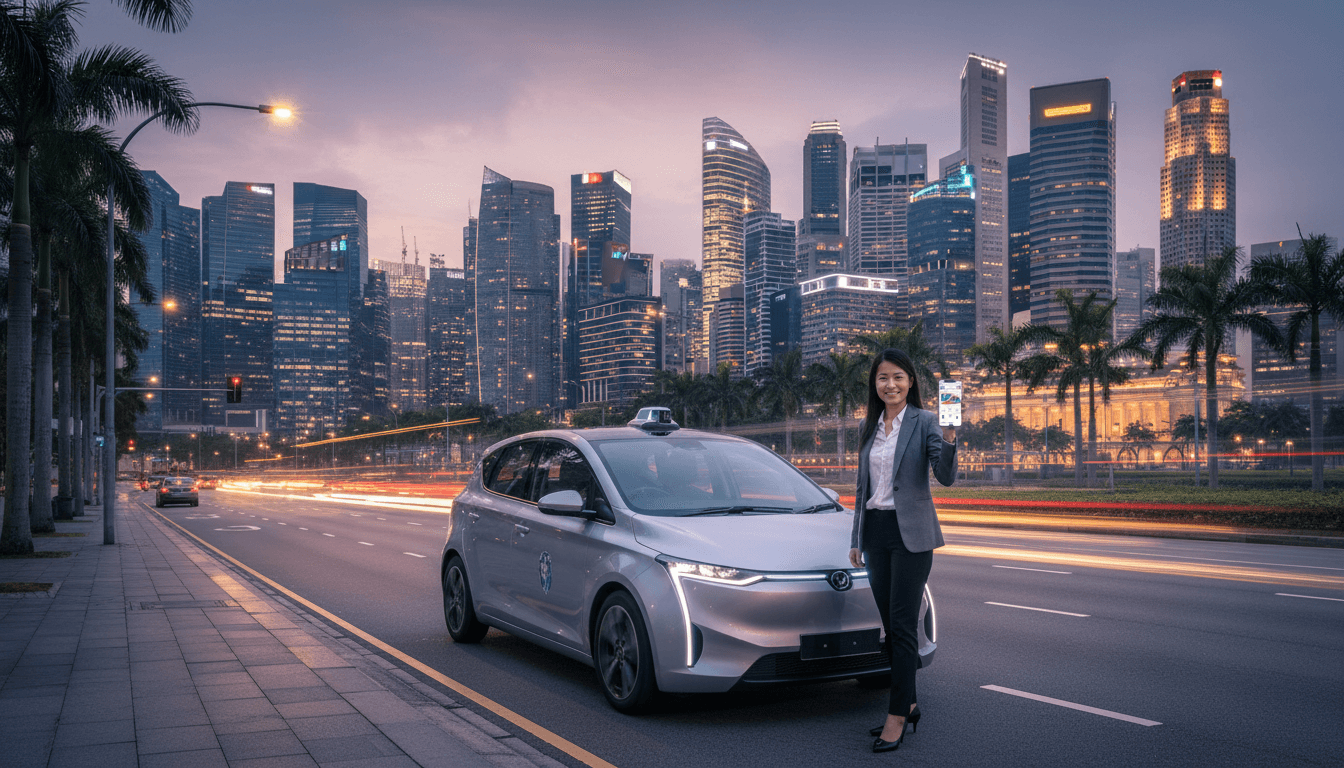
Uber’s Robotaxi Bet: AI Lessons for SG Startups
Uber just reminded the market of an uncomfortable truth: demand can be strong and profits can still get squeezed.
In early February 2026, Uber reported 22% trip growth in Q4, yet forecast lower-than-expected profit for the next quarter. Two culprits stood out: cheaper rides (to keep users loyal) and higher taxes (Uber expects an effective tax rate of 22%–25% this year as it operates across 70+ countries). At the same time, Uber doubled down on a capital-heavy plan: expanding robotaxi trips to up to 15 cities by end-2026, with Hong Kong positioned as its first autonomous ride market in Asia.
For Singapore startups—especially those thinking about regional growth—this is more than a transport story. It’s a case study in how AI and automation become a business strategy when margins are under attack, and how that strategy must be packaged, marketed, and financed to survive scrutiny.
Why Uber’s robotaxi push matters for Singapore startup marketing
Answer first: Uber’s robotaxi strategy shows how AI can be positioned as a margin defense and growth engine at the same time—exactly the narrative many startups in Singapore need when expanding across APAC.
In the “Singapore Startup Marketing” series, we often talk about product-market fit, go-to-market, and distribution. But 2026 has made something clear: your unit economics are part of your marketing. When customers demand affordability and regulators raise costs, the story you tell investors, partners, and users has to connect three dots:
- Lower cost to serve (automation, better utilization, fewer idle hours)
- Better experience (shorter pickup times, more reliability)
- A credible scaling model (financing and operations that don’t implode at city #3)
Uber is trying to tell that story with robotaxis: autonomous fleets add supply, lower prices, and increase trip volume—while Uber aims to avoid owning most of the fleet outright.
For Singapore founders, the practical question is: How do you adopt AI in operations in a way you can sell—without overspending or overpromising?
The “cheap rides + higher taxes” squeeze: a familiar startup problem
Answer first: Uber’s profit pressure is the same squeeze many startups face in Singapore—price competition plus rising compliance costs—so the response pattern is useful even outside mobility.
Uber’s results highlight a pattern that shows up across SaaS, e-commerce, logistics, fintech, and B2B marketplaces:
- Customers anchor on price (shared rides and lower-cost products grew usage)
- Regulatory and cross-border friction increases (tax, reporting, licensing, data rules)
- Growth looks good, profitability looks worse (especially when you subsidise adoption)
If you’re a Singapore startup expanding into Hong Kong, Indonesia, Malaysia, or beyond, you’ll recognise the “70+ countries” problem in miniature: every new market brings extra layers—payments, language, legal, customer support, fraud, invoicing, tax handling.
The operational insight: you can’t discount forever
Discounting buys time. It rarely buys durability.
Uber’s move toward robotaxis is partly a bet that cost per trip can fall structurally over time if fleet utilization improves and driver costs are reduced or reshaped. For startups, the equivalent is using AI to reduce cost per transaction, ticket, shipment, claim, or onboarding.
Here’s a strong stance I’ve found holds up: AI is most valuable when it removes recurring operational drag, not when it merely produces more content. Content helps acquisition; operational AI protects margin.
Uber’s real play: platform economics + AI-driven utilisation
Answer first: Uber is betting that a multi-product platform with strong demand can run autonomous fleets more efficiently than standalone robotaxi apps—because utilisation is everything.
Uber’s CEO argued that vehicles operating through Uber have achieved higher utilization and shorter pickup times than standalone robotaxi services. Whether every detail holds in every city is debatable, but the economic principle is solid:
- High utilisation spreads fixed costs across more trips.
- Lower pickup times improves conversion and retention.
- Better reliability supports higher frequency use.
This is platform thinking, not just AI thinking.
What Singapore startups should copy (and what they shouldn’t)
Copy the logic, not the headline.
What to copy:
- Design for utilisation: If you sell a service, ask “How do we reduce idle time?”
- Bundle products to raise frequency: Uber has rides + delivery + other services. Startups can bundle onboarding + compliance + payments; or analytics + alerts + workflows.
- Instrument everything: You can’t improve pickup times (or any KPI) if you don’t measure it with ruthless consistency.
What not to copy:
- Betting your company on a moonshot before your core metrics are stable.
- Pitching AI as magic. Regulators, investors, and enterprise buyers punish vague claims in 2026.
A practical AI adoption playbook for APAC expansion
Answer first: The safest way to adopt AI is to start with one operational KPI, automate the workflow around it, and market the measurable outcome—not the model.
Uber’s robotaxi narrative is long-term. Most startups don’t have that runway. The good news: you can still apply the same approach at startup scale.
Step 1: Pick one “margin KPI” and commit to it
Choose a metric that hits cost and experience simultaneously. Examples:
- Customer support: time to first response, resolution time, cost per ticket
- Sales ops: lead-to-meeting time, proposal turnaround, sales cycle length
- Logistics/field ops: on-time rate, route efficiency, cost per delivery
- Marketplace ops: match time, fill rate, cancellation rate
Uber’s version of this is pickup time and utilisation. Yours should be just as concrete.
Step 2: Automate the workflow, not just the interface
The common mistake: founders add a chatbot, then declare “we implemented AI.”
The better approach is workflow automation:
- Capture signals (emails, tickets, calls, orders, telemetry)
- Classify and route (intent, urgency, language, risk)
- Take action (draft response, trigger refund, schedule follow-up, escalate)
- Close the loop (measure outcome, learn, update playbooks)
If AI doesn’t change the workflow, it won’t change the economics.
Step 3: Build the “trust layer” early (APAC is unforgiving)
As you expand regionally from Singapore, your AI systems will face more edge cases: languages, slang, address formats, regulatory constraints, payment fraud patterns.
A simple trust layer includes:
- Human-in-the-loop for high-risk actions
- Audit logs for decisions
- Clear policy rules (what AI can’t do)
- Monitoring for failure patterns
You don’t need perfection. You need predictability.
Step 4: Market outcomes with numbers people can repeat
Uber’s story contains repeatable numbers: 22% trip growth, 22–25% tax rate, up to 15 cities.
Your marketing should aim for the same clarity. Examples:
- “Reduced cost per support ticket by 28% in 60 days.”
- “Cut quote turnaround from 3 days to 6 hours.”
- “Improved on-time delivery from 91% to 96%.”
Numbers are portable. They travel across borders better than brand claims.
Financing and partnerships: Uber’s underappreciated lesson
Answer first: Uber is trying to finance autonomous fleets with banks and private equity while committing capital to secure supply—this is a blueprint for startups that need scale without owning everything.
One of the most interesting parts of the report wasn’t robotaxis—it was how Uber plans to pay for them.
Uber said it will work with banks and private equity firms to finance most of the autonomous fleets, while committing capital to vehicle partners to secure early supply. In plain terms:
- Uber wants distribution and utilisation.
- Partners and financiers take on more of the asset ownership risk.
For Singapore startups, this translates into a regional growth tactic:
- If you’re entering a new APAC market, consider partnerships where you own the workflow and customer relationship, while partners own more of the heavy lifting (assets, licenses, local operations).
This is as much a marketing move as a financing move: partners can become your credibility channel.
“People also ask” (quick answers founders can use)
Will robotaxis replace drivers, or expand the market?
Uber’s stated view: robotaxis expand the mobility market by adding supply, improving reliability, lowering prices, and increasing trip volumes. Translation: more total rides, different cost structure.
Why would profitability fall even when usage grows?
Because growth can be purchased with lower prices, while costs rise through taxes, compliance, incentives, and investment in long-term bets. Revenue up doesn’t guarantee margin up.
What’s the startup version of a robotaxi bet?
Operational AI that reduces cost-to-serve in a repeatable way: support automation, fraud detection, route optimisation, demand forecasting, or AI-assisted sales ops.
What to do next if you’re a Singapore startup building with AI
Uber’s forecast miss and robotaxi push lands on a clear message: AI is a strategy when the business model gets squeezed. For Singapore startups marketing into APAC, that’s good news—if you focus on operational outcomes and tell the story with discipline.
Here’s the next step I’d take this week:
- Write down your top 3 cost drivers (time, headcount, incentives, chargebacks—be specific).
- Pick one KPI that represents “cost + customer experience.”
- Ship a small AI workflow that moves that KPI within 30 days.
- Turn the result into a case study your sales team can use in Singapore, Hong Kong, and beyond.
If Uber is right, markets like Hong Kong will become a proving ground for autonomous operations in Asia. The bigger question for founders is closer to home: when your costs rise next quarter, will your AI efforts be a demo—or a defence that actually shows up in the numbers?
Source reference: Uber results coverage from CNA (Reuters), Feb 2026: https://www.channelnewsasia.com/business/uber-forecasts-profit-below-estimates-cheaper-rides-and-higher-taxes-5907091