Mitsubishi Electric’s new India AC plant is a masterclass in localization. Here’s how Singapore startups can apply the same market-entry logic to win in India.
Localize Fast: Lessons from Mitsubishi’s India Push
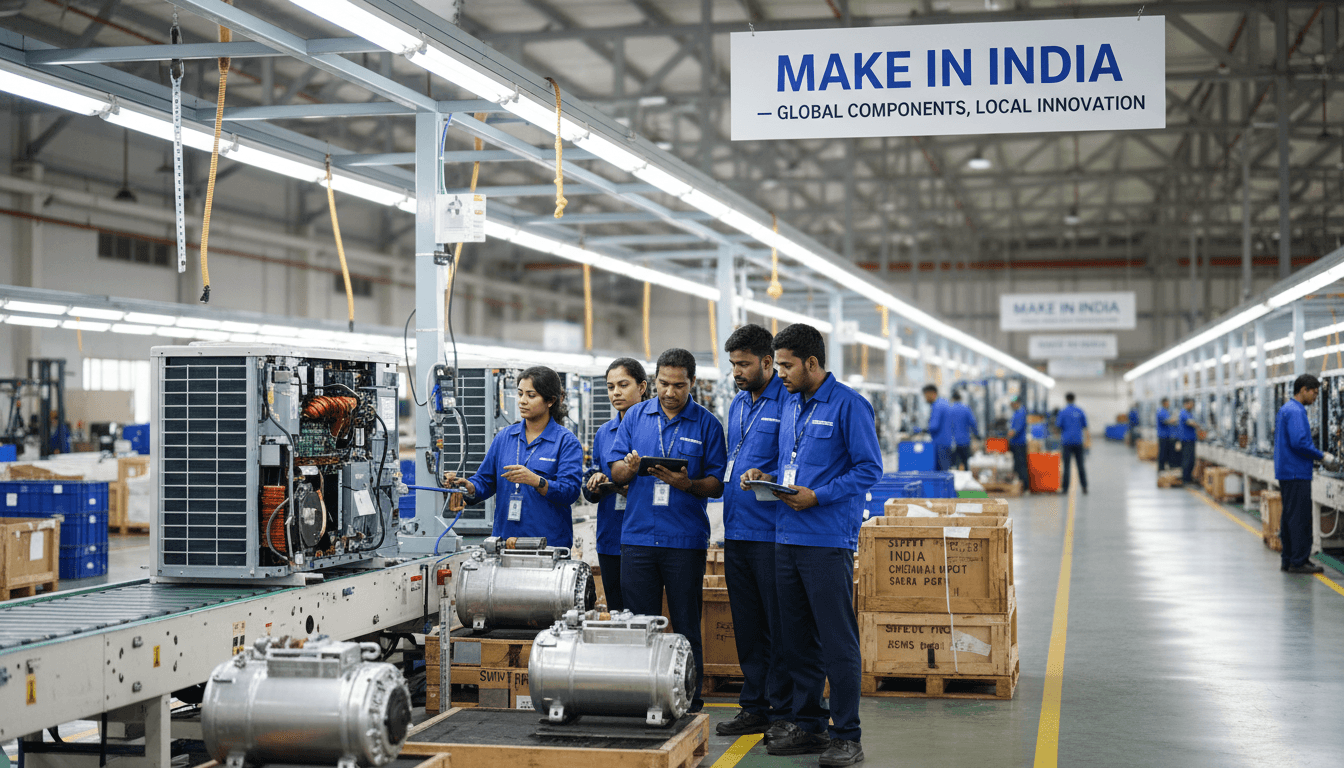
Mitsubishi Electric didn’t enter India’s booming home air-conditioner market with a bigger ad budget. It entered with a factory.
On Feb. 6, 2026, the company began full-scale operations at its first residential air conditioner plant in India, investing 21 billion rupees (about $232m) in Tamil Nadu. Capacity is set at 300,000 inverter room air conditioners and 650,000 compressors per year. That detail matters: compressors are the heart of the product—and controlling them locally is a control point for cost, quality, and lead time.
For this Singapore Startup Marketing series, I’m treating this as a practical case study in APAC expansion strategy. You probably won’t build a 21-billion-rupee plant. But the logic behind the move—local procurement, shorter delivery cycles, premium positioning, and export optionality—translates cleanly to how startups should approach India and other high-growth markets.
Why manufacturing localization is a growth strategy (not ops)
Localizing production isn’t a back-office decision. It’s a go-to-market advantage.
Mitsubishi Electric’s stated goal is to cut production costs and delivery times by procuring more parts locally. That’s not just margin protection—it’s a way to compete in a market where demand spikes seasonally, channels want reliable availability, and customers are increasingly value-conscious.
Here’s the startup translation:
- If you can’t deliver reliably, your CAC goes up. Your marketing promises get punished by reality—refunds, delayed onboarding, channel churn.
- If your unit economics depend on imported inputs, your pricing becomes fragile. FX swings and shipping delays turn “growth plans” into apology tours.
- If your service level lags local competitors, your brand becomes “premium” only in price, not experience.
Localization is really about reducing friction across the whole funnel—from acquisition to activation to retention.
The hidden marketing benefit: speed improves conversion
Most teams think conversion rate is a landing-page problem. Often it’s a lead-time problem.
When delivery and installation get faster (or onboarding time drops from weeks to days), you can:
- Run tighter campaigns tied to specific time windows.
- Use scarcity and seasonal demand honestly (because you can fulfill it).
- Close partnerships with channels that require consistent supply or SLA compliance.
That’s why Mitsubishi’s “local parts + local production” approach is also a marketing story: “available, efficient, built for India.”
India’s demand is real—and competition is already concentrated
The India AC market isn’t a “future opportunity.” It’s already enormous.
According to the Japan Refrigeration and Air Conditioning Industry Association, India’s residential air conditioner market grew 30% in 2024 to 11.63 million units, surpassing Japan in scale.
At the same time, the market is not wide open. Voltas, LG Electronics, and Daikin together hold nearly 50% market share (Euromonitor data cited in the article). That tells you two things:
- Distribution and brand trust compound. Once a handful of brands dominate shelf space and installer networks, late entrants pay a “tax.”
- Differentiation has to be operational, not just promotional. If everyone can buy ads, the winners are the ones who can supply, service, and innovate locally.
For Singapore startups expanding into India—whether you’re selling SaaS, consumer goods, fintech infrastructure, or B2B services—the parallel is direct: assume you’re entering a market where incumbents already have channels locked in.
A contrarian stance: don’t default to “mass market” in India
Many startups hear “India scale” and immediately chase volume. That’s usually a mistake.
Mitsubishi Electric is explicit: it wants the “premium zone,” prioritizing high-margin products and energy-saving models rather than pure volume.
I agree with that approach for most venture-backed teams. If you’re new to India:
- Competing on price before you have local ops is a fast way to destroy margins.
- Your early customer success stories matter more than your early unit volume.
- Premium segments are often less price-sensitive and more experience-sensitive—an advantage if you can deliver a better product.
“Premium” doesn’t mean luxury branding. It means clear differentiation + reliable delivery + measurable outcomes.
Mitsubishi’s playbook, translated for Singapore startups
The core move here is simple: build an India base so India becomes a core growth engine, not a remote sales territory.
Mitsubishi Electric’s India sales across businesses were 42 billion rupees in fiscal 2024, with around half generated by air conditioners. It’s also targeting 10%+ average annual sales growth through fiscal 2030 in its air conditioner business (including commercial).
A company doesn’t make those statements unless it’s committing to local execution.
So what’s the startup version of “building the plant”? It’s picking the right layer of localization for your stage.
Stage 1: Localize the offer (before you localize the org chart)
Start with what your customer touches.
- Pricing and packaging: India often prefers clearer, outcome-tied packages over abstract tiers. For B2B, consider implementation-included bundles.
- Proof: Replace generic testimonials with India-relevant cases: same industry, similar scale, local constraints.
- Performance claims: Mitsubishi is pushing energy-efficient inverter models. That’s a crisp, measurable benefit. Your equivalent should be equally concrete (e.g., “reduces reconciliation time by 38%” beats “improves productivity”).
If your positioning can’t survive contact with local buying criteria, hiring a country manager won’t fix it.
Stage 2: Localize delivery (the equivalent of cutting lead times)
Mitsubishi’s stated win is lower cost + faster delivery via local procurement. Your version is reducing time-to-value.
For startups, delivery localization could mean:
- Hosting and latency improvements (where relevant)
- India-friendly payment rails and invoicing workflows
- Implementation partners who can deploy and support locally
- Better SLAs and a support window that matches local working hours
A useful rule: If your onboarding takes longer than your competitor’s procurement cycle, you’ll lose deals.
Stage 3: Localize the supply chain (only where it creates a moat)
Not every startup needs a physical supply chain. But if you do (hardware, consumer products, regulated industries), Mitsubishi’s move highlights a practical principle:
Local sourcing is a competitive moat when it improves availability and protects margins at the same time.
If you’re selling physical products into India from Singapore, common “moat” steps include:
- Dual-sourcing critical components
- Local final assembly to reduce duties and shipping constraints
- Service and spare-parts availability (often the real brand builder)
Use India as a hub: the export-optional strategy
Mitsubishi is considering India as a future export hub to Africa and the Middle East.
That’s smart because it avoids a classic expansion trap: building a country team that only works for one country. A hub strategy forces you to build reusable capabilities—operations, partner management, compliance muscle, multilingual support.
Singapore founders should pay attention here because Singapore already functions as a regional node. The opportunity is to build a two-hub model:
- Singapore for regional HQ functions: fundraising, product strategy, regional partnerships.
- India for execution power: engineering, operations, high-velocity sales, and potentially manufacturing/assembly (if relevant).
When that works, you don’t just “enter India.” You upgrade your entire APAC operating system.
The marketing angle most teams miss: hub stories build trust
If you’re using India as a hub, say it plainly. Buyers and partners respond to commitment.
Messaging that works:
- “Built and supported in India” (if true)
- “Local implementation partners in major metros”
- “Regional delivery from India for MENA/APAC customers”
The signal is commitment: you’re not testing the market—you’re building in it.
A practical checklist for Singapore startups expanding into India
If you want an actionable takeaway from this case, use this checklist to pressure-test your plan.
Market entry: are you choosing the right wedge?
- One vertical you can own in 6–12 months
- One killer metric you can improve (time saved, cost reduced, yield improved)
- One channel you can scale (direct sales, platform partnerships, distributors, communities)
Localization: what are you localizing first?
- Offer (packaging, pricing, proof)
- Delivery (onboarding time, support, SLAs)
- Operations (partners, hiring, compliance)
- Supply chain (only if it protects margin and availability)
Competitive stance: are you avoiding the volume trap?
- Premium wedge with measurable ROI
- Clear differentiation that doesn’t depend on ads
- Operational advantage that compounds (speed, reliability, service)
Metrics: what should you track in the first 90 days?
- Time-to-first-value (median days)
- Win rate by segment and channel
- Churn risk signals (support tickets, onboarding stalls)
- Gross margin sensitivity to FX/logistics (if physical)
What Mitsubishi Electric gets right (and what startups should copy)
Mitsubishi’s India move works because it’s coherent:
- Demand is expanding fast (30% growth in 2024; 11.63m units).
- It’s choosing premium positioning instead of chasing volume.
- It’s investing to reduce cost and delivery time via local procurement.
- It’s keeping an eye on regional export optionality.
The part I’d copy as a Singapore startup isn’t “build a plant.” It’s this sentence you can apply to almost any category:
Build local capability to make your promise true faster than competitors can imitate your ads.
If you’re working on APAC expansion strategy this quarter, use Mitsubishi’s move as a forcing function: where are you still acting like India is just a sales territory, not a capability base?
If you had to make one “factory-like” investment—something that permanently reduces cost, cycle time, or failure rate—what would it be?
Source: Mitsubishi Electric launches air conditioner production in India (Nikkei Asia), https://asia.nikkei.com/business/electronics/mitsubishi-electric-launches-air-conditioner-production-in-india