A blood donation app idea shows how reducing one fear point can drive adoption. Learn a practical trust-first marketing playbook for Singapore startups.
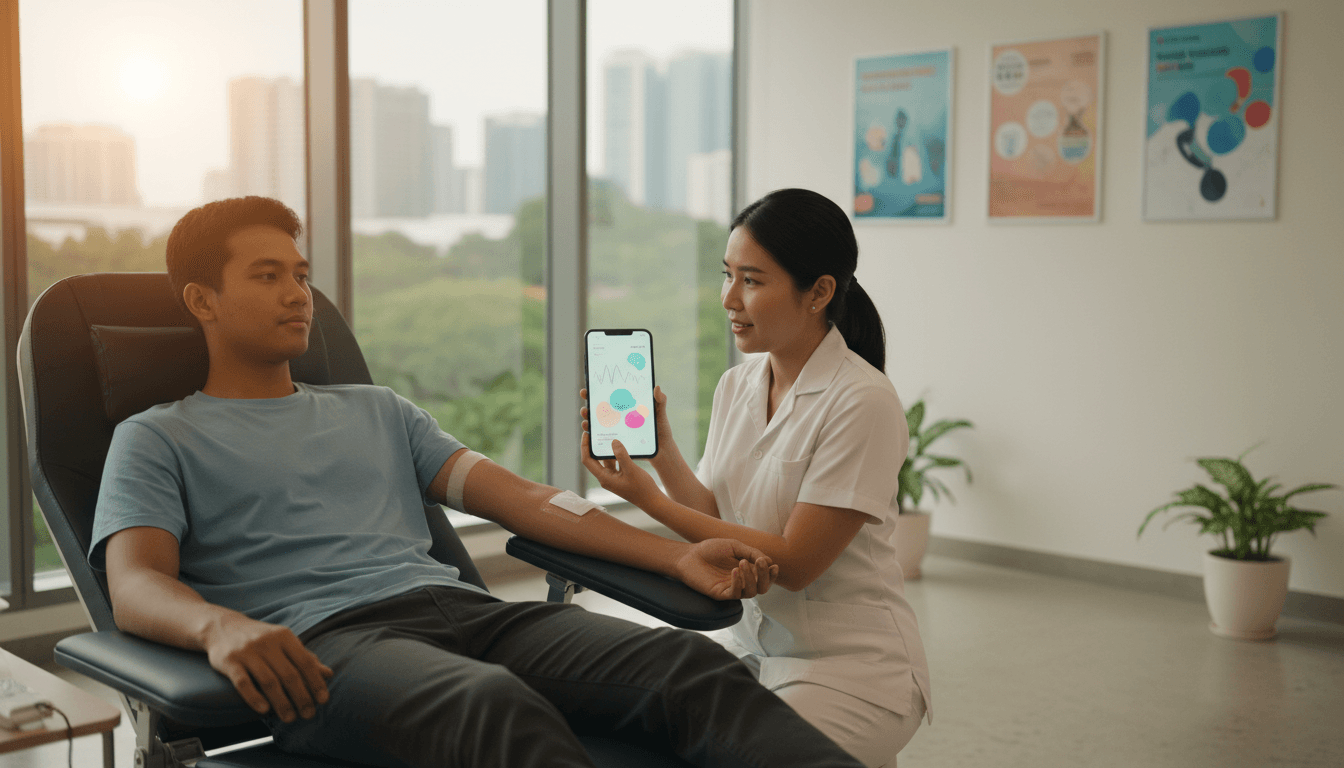
Build Health Apps People Trust: Lessons from Blood Donors
A painful finger-prick is a tiny medical step. Yet it blocks a surprisingly large number of people from donating blood—especially in parts of Asia where demand already outpaces supply. In Singapore alone, a retrospective study of the Singapore Blood Transfusion Service found 14.4% of prospective donors were deferred during pre-donation screening, with low haemoglobin among the top reasons.
That’s the marketing lesson many Singapore startups miss: growth isn’t always about louder ads or more content. Often, it’s about removing one psychological friction point that’s quietly killing conversion.
Cathy Tan’s story (founder of Genesis1) is a clean case study in digital solutions for social good: she built an app concept that uses non-invasive haemoglobin screening (via a lip scan) to reduce donor anxiety, cut deferrals, and potentially expand screening access beyond donor centres. For this Singapore Startup Marketing series, the angle that matters is how a community-impact product earns trust, adoption, and referrals—especially when it touches healthcare.
Blood donation is a supply problem—and a confidence problem
Asia’s blood systems face recurring shortages. The World Health Organisation highlights a global imbalance where 40% of blood donations come from high-income countries despite those countries making up 16% of the world’s population. In many Asian markets, the shortage isn’t just operational. It’s behavioural.
The real blocker isn’t the needle—it’s the screening moment
People rarely say, “I don’t donate because I don’t care.” They say things like:
- “It must be painful.”
- “I’m worried I won’t qualify.”
- “I don’t want to get turned away.”
That last one is key. Being deferred after showing up costs time, confidence, and face. If your product creates even mild embarrassment or uncertainty, your funnel leaks.
Tan points to a particularly sharp friction point: haemoglobin screening typically uses a finger-prick blood sample. It’s medically minor but emotionally significant.
The WHO has also called for accelerated action to reduce anaemia, estimating anaemia affects 571 million women and 269 million young children globally, with the highest prevalence in South and Southeast Asia. In some Asian countries, 15–20% of potential donors are turned away due to low haemoglobin.
Marketing takeaway: if 15–20% of your interested users “fail” at the first gate, you don’t just lose transactions—you lose advocates.
The product idea: non-invasive haemoglobin scanning (and why it’s a growth lever)
Genesis1’s concept is simple to explain and strong in impact: an app paired with a non-invasive haemoglobin scanner that lets people check eligibility quickly and painlessly before heading to a donation centre.
Why pre-screening changes behaviour
Pre-screening does three things that map directly to digital marketing fundamentals:
- Reduces anxiety (top-of-funnel): People are more willing to consider donating if they can “check first” without pain.
- Cuts wasted trips (mid-funnel): If someone is likely to be deferred, they can postpone until they’re ready.
- Creates a repeatable habit loop (retention): Quick checks can become routine—especially for lapsed donors.
And the insight goes beyond donors. Feedback Tan received included people who need frequent blood tests for medical reasons and inactive donors who said they’d be more inclined to donate if screening felt less invasive and fast.
My stance: “Non-invasive” isn’t a feature. It’s a positioning strategy. It signals modernity, empathy, and safety in a single phrase.
A note on trust: AI in health needs restraint
The article references using AI and Machine Learning to support screening and normalise donation. In healthtech, AI marketing can backfire if you oversell certainty.
A better approach is:
- Be explicit about what the scan is (a screening aid, not a diagnosis)
- Publish validation metrics when available (accuracy across skin tones/lighting conditions, false positives/negatives)
- Explain edge cases (make-up, lip pigmentation differences, camera quality)
In Singapore startup marketing, trust is your CAC reducer. The more credible your claims, the less you’ll spend convincing people.
“Beyond donor centres” is where startups find scale in Southeast Asia
A strong product story expands from one use case into adjacent workflows. Tan’s piece makes a practical point: anaemia often goes undiagnosed, especially in communities with limited healthcare access. A portable, easy-to-operate tool could enable screening in:
- Clinics and community health posts
- Schools
- NGOs and self-help groups
- Workplace health programmes
Why this matters for SMEs (even outside health)
Most Singapore SMEs hear “regional expansion” and think: new markets, new languages, new ad budgets. But the repeatable path is usually:
Build one workflow that people already need, then distribute it through partners who already have the audience.
For healthtech, that could be blood banks, clinics, and NGOs. For non-health SMEs, the equivalents are associations, distributors, franchisors, and platforms.
Bridge to digital marketing: partnerships scale faster when your product removes friction and produces measurable outcomes (lower deferrals, higher attendance, faster screening).
The marketing playbook: turn a social-good product into consistent leads
If you’re a startup or SME building a digital product in Singapore, Genesis1’s story suggests a practical go-to-market sequence. Here’s what I’ve found works when you’re selling trust-sensitive solutions (health, finance, education, HR):
1) Start with one scary moment and name it
Tan focuses on the finger-prick. That’s good marketing because it’s specific.
For your product, identify the one moment customers dread:
- “I’m afraid I’ll choose the wrong plan.”
- “I hate being upsold at checkout.”
- “I’m worried my data will leak.”
Then build content around it. Not generic thought leadership—plain-language reassurance.
Snippet-worthy line: The fastest way to earn trust is to describe the customer’s fear more clearly than they can.
2) Use pre-qualification as a conversion tool
Non-invasive haemoglobin checks are essentially a pre-qualification step.
SME parallels:
- A short assessment quiz that routes leads to the right package
- A pricing estimator that sets expectations early
- A “fit check” checklist that prevents poor-fit enquiries
This is lead generation with fewer bad leads. Your sales team will thank you.
3) Show the numbers people can repeat
The article includes numbers that spread well:
- 14.4% donor deferral rate at pre-screening (Singapore study)
- 15–20% deferrals due to low haemoglobin in some Asian countries
- WHO anaemia estimates: 571M women, 269M children
If you want PR, partner distribution, and organic shares, you need 2–3 numbers that make your case without hype.
4) Build community distribution, not just social media posting
For Singapore startups, “community” can’t mean “we post on Instagram.” It has to mean structured participation:
- Co-host educational webinars with partner organisations
- Equip volunteers/ambassadors with a one-page explainer
- Create simple referral prompts (“Share your last donation story”)
Blood donation is already social proof-driven. Your product should amplify that.
5) Design your onboarding like a confidence ramp
For a sensitive action like donation, onboarding should reduce uncertainty step-by-step:
- Explain what the scan does and does not do
- Provide a clear next action (book slot / check eligibility tips)
- Offer “what if” scenarios (low reading, recheck guidance)
- Remind users that deferrals are common and temporary
This is product-led growth, but grounded in empathy.
What Singapore startups should learn about regional expansion from this story
A healthtech product built in Singapore often faces Southeast Asia’s reality: diverse populations, uneven healthcare access, and different operational constraints. Tan notes that even a small increase in active donors can have outsized impact.
“Small shifts, big impact” is also a positioning strategy
If you can plausibly argue that a 5% increase in participation results in “thousands of lives saved annually” (as the article suggests), you’ve got a narrative that governments, NGOs, and corporate CSR teams will pay attention to.
For the Singapore Startup Marketing series, the strategic insight is:
- Impact claims need a model. Define what 1% improvement means in real outcomes.
- Distribution needs institutions. Social-good products scale through systems, not just consumers.
- Trust messaging must be consistent across markets. Don’t rewrite your promise country by country.
And yes—February is a useful moment to plan this. Many organisations set annual CSR and health campaign calendars early in the year. If your startup targets partners, Q1 is when you want your partnership deck, pilot plan, and measurement framework ready.
A practical checklist: if you’re building a “less scary” app, do this
Here’s a compact checklist you can borrow, whether you’re in healthtech or a totally different SME category:
- One fear, one sentence: State the customer’s anxiety plainly.
- One painless first step: Offer a low-effort action that gives immediate clarity.
- One measurement that matters: Pick a metric tied to behaviour (deferrals reduced, no-shows reduced, time saved).
- One partner channel: Choose a single partner type to pilot distribution.
- One credibility asset: A validation study, pilot results, or clinician/advisor quote.
If you can’t fill these in, you don’t have a marketing problem yet. You have a product clarity problem.
Where this goes next for Singapore’s digital-first SMEs
Blood donation is an act of solidarity, but it’s also a funnel: awareness → intent → eligibility → action → repeat. Genesis1’s non-invasive screening idea is powerful because it targets the most fragile step—eligibility anxiety—with a digital experience designed around comfort.
If you’re building in Singapore and selling regionally, that’s the bar to aim for: products that lower fear, not just effort. It’s the difference between a one-time campaign spike and a habit that spreads.
So here’s the question I’d leave you with for your next quarter’s growth plan: What’s the one “small” moment in your customer journey that feels scary—and what would it take to make it feel safe?