Humanoid robots don’t need human hands. Here’s why rugged, task-focused grippers and better touch sensing drive real industrial ROI.
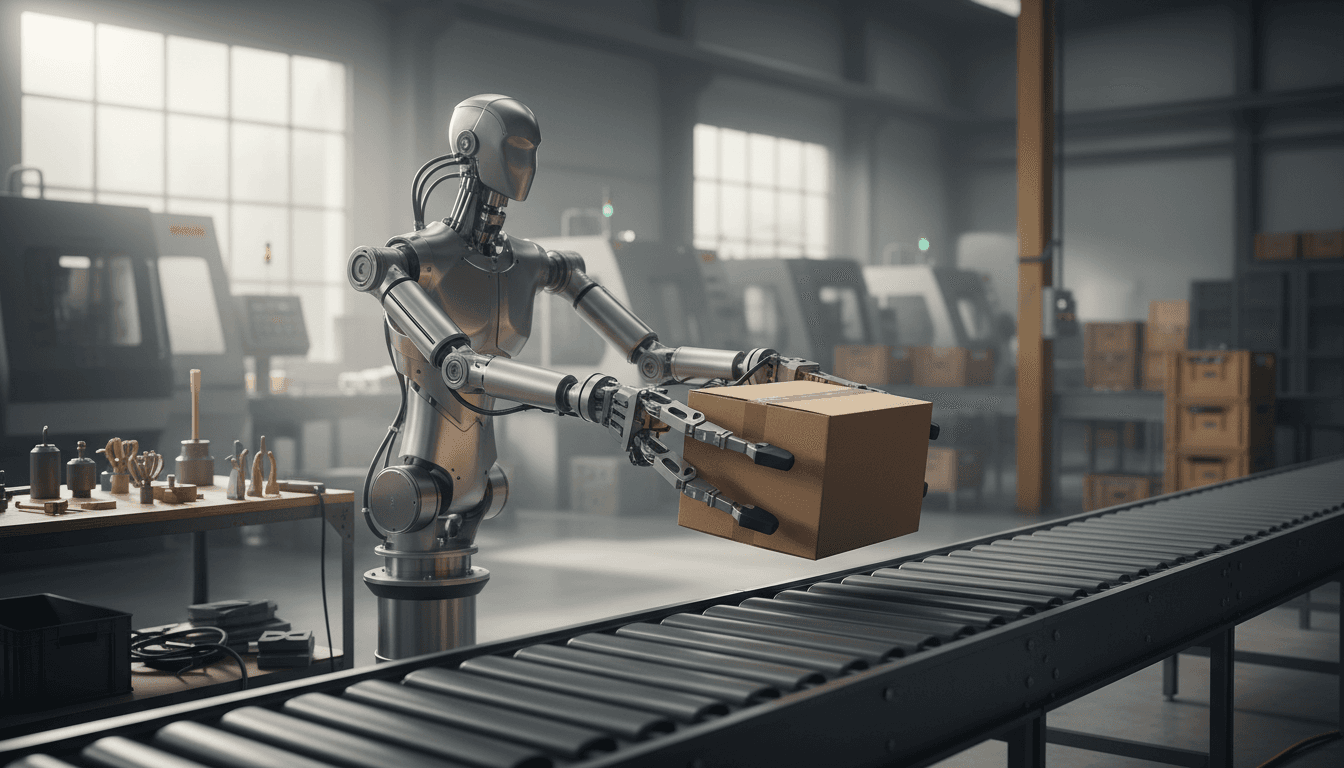
Why Humanoid Robots Need Tougher, Smarter Grippers
Most humanoid robot demos fail in the exact same place: the hands.
Not because engineers can’t build five-fingered hands—they can. The issue is that human-like hands are often the wrong design target for real work. They’re fragile, expensive, and over-specified for tasks that mostly boil down to: pick, place, hold, push, pull, press, and occasionally manipulate a tool.
Boston Dynamics recently highlighted a gripper approach that feels refreshingly honest about the job: design for falls, design for throughput, and don’t worship human anatomy. That one design stance connects to a bigger theme we keep seeing across this “Artificial Intelligence & Robotics: Transforming Industries Worldwide” series: the winners in industrial robotics aren’t the robots that look the most human—they’re the robots that deliver reliable outcomes at scale.
Non-humanoid robot grippers: the practical bet
The best gripper for a humanoid robot is usually not a human hand. It’s a task-focused end-effector built for durability, repeatability, and predictable maintenance.
The Boston Dynamics angle is especially grounded: assume the robot will fall, and assume the hand will take the hit. That’s not pessimism—it’s field reality. Early deployments in warehouses, factories, and labs are messy. Floors are slippery. People step into shared workcells. Payloads shift. A “delicate” five-fingered hand packed with tiny linkages becomes a high-cost failure point.
A more industrial mindset asks different questions:
- Can the gripper survive an impact without losing calibration?
- Can it be swapped in minutes, not hours?
- Does it provide enough grasp stability for the actual SKU mix?
- Can it tolerate dust, oil mist, cardboard fibers, and the occasional collision?
Those questions matter because robot ROI is dominated by uptime. If a hand breaks once a week, the robot isn’t “advanced”—it’s a maintenance project.
The myth: “If it’s humanoid, it needs human hands”
Here’s what I’ve found talking with operations teams: they don’t buy dexterity. They buy completed work. A humanoid form factor can be useful for navigating human environments—stairs, doors, tight aisles, and existing workstations. But that doesn’t automatically mean each joint in the hand needs to mimic biology.
In fact, biology is full of compromises:
- Human fingers prioritize sensory richness and versatility.
- Industrial tasks prioritize repeatability and tolerance.
A robot can cheat. It can use:
- Fewer fingers with higher grip force
- Passive compliance (mechanical “give”) to handle variation
- Quick-change fingertips for different materials
- Geometry that humans can’t do (wider pinch, deeper hooks, integrated guides)
The reality? Many industrial tasks can be done with 2–3 contact points and good control.
Ruggedness is a feature, not an afterthought
If your robot can’t fall and keep working, it won’t last in production. That’s why rugged end-effectors are a strategic innovation—not a downgrade.
Humanoid robots are entering environments originally built for people, not for robots. That means unstructured clutter, dynamic obstacles, and imperfect processes. Even with strong perception and planning, unexpected contact happens. When it does, the hand is usually first to hit.
Designing for impact changes everything:
- Material choices shift toward tough polymers, metal frames, and sacrificial bumpers.
- Actuation favors fewer, more protected moving parts.
- Serviceability becomes central: modular fingers, standardized fasteners, replaceable pads.
This is also where AI and robotics intersect in a very practical way: AI helps you avoid errors, but mechanical design determines how costly the remaining errors are. You can reduce collisions by 90%, and still lose money if the remaining 10% cause catastrophic damage.
A simple decision rule for operations teams
If you’re evaluating robots for logistics automation or manufacturing automation, ask one blunt question:
“What breaks first, how often, and how fast can we fix it?”
Vendors who can answer that with specifics—swap times, part costs, MTBF targets—tend to be the ones ready for real deployments.
Touch without “robot skin”: why sensing is shifting
Better touch sensing is moving from exotic add-ons to integrated capability. One item in the RSS roundup points to a system that can feel where it’s touched, recognize symbols, and use virtual buttons using force sensing plus deep learning.
That matters for two reasons:
- Human-robot collaboration needs safe, intuitive contact. In shared spaces, you want robots that can detect intent through light touch (a nudge, a tap, a guided reposition) rather than forcing people to use tablets and e-stops for every interaction.
- Manipulation needs feedback. Vision gets you close. Touch closes the loop. Especially with deformable objects—bags, foam, produce, cables—force and contact data make the difference between “picked” and “dropped.”
For end-effectors, the interesting trend is that you don’t always need full tactile skins. You can often get high value from:
- Force/torque sensors at the wrist
- Motor current sensing (as a proxy for load)
- Sparse contact sensors in fingertips
- Learned models that infer contact location and intent
If you’re building a business case, this is the key: touch improves both success rate and safety, which shows up directly in throughput and incident reduction.
Differentiation in humanoids: hands, navigation, and the “useful work” test
Humanoid robotics companies are entering the differentiation phase. The RSS summary hints at this, and you can feel it across the industry: many teams can build a flashy biped demo now. Fewer can deliver dependable task performance for eight hours a shift.
Two differentiators stood out in the roundup:
Navigation that’s built for deployment
Agility Robotics’ discussion of rebuilding a navigation stack and upgrading footstep path planning points to a broader truth: walking isn’t the hard part—reliable autonomy in dynamic environments is.
In a warehouse, navigation has to handle:
- People stepping into the path
- Narrow clearances
- Pallets that appear “out of nowhere”
- Temporary signage and ad-hoc staging
- Slippery or uneven surfaces
Better footstep planning isn’t just academic. It reduces falls, prevents ankle/knee over-torquing, and increases confidence for operating near humans.
Hands that match the job, not the marketing
The Boston Dynamics gripper viewpoint is a quiet but important pushback on “hand theater”—beautiful fingers doing impressive gestures that don’t translate to industrial automation.
A practical approach is to segment tasks:
- High-volume handling: boxes, totes, trays → simple robust grippers win
- Tool use: drills, scanners, torque tools → hybrid grippers with tool interfaces
- Delicate manipulation: labware, medical devices → compliant, sensor-rich fingertips
One robot doesn’t need one perfect hand. It needs the right end-effector strategy, including quick swaps.
Beyond factories: what these videos tell us about robotics in 2026
The RSS roundup also included projects that look “non-industrial” at first glance—mushrooms grown under altered gravity simulation (MycoGravity), drone swarm choreography using language models (SwarmGPT), microsurgery scaling in virtual reality, and space robotics work on Mars sample processing.
They’re not tangents. They’re signals.
Robotics is becoming a platform, not a product category
- MycoGravity shows robotics as a scientific instrument: motion control as a way to explore biology.
- SwarmGPT shows AI as an interface layer: natural language to generate complex multi-agent behaviors.
- VR microsurgery shows scale transformation: making “impossible” manipulation possible by changing the operator’s frame of reference.
- Mars lab mechanisms show robustness under constraints: delayed comms, harsh environments, strict reliability.
The connective tissue is this: AI is turning robotics into configurable systems. But physical constraints still rule. A drone choreography can be generated in seconds, yet safety constraints and collision avoidance remain non-negotiable. A humanoid can be taught tasks faster with AI, yet if the gripper can’t take a fall, you’ll burn budget on repairs.
What to do if you’re buying or deploying robots in 2026
If your goal is scalable automation, treat grippers and sensing as core strategy. Not accessories.
Here’s a straightforward checklist I’d use for manufacturing leaders, logistics directors, and innovation teams evaluating humanoid robots or mobile manipulators:
-
Define your top 20 actions, not your top 20 “tasks.”
- Actions: pick from bin, place on conveyor, pull tote, press button, open latch.
- This prevents over-buying dexterity.
-
Audit contact risk.
- Where will the robot bump into fixtures, carts, racks, or people?
- If the answer is “often,” you need impact-tolerant end-effectors.
-
Demand end-effector modularity.
- You want quick-change wrists, standardized power/data connectors, and field-replaceable fingertips.
-
Measure success rate and recovery behavior.
- A 95% grasp success rate can still be a disaster if failures require manual resets.
- Ask what happens after a miss: does it re-attempt, re-plan, or freeze?
-
Validate maintainability with real timings.
- How long to swap a finger module? A pad? A gearbox?
- “Tool-less” is great—“fast with gloves on” is better.
-
Prioritize touch and force feedback for deformables.
- If you handle bags, food, textiles, or mixed packaging, tactile/force sensing is not optional.
The bigger shift: humanoids optimized for work, not resemblance
Non-humanoid grippers are a sign that humanoid robots are growing up. As this series has argued across industries, the direction of travel is clear: AI-powered robotics is moving from demos to deployments, and deployments punish fragile designs.
Expect 2026 to bring more of what this RSS roundup hints at: practical end-effectors, better navigation stacks, and human-robot interaction that feels less like “programming” and more like collaboration.
If you’re planning automation initiatives for the new year, start with the unglamorous part: how the robot touches the world. The hand is where reliability becomes real—and where many business cases either hold together or fall apart.
What would change in your operation if a robot could safely handle your top three item types all day—and recover from mistakes without a technician on standby?