Airtel’s Starlink direct-to-cell rollout (2026) could widen SA’s AI commerce reach. Here’s how to design AI e-commerce for low-bandwidth reality.
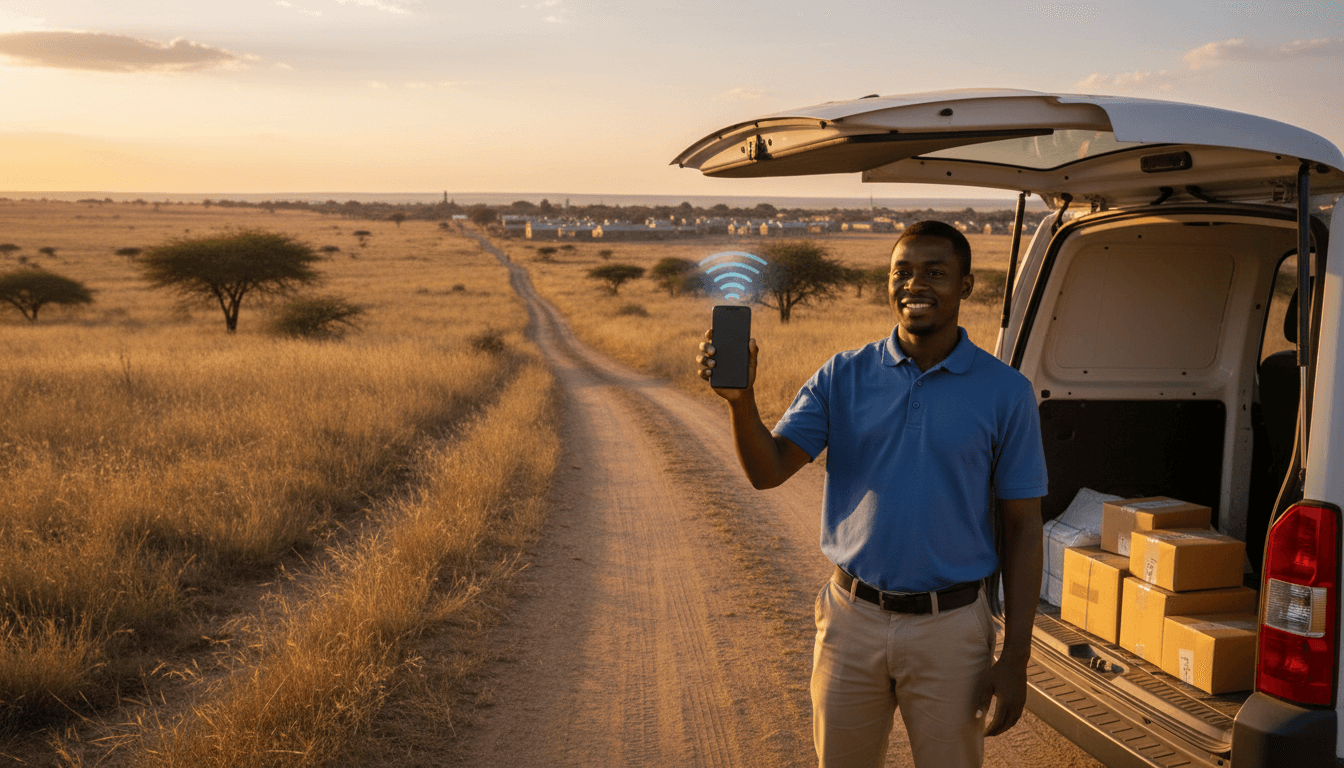
Starlink Direct-to-Cell: Fuel for SA AI Commerce
Airtel Africa’s plan to roll out Starlink direct-to-cell across 14 markets from 2026 sounds like a telecom story. It’s bigger than that. When a smartphone can pick up a satellite signal in places with no towers, it changes what “online” means for customers—and what’s realistic for AI-powered e-commerce and digital services in South Africa.
Most companies still treat connectivity as a background detail. But for AI products—recommendation engines, fraud models, customer-support bots, dynamic pricing, real-time delivery ETAs—connectivity is a feature. And in Southern Africa, connectivity isn’t evenly distributed: cities get the full buffet, while peri-urban areas, farms, mining regions, and long-haul routes often fall back to patchy coverage.
Direct-to-cell satellite connectivity won’t magically fix every constraint (data cost, device compatibility, regulation, and latency still matter). But it removes a brutal bottleneck: no signal at all. That’s the difference between “our AI can’t run here” and “our AI runs, just more efficiently in some places than others.”
What Airtel + Starlink direct-to-cell actually changes
Direct-to-cell means your regular phone connects to a satellite when there’s no terrestrial coverage—no dish, no special terminal. Airtel says the service will start in 2026 with text messaging and data for select applications, expanding as capabilities mature. They’ve also referenced next-generation satellites designed for much higher data speeds.
Here’s the practical shift for digital businesses: coverage gaps stop being hard stop points.
From “dead zones” to “low-bandwidth zones”
For e-commerce and digital services, there’s a big difference between:
- A customer who can’t load a product page at all
- A customer who can load a lightweight page and complete checkout
- A driver who can’t receive a delivery update
- A driver who can at least receive a route change and confirm delivery
Direct-to-cell turns many dead zones into usable zones. That doesn’t only help consumers—it helps the entire commerce chain: sales, support, payments, dispatch, last-mile proof-of-delivery, returns.
Reliability becomes part of the customer experience
If you’ve built AI into your customer journey, you already know this pain: AI is often blamed for what connectivity broke. The chatbot “ignored me.” The payment “failed.” The order “disappeared.”
When the network is more resilient, AI-driven experiences become more consistent—and consistency is what builds trust.
A simple rule: AI doesn’t win customers over by being clever. It wins by being dependable.
Why this matters specifically for AI-powered e-commerce in South Africa
South Africa has one of the most developed digital commerce ecosystems on the continent, but it still runs into a familiar constraint: the best AI features assume steady data access.
As direct-to-cell expands across Africa, South African retailers and digital providers can build for a wider reality: people who move between strong coverage and weak coverage during the same day—commuters, field workers, delivery drivers, informal traders.
AI personalisation works better when the loop is closed
Recommendation engines and personalisation need feedback signals: clicks, add-to-cart events, purchases, returns, delivery confirmations. In low-coverage areas, that feedback arrives late or not at all.
When connectivity becomes more available:
- Models learn faster (more complete events)
- Personalisation improves (less guesswork)
- Marketing automation gets cleaner attribution (fewer missing sessions)
That’s not theory—it’s mechanics. If the data pipeline is incomplete, the model’s output is weaker.
Support automation becomes viable outside metros
A lot of businesses deploy AI customer service where it’s easiest: stable internet users, app-first customers, high-value segments.
Direct-to-cell improves the case for:
- WhatsApp-first support in underserved regions
- AI-assisted agents who can handle spikes (Black Friday, festive season delivery issues)
- Order-status bots that reduce inbound contact volume
December is the stress test. Customers don’t care that your warehouse is slammed; they care that their parcel arrives before they travel. Better coverage means fewer “silent failures” where the customer can’t reach you, and your system can’t reach them.
The real opportunity: AI services built for “just enough internet”
Most companies get this wrong: they build AI experiences for perfect connectivity, then wonder why adoption stalls outside major centres.
There’s a better way to approach this—design AI systems that degrade gracefully. Direct-to-cell makes that approach far more practical.
Practical patterns to build now (before 2026)
You don’t need to wait for the rollout to benefit. Build products that assume connectivity will vary, and you’ll be ready the moment more coverage lands.
1) Offline-first customer journeys
- Cache catalog, prices, and store policies
- Save carts and forms locally
- Sync events when signal returns
2) Low-data UX by default
- Compress images and use adaptive loading
- Offer “lite mode” checkouts
- Use text-first order tracking
3) AI that runs on-device when possible On-device models can do helpful work without constant network access:
- Product search suggestions
- Language detection and translation hints
- Form auto-completion
- Basic troubleshooting steps
Then the cloud model can take over when bandwidth improves.
4) Event-driven backends, not always-on sessions Satellite links can be intermittent. Architect your system so it doesn’t require long, fragile sessions.
- Use idempotent APIs
- Queue events
- Retry safely
This is unglamorous engineering, but it’s the difference between “it works in the demo” and “it works on a dirt road outside town.”
What this means for last-mile delivery, returns, and trust
E-commerce growth in South Africa isn’t only about marketing and product range. It’s also about logistics trust: can you deliver, prove it, and resolve issues quickly?
Direct-to-cell connectivity helps in three concrete ways.
1) Better proof-of-delivery and fewer disputes
When drivers can reliably sync proof-of-delivery (signature, photo, GPS ping), it reduces:
- “I never received it” claims
- Refund delays
- Re-delivery costs
AI can then do what it’s good at: flag anomalies, detect repeat offenders, prioritise investigations.
2) Smarter routing where coverage used to break the model
Route optimisation models get weaker when live traffic, location updates, and scan events are missing.
Direct-to-cell won’t turn remote routes into urban fibre, but it can provide enough continuity for:
- Route changes to actually reach the driver
- Scans to sync before end-of-day
- Customers to receive reliable ETAs
3) Returns become less painful (and less expensive)
Returns are a margin killer. They’re also a customer loyalty maker.
AI can predict return risk and recommend interventions (better sizing guides, clearer product photos, proactive support). But operationally, you still need to coordinate pickups, labels, and status updates.
More consistent connectivity means fewer returns that turn into long email chains and call-centre escalations.
“People also ask” questions business leaders should be answering
To make this post useful for teams planning 2026+ roadmaps, here are the questions I’d want answered in any strategy session.
Will direct-to-cell replace terrestrial mobile networks?
No. Terrestrial networks will remain primary for speed, capacity, and cost in dense areas. Direct-to-cell is best seen as coverage extension and resilience, not a full replacement.
What kind of AI use cases benefit first?
The early winners are text-first, event-based, and operational:
- Order and delivery notifications
- Two-factor authentication and account recovery
- Basic customer support flows
- Field service workflows
- Inventory and dispatch confirmations
High-bandwidth AI experiences (video-heavy shopping, rich AR) will still prefer strong terrestrial networks.
Does this help payments and fraud prevention?
Yes—mainly by improving session reliability and verification flows.
Fraud models perform better when they receive complete signals (device, location consistency, transaction behaviour). Connectivity gaps create blind spots. Reducing those blind spots improves model accuracy and lowers false declines.
What to do next: a 90-day checklist for SA e-commerce teams
If your business sells online or runs a digital service in South Africa, here’s what I’d do over the next three months to prepare for a world where more people are reachable more often.
- Map your “connectivity pain points” across the customer journey (browse → checkout → payment → delivery → returns). Identify where failures cluster geographically.
- Instrument your funnel so you can separate UX issues from network drop-offs (client-side logging, retry events, offline queues).
- Build a low-data mode and make it the default for first-time visitors. Heavy experiences can be optional.
- Shift key workflows to messaging (order status, reschedules, support triage). Messaging tolerates low bandwidth better than app-only flows.
- Audit your AI dependencies: which features break without stable internet? Prioritise hybrid designs (on-device + cloud).
- Stress-test your festive peak plan: if you can handle December, you can handle the rest of the year.
The teams that win won’t be the ones with the fanciest AI. They’ll be the ones whose AI keeps working when conditions aren’t perfect.
Where this sits in the “AI powering e-commerce” story
This post fits a broader theme I keep seeing across South African digital commerce: AI adoption is no longer the hard part. Infrastructure reliability is.
Airtel’s Starlink direct-to-cell rollout across Africa is a signal (pun intended) that the connectivity floor is rising. That opens the door to AI-driven commerce experiences that don’t exclude customers because of where they live or travel.
If you’re planning your 2026 roadmap now, treat direct-to-cell as a prompt to widen your addressable market. Then build the operational muscle—data pipelines, low-bandwidth UX, resilient customer support—so your AI actually delivers on the promise.
What’s the first AI-powered customer experience you’d ship if you could assume every customer had some signal, even outside terrestrial coverage?