Smarter, greener networks are the foundation for AI-powered e-commerce in South Africa—improving reliability, lowering costs, and enabling scalable digital services.
Smarter Networks: The Quiet Engine Behind AI Commerce
Data traffic in South Africa is growing at roughly 20% per year, and that growth isn’t just driven by streaming video anymore. It’s driven by machines—product recommendation models, fraud detection, conversational commerce, real-time delivery routing, automated ad bidding, and customer-service bots that never sleep.
Here’s the part most e-commerce and digital service teams miss: your AI strategy is only as good as the network it runs on. When networks get expensive to operate, unstable under load, or overly dependent on diesel during power interruptions, every “AI-powered” promise starts to crack—checkout latency rises, support bots time out, and customer experience gets inconsistent.
That’s why Telkom’s push for smarter, more energy-efficient networks matters beyond telecom. It’s foundational infrastructure for scaling AI across e-commerce and digital platforms in South Africa—responsibly, affordably, and with fewer outages.
Why network efficiency is now an AI business problem
Answer first: AI increases network demand and compute intensity, so network efficiency directly affects digital service reliability and customer acquisition costs.
AI doesn’t just “use the internet.” It changes how your services behave on the network. Instead of a few big spikes (like a campaign launch), AI tends to create continuous, always-on demand:
- Personalisation engines call APIs constantly to refresh recommendations.
- Fraud systems score transactions in milliseconds.
- Search and merchandising models update rankings multiple times per day.
- Customer support shifts from email to chat, increasing real-time interactions.
When the underlying network costs rise, platforms get squeezed from both ends: you pay more for hosting and delivery, and customers become less tolerant of delays.
Telkom’s network footprint illustrates the scale: it operates national data centres and around 8,000 base stations, each drawing about 5 kW on average. That’s a lot of electricity—meaning a lot of operating cost and carbon exposure.
For e-commerce leaders, the practical takeaway is blunt: if networks don’t get more efficient, AI adoption gets more expensive. And in a market where price sensitivity is real, that cost pressure eventually shows up in customer pricing, churn, and reduced experimentation.
Telkom’s data-led sustainability strategy (and why digital teams should care)
Answer first: Telkom’s sustainability program is also a resiliency and cost-control program—exactly what AI-powered commerce needs to scale.
Telkom reports that since 2022, it has reduced combined Scope 1 and 2 carbon emissions from its network by 32% through multiple interventions. The company’s targets are carbon neutrality by 2035 and net-zero emissions by 2040.
Those numbers matter even if you’re not running a telco, because sustainability in network operations is tightly linked to:
- Lower and more predictable operating costs (less diesel, better energy management)
- More stable network availability (better backup strategies and smarter power use)
- More headroom for growth (capacity expansion without linear energy increases)
When a network becomes more efficient, it becomes easier to keep data affordable. And affordable data is still one of the strongest growth levers for online retail and digital services in South Africa.
Snippet-worthy truth: If your customers can’t afford reliable data, your “AI features” become a nice demo instead of a daily habit.
The hidden link between renewables and reliable customer experience
Answer first: Renewables aren’t only about emissions—they reduce downtime risk and stabilise service availability during grid disruptions.
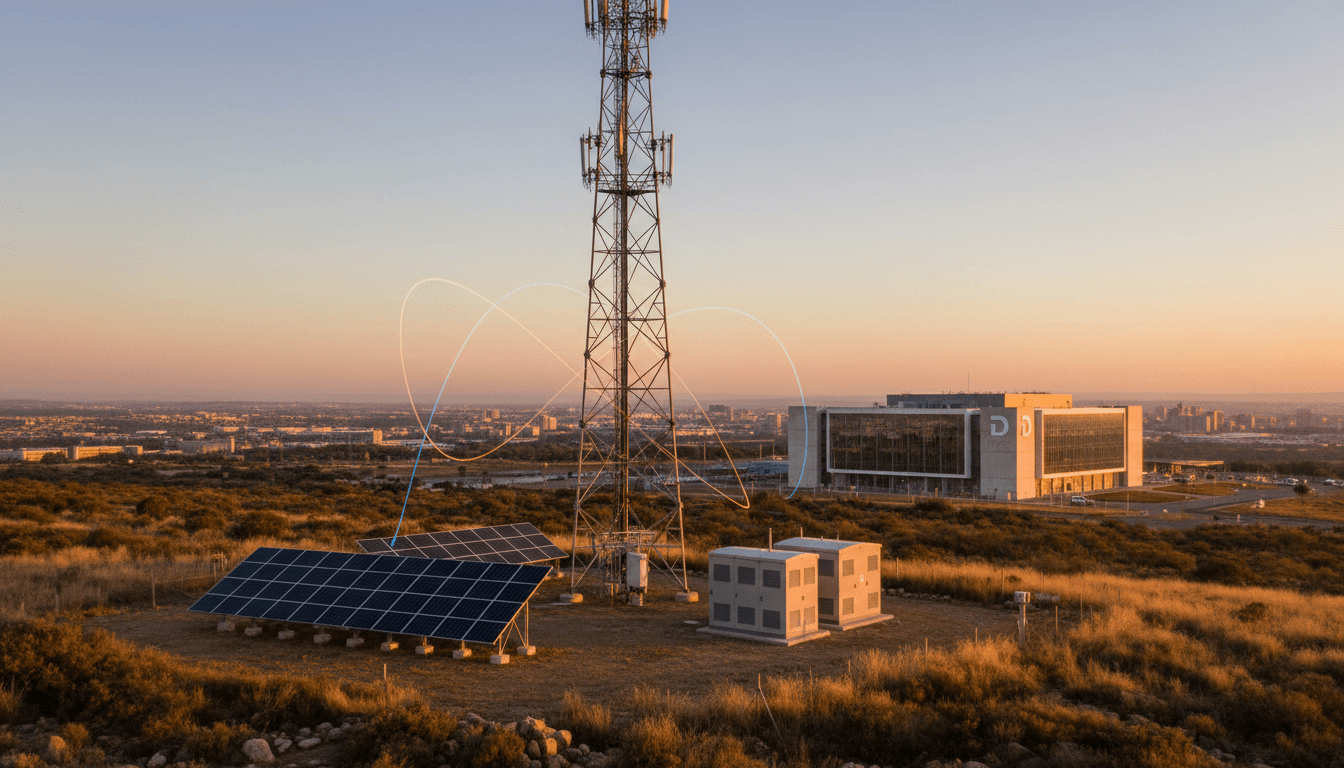
Telkom has increased renewables in its power mix, supported by a one-megawatt solar plant in Centurion that helps power a major data centre and reduces diesel usage.
The interesting part is why this is hard to replicate everywhere. Telkom doesn’t own most mast sites; it leases tower and ground space, and meaningful solar installations need physical footprint. So rollout becomes selective: focus first on places where grid power is unreliable and the business case is strongest.
For e-commerce operators, that’s a useful mental model. You don’t need to “go green everywhere” overnight. You start where the risk is highest and the payoff is immediate—then expand.
What “network renewables” mean for e-commerce and digital services
When a base station has solar support, it can reduce the gap during outages. Telkom highlights a practical sequence: during power failure, networks use batteries, but solar can help refill the gap and keep availability higher.
Translate that into customer experience terms:
- Fewer failed payments during peak shopping hours
- Fewer support escalations caused by timeouts
- More reliable location and delivery tracking
- Better continuity for conversational commerce (WhatsApp/chat)
AI doesn’t forgive instability. A recommendation model is useless if product pages stall. A customer-service bot can’t build trust if it disappears mid-conversation.
AI inside the network: how power savings become affordability
Answer first: Using AI to control radio power based on demand can cut energy consumption dramatically, lowering costs that ultimately influence data pricing.
Telkom’s Managing Executive for Mobile Networks, Lebo Masalesa, describes a shift from “always-on full power” to demand-based transmit power using AI tooling (deployed with Huawei).
The key idea is simple: base stations don’t need maximum transmit power all day. Many sites have two real peak periods in a 24-hour cycle. If the radio transmits at full power continuously, you waste energy when demand is low.
Masalesa notes that by dynamically adjusting power levels, some scenarios move from 100% power usage to less than 50%—without compromising the service people feel during peak times.
That’s not a nice-to-have. It’s the only sustainable way to handle data growth and AI-driven traffic without pricing people out.
Why this matters for AI-powered e-commerce
The campaign topic for this series is how AI is powering e-commerce and digital services in South Africa—content generation, marketing automation, customer engagement. Those AI capabilities increase:
- Content delivery (images, video, richer pages)
- Real-time interactions (chat, voice, live support)
- Back-end calls (inventory, pricing, recommendations)
A more efficient network makes it more realistic for brands to roll out AI features to all users, not just high-end devices on premium packages.
Opinion: The real “innovation” isn’t flashy AI demos. It’s making AI dependable and affordable for ordinary customers on ordinary connections.
What online retailers should do differently in 2026 planning
Answer first: Build your AI roadmap around reliability, data cost sensitivity, and network-aware product design—not just model performance.
South African e-commerce teams heading into 2026 planning cycles (and post-Black-Friday reality checks) should treat network conditions as a first-class constraint. I’ve found that teams that do this ship faster and get fewer nasty surprises at scale.
1) Design AI customer experiences for variable connectivity
If your AI features assume constant high bandwidth, you’ll lose customers outside ideal conditions.
Practical steps:
- Offer lite experiences: smaller images by default, progressive loading, offline-friendly carts.
- Keep AI chat interactions resilient: short responses, retry logic, graceful fallbacks to human support.
- Cache recommendations and content where possible so the experience doesn’t collapse when latency spikes.
2) Treat latency and timeouts as revenue KPIs
AI features create more API calls. More calls mean more chances to fail.
Track:
- Checkout latency (p95, not average)
- Payment success rate by time and region
- Chat completion rate (how often customers reach resolution)
- Recommendation service error rates during peaks
Then do something with the data—route traffic, degrade gracefully, and plan capacity before promotions.
3) Ask vendors hard questions about energy and efficiency
If your AI stack forces you into constant compute and constant network chatter, it will get expensive.
Questions worth asking:
- Can models run in smaller modes (distilled models, smaller embeddings)?
- Can inference be batched or cached?
- What’s the bandwidth impact of the “AI feature” in real usage?
The telco world is already proving that dynamic power control beats “full blast all the time.” Your AI architecture should follow the same logic.
4) Align AI growth with responsible digital expansion
Telkom’s approach makes a strong point: sustainability and universal access aren’t competing goals. They reinforce each other.
For retailers and platforms, “responsible AI growth” looks like:
- Avoiding wasteful heavy assets that punish users on limited data
- Building trust with reliable, consistent experiences
- Supporting broader access by keeping digital services efficient
If you care about expanding your market beyond the usual metro early adopters, this isn’t philosophy—it’s strategy.
People also ask: does greener infrastructure really help AI adoption?
Answer first: Yes—because greener infrastructure typically reduces reliance on diesel backups, improves uptime, and lowers operating costs that influence data pricing.
“Greener” can sound like a branding exercise. In networks, it’s operational.
- Renewables reduce diesel dependency and logistics risk.
- Smarter energy management reduces costs per gigabyte.
- More stable networks make AI-driven services usable at scale.
AI adoption grows when customers can use services confidently, not when brands publish AI press releases.
Where this is heading for South Africa’s digital economy
Telkom’s progress—32% Scope 1 and 2 reduction since 2022, renewables expansion, and AI-based energy optimisation—signals a broader shift: networks are becoming adaptive systems rather than static infrastructure.
That shift is exactly what AI-powered e-commerce needs. As you roll out personalisation, automation, and always-on customer engagement, you’re increasing dependency on reliable connectivity. Smarter networks reduce the cost and carbon intensity of that dependency.
If you’re building AI into your customer journey, here’s the question I’d keep on the table for 2026: Are your AI experiences designed for the South Africa your customers live in—power constraints, data costs, and all—or only for ideal lab conditions?