Embedded eSIMs show how apps can sell connectivity as a built-in service. Learn what South African e-commerce can copy using AI and smart partnerships.
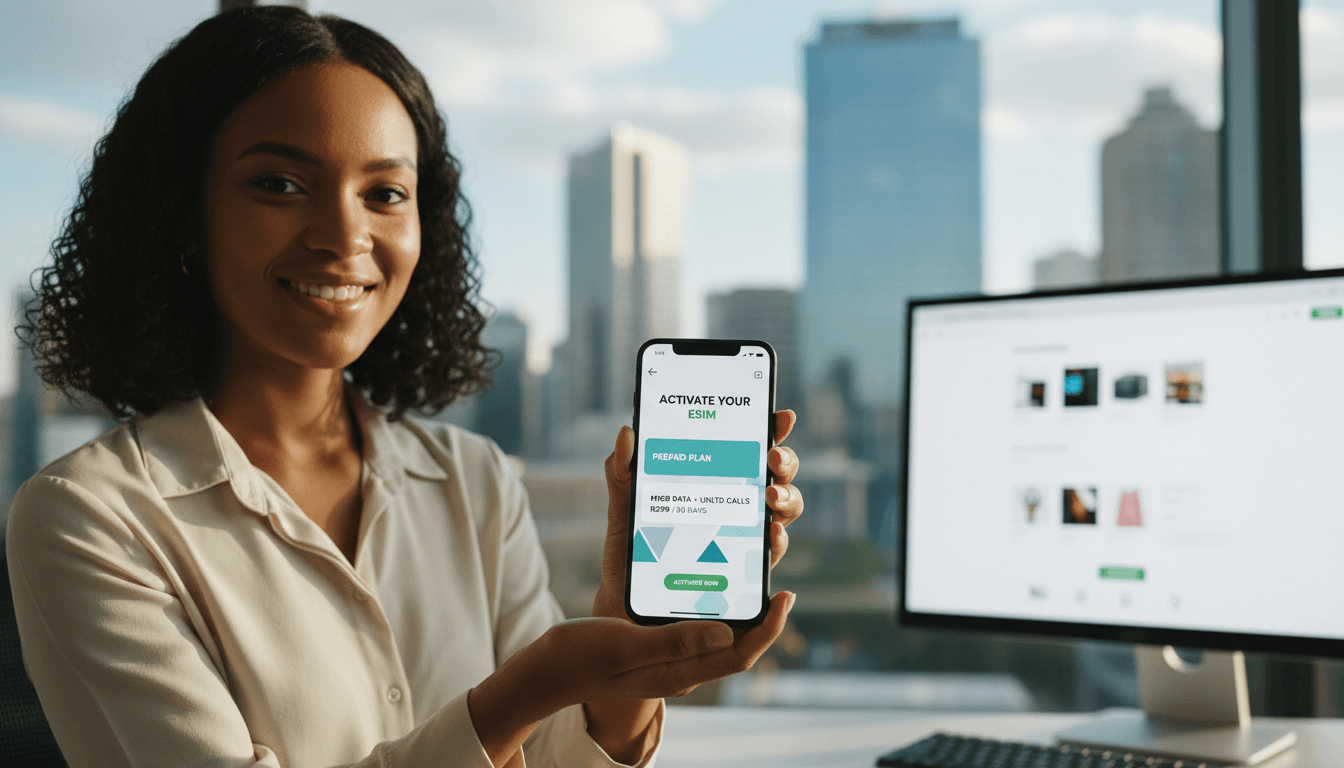
Embedded eSIMs: The Next Digital Upsell for SA
A banking app selling mobile plans sounds like a distraction—until you look at the numbers behind modern “super apps”. Revolut now offers bundled mobile plans in Poland via 1GLOBAL’s embedded eSIM stack, starting at zł 25/month (about €6) with unlimited calls and texts across Poland and the EU. That price point is attention-grabbing, but the real story is the product design: connectivity is becoming a native feature inside digital platforms, not a separate purchase.
For South African e-commerce and digital service teams, this matters because embedded services are the most reliable way to increase customer lifetime value without drowning users in more marketing. I’ve found that the companies that win in 2026 won’t be the ones shouting the loudest—they’ll be the ones that make the next purchase feel like a single tap.
This post is part of our “How AI Is Powering E-commerce and Digital Services in South Africa” series, and we’re using the Revolut–1GLOBAL move as a practical example of a broader trend: AI + API integration is turning apps into marketplaces for adjacent services—connectivity included.
What Revolut and 1GLOBAL actually built (and why it works)
Revolut didn’t “become a telco” in the old-school sense. It embedded a telco capability—eSIM provisioning and mobile plan management—inside an app people already trust for money.
That distinction is everything.
With 1GLOBAL’s proprietary API integration, Revolut can offer white-label mobile plans that feel like a Revolut product from the first tap to the ongoing billing experience. Users don’t need to visit a mobile network store, fill in forms, or wait for SIM delivery. eSIM turns “mobile plan purchase” into a software flow.
The product mechanics: one app, one identity, one checkout
Embedded telco works because it collapses friction:
- Existing identity and KYC: The customer is already verified in the fintech app.
- Fewer steps to activation: eSIM provisioning can be near-instant once approved.
- Unified billing and support: One place to view transactions, subscriptions, and usage.
Connectivity is the ultimate “always-on” utility—when it lives inside your primary app, it becomes a retention engine, not just a line item.
The business mechanics: more engagement, more surfaces for cross-sell
1GLOBAL positions this model as part of an “embedded telco services strategy” used by thousands of partners across fintech, travel, and hospitality. The reason is simple: if a platform can add a recurring subscription that’s genuinely useful, it creates:
- Higher customer engagement (more app opens per month)
- More predictable revenue (subscription-style, not once-off)
- More cross-sell moments (insurance, travel, credit, devices, delivery memberships)
For South African digital businesses, that blueprint is highly portable—especially as consumers consolidate spending into fewer trusted apps.
The South African angle: embedded services are the new e-commerce growth hack
South African e-commerce is getting tougher: paid social is noisy, delivery expectations are higher, and consumers are price-sensitive. That’s why AI-powered e-commerce strategies are shifting from “more ads” to “more value per customer”. Embedded services do exactly that.
Here’s the stance: most e-commerce brands in South Africa are under-monetising trust. They have customers, data, and permission to communicate—but they only sell products. Meanwhile, the next wave of growth is selling outcomes and utilities.
Why connectivity belongs in the conversation
If you run an online retail or digital services business, connectivity affects your customer experience more than you think:
- Customers drop off at checkout because of network interruptions.
- Delivery updates, OTPs, and support depend on reliable messaging.
- Cross-border shoppers and travellers care about roaming costs and setup hassle.
A connectivity add-on (or partner offering) can sit naturally alongside:
- device sales (phones, wearables)
- travel products
- delivery subscriptions
- financial services (buy-now-pay-later, wallet, rewards)
The Revolut example proves that if the flow is simple enough, customers won’t see it as “scope creep”. They’ll see it as convenience.
Where AI fits: embedded telco is an AI distribution problem
People often talk about AI in e-commerce as if it’s only for chatbots and product recommendations. The bigger opportunity is AI-orchestrated service bundling—deciding what to offer, to whom, when, and at what price.
If you want embedded services to drive leads and revenue (not clutter), AI helps you avoid the most common failure: offering the right product to the wrong user at the wrong time.
1) AI-driven targeting: who should see a mobile plan offer?
For a South African e-commerce platform, a basic rules engine is a start. But AI takes you further by predicting propensity:
- customers who frequently buy data-heavy products (streaming devices, tablets)
- customers with high travel intent (passport accessories, luggage, forex purchases)
- customers with repeated OTP failures or checkout drop-offs (possible connectivity pain)
A practical approach is a propensity model that outputs a simple score, like P(mobile_plan_purchase_30d). Your marketing automation then uses that score to:
- trigger an in-app offer
- personalise the bundle (data-first vs voice-first)
- throttle frequency so it doesn’t feel spammy
2) AI-assisted pricing and bundling (without getting weird)
Dynamic pricing can backfire if it feels unfair. A safer play is AI-guided bundling, where price stays transparent but the package adapts.
Examples that work in retail:
- “Add a travel eSIM for your December trip” bundle at checkout
- “Family add-on line” prompts for household shoppers
- “Wearable connectivity” upsell for smartwatch buyers
The goal isn’t to be clever; it’s to be relevant.
3) AI for customer support: connectivity creates new questions
If you embed a service like mobile plans, your support volume changes. AI can absorb the repetitive load:
- activation steps
- eSIM compatibility checks
- usage explanations
- roaming settings
The best pattern I’ve seen is a tiered system:
- Self-serve help (guided flows)
- AI support agent for common issues
- Human escalation for billing disputes or complex device problems
That’s how you add a new product line without doubling your support team.
Lessons from Poland: how to design embedded services that actually convert
Revolut’s rollout highlights a few product truths that South African teams can adopt immediately.
Make the offer concrete (price, inclusions, and activation time)
Poland’s offer is easy to evaluate: starting price, unlimited calls/texts, and straightforward coverage. If you want conversion, avoid vague claims.
A good embedded offer answers, in plain language:
- What do I pay each month?
- What do I get (data, calls, texts, roaming)?
- How fast does it activate?
- What happens if I cancel?
Avoid hidden fees and “gotcha” terms
Revolut’s telco GM explicitly calls out “no hassle or hidden fees.” That line is doing heavy lifting, because telecom has a trust problem.
For South African brands, this is non-negotiable: if the first bill surprises customers, your core brand takes the hit—not the partner.
Build for devices and wearables, not just phones
The release mentions “future-proof setup for devices and wearables.” That’s a quiet signal: embedded connectivity is moving into watches, trackers, and even asset monitoring.
If you’re in South African retail, that suggests new bundles:
- smartwatch + connectivity subscription
- kid-safe wearables + parent app
- SME delivery fleet tracking + data plan
Those bundles generate leads because they solve a real problem with a recurring service.
A practical playbook for South African e-commerce teams
You don’t need to become a telco to copy the strategy. You need the right partner, the right UX, and a disciplined operating model.
Step 1: Choose an embedded service that matches your customer’s “next job”
Connectivity is one option. Others include insurance, warranties, identity protection, returns memberships, or financing.
A simple test: Will the customer use it weekly? If yes, it can drive retention.
Step 2: Treat API integration like product design, not an IT task
Embedded services succeed when:
- the offer appears at the right moment (checkout, onboarding, travel purchase)
- the flow takes fewer than ~60 seconds
- billing and cancellation are one tap
If your integration produces a clunky redirect or a separate login, conversion drops.
Step 3: Put AI guardrails on acquisition and messaging
Use AI to:
- cap offer frequency
- suppress offers to unhappy customers (recent refund, poor NPS)
- personalise by intent (traveller vs family vs device buyer)
This is how AI-powered digital services feel helpful rather than pushy.
Step 4: Measure the metrics that matter
If you’re doing this for leads and revenue, track:
- attach rate (% of customers adding the service)
- activation completion rate
- churn at 30/90 days
- support contacts per 1,000 subscribers
- uplift in repeat purchases among subscribers
A useful benchmark mindset: if an embedded service increases repeat purchase rate even modestly, the downstream margin impact can beat most paid acquisition.
What this means for 2026: the “super app” is really a smart bundle
Revolut’s partnership with 1GLOBAL is a clean example of where digital services are heading: apps that already own trust will keep adding utilities that reduce friction and increase stickiness. South African e-commerce will follow the same path, because the economics are too good to ignore.
If you’re building in this market, the question isn’t whether you should add more services—it’s whether you can do it without adding complexity. That’s where AI earns its keep: better targeting, better support, better timing.
If you’re planning your 2026 roadmap, pick one embedded service (connectivity is a strong candidate), design the one-tap experience, and use AI to keep it relevant. What would your store look like if every second purchase also strengthened retention?