AI logistics is making SA e-commerce deliveries more predictable. Learn how pickup points, local data and smarter messaging cut failed drops and support load.
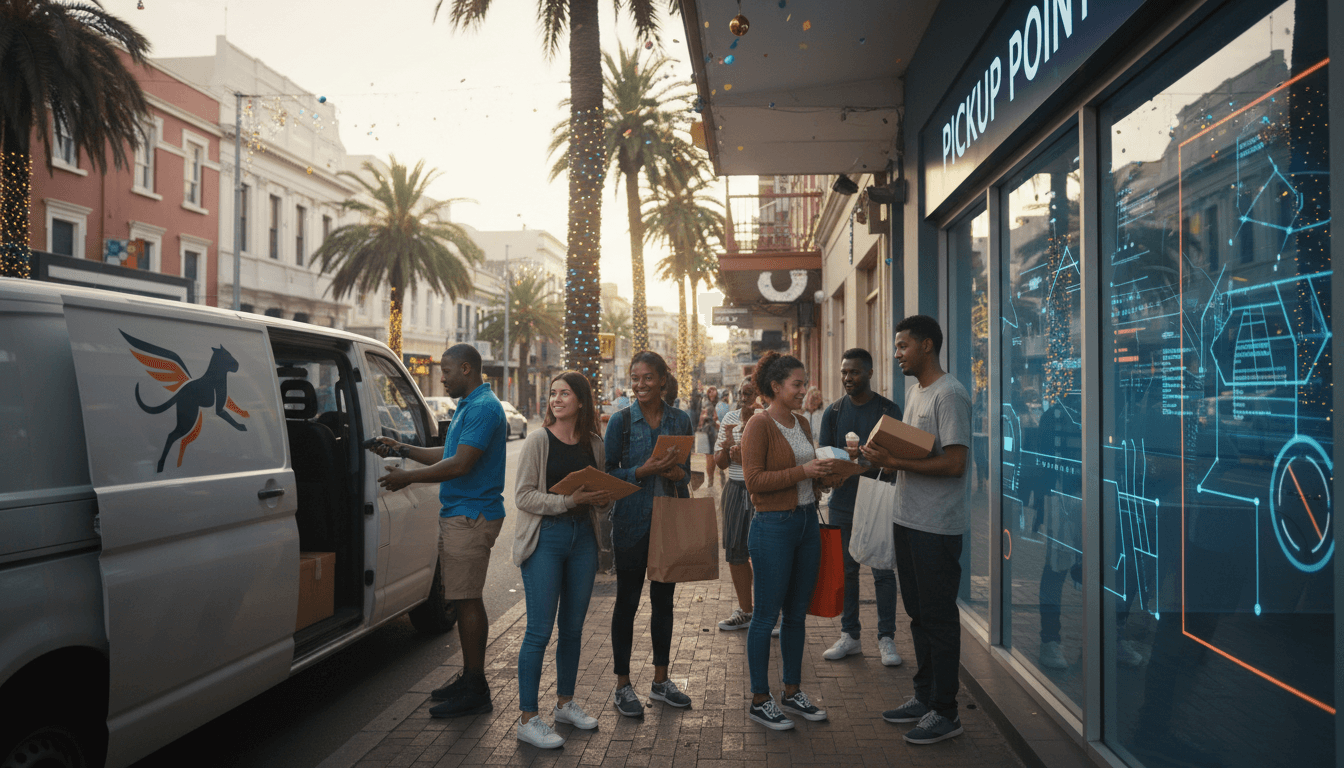
AI Delivery Fixes for SA E-commerce (No More Missed Parcels)
Roughly 1 in 4 last-mile deliveries can fail in South Africa when drivers are sent to vague directions, locked gates, or customers who simply aren’t home. That failure rate isn’t just annoying — it’s expensive. Every re-attempt burns fuel, time, support costs, and customer trust.
December makes this pain louder. More online orders, more “out for delivery” notifications, more missed handovers — and a spike in “Where’s my parcel?” messages hitting call centres and WhatsApp lines. The fix isn’t a bigger fleet. It’s smarter fulfilment.
In this edition of our series “How AI Is Powering E-commerce and Digital Services in South Africa,” I’m taking a clear stance: the winners in SA e-commerce won’t be the brands that ship fastest; they’ll be the brands that deliver most predictably. Pickup networks like Pargo, township-first operators like Delivery Ka Speed (DKS), and AI-assisted platforms like Wise Move show what predictable delivery actually looks like when you combine local reality with software — and, increasingly, AI.
The real last-mile problem: addresses aren’t the system
South Africa’s delivery bottleneck isn’t demand — it’s location certainty. Many customers don’t have formal addresses, and even where addresses exist, they’re not always easy to use for routing and verification. A driver who gets directions like “the white house behind the big tree” isn’t dealing with a “logistics problem” as much as a data problem.
That’s why last-mile delivery is often the most expensive leg of the supply chain. A courier can load 100 parcels, but if each parcel requires a different stop — and 20% to 30% fail — the economics collapse quickly. Re-deliveries stack up. Support tickets multiply. Refunds and replacements rise. Then brands start charging more for delivery, which pushes e-commerce further out of reach for township and rural customers.
Here’s the blunt truth: if your checkout assumes every buyer has a precise, mappable address and will be available 9–5, you’re designing for a minority of South Africans.
What “AI in logistics” really means in SA
When people hear AI logistics, they often picture self-driving vans. In South Africa, the practical AI wins are more basic — and more profitable:
- Address intelligence: normalising messy address inputs, detecting duplicates, flagging missing fields, and predicting “likely locations” from partial info.
- Delivery probability scoring: estimating whether a door delivery will succeed (based on past success, time-of-day patterns, building type, and customer responses).
- Dynamic routing: routing that updates based on risk, traffic, and success likelihood — not just distance.
- Proactive customer messaging: automated WhatsApp/SMS flows that reduce failed handovers and reduce support load.
The thread tying these together is simple: AI reduces uncertainty.
Pickup points: the simplest way to eliminate failed deliveries
Pickup points work because they convert 100 uncertain doorstops into a smaller number of high-certainty drops. Pargo’s model is a good example: a network of 4,500+ pickup points across Southern Africa, partnered with retailers ranging from large chains to smaller local stores.
Instead of one parcel per address, drivers drop multiple parcels at a single pickup location — with near-zero “customer not home” failures. That immediately improves unit economics.
But the part many businesses miss: pickup points only scale when the software is strong. Pargo runs a platform built in-house on AWS, with API integrations into e-commerce checkouts, courier systems, and logistics providers. Store staff can scan parcels in and out, and consumers get track-and-trace updates via WhatsApp or SMS.
Where AI strengthens pickup networks
Pickup points already reduce cost. AI pushes the model further by improving matching, forecasting, and experience:
-
Pickup point recommendation at checkout
- AI can rank pickup points based on true convenience: operating hours, distance, typical queue times, safety signals, and past customer choices.
-
Demand forecasting and capacity planning
- Predict weekly parcel volume per pickup point (especially during festive peaks), then rebalance line-hauls and staffing.
-
Exception prediction
- Flag parcels likely to miss SLA (weather, holiday closures, carrier congestion) so the customer is informed early.
-
Customer comms that actually reduce WISMO
- “Where is my order?” contacts are a silent tax. AI-driven message timing and content can cut WISMO by sending the right update before the customer asks.
A line I keep coming back to: your delivery network is only as good as your exception handling. AI helps you spot exceptions early and handle them cheaply.
Township logistics: why local knowledge is a competitive advantage
Townships and outlying areas aren’t ‘hard to deliver to’ — they’re under-modelled. Many courier playbooks assume a well-mapped environment with predictable address formats and low security risk. When those assumptions break, companies respond with surcharges.
DKS is interesting because it didn’t start as “a logistics company.” It began in 2021 as a township-based food delivery service on bicycles, validating demand quickly (including a reported R1 million in six months via a community WhatsApp ordering model). It then expanded, raised funding, built an app, and later pivoted into broader logistics after corporates repeatedly asked for help getting products into townships reliably.
DKS now operates with five warehouses in three provinces and 150 drivers, and delivery volumes have reportedly increased tenfold. That growth is operational — but the real moat is informational.
Because route optimisation tools struggle in areas that aren’t properly mapped, DKS had to do the unglamorous work: calling customers, getting directions, and plotting locations over time. It also hired locally, which improves navigation and reduces crime risk while creating jobs.
How AI can support township-first delivery (without pretending data is perfect)
AI doesn’t replace community knowledge here — it captures and compounds it.
-
Address clustering and “landmark maps” Train models that recognise recurring landmarks and community naming conventions, then standardise them into consistent delivery zones.
-
Driver-assisted data capture Mobile workflows that let drivers confirm a drop with structured inputs: landmark tags, geolocation, photo proof, and safe notes. AI then turns that into reusable location intelligence.
-
Risk-aware routing Routing that accounts for time-of-day safety patterns and known hotspots, not just shortest distance.
-
Delivery slot prediction Predict the best delivery windows per area based on historical success (for example, after-school vs mid-morning), then offer those slots at checkout.
This is the practical bridge between AI in e-commerce and real-world inclusion: AI can make township deliveries cheaper without pushing cost back onto the customer.
Customer experience is now a logistics feature
Most delivery anxiety is an information gap. Customers don’t panic because a parcel is late; they panic because the messaging is vague. “Out for delivery” with a 9am–5pm window is basically telling someone to put their whole day on hold.
Pargo’s approach — managing consumer communication through WhatsApp/SMS — points to the real shift: logistics companies are becoming customer experience platforms.
What to automate (and what not to)
Here’s what works when you’re building AI-enabled delivery communications:
- Automate predictable updates: collection ready, reminder after 24 hours, final notice before return-to-sender.
- Automate intent capture: “Can’t collect today” → suggest alternate pickup point or extend hold time.
- Don’t automate edge-case empathy: theft, loss, damaged parcels, medical deliveries, or high-value items need a human escalation path.
A good rule: use AI to reduce friction, not to dodge responsibility.
Wise Move: a clear example of AI that saves time immediately
Wise Move operates in a different lane (moving and removals), but the AI lesson is directly relevant to e-commerce: remove form-filling friction and quoting delays.
Wise Move integrated the ChatGPT API so users can upload a photo of a handwritten list and have the system populate an inventory automatically. That takes a 30–60 minute task and turns it into seconds.
It also uses data from 30,000+ home moves in South Africa to help carriers price better and offer instant quotes.
What e-commerce teams should copy from this
- Use AI where the customer feels time pain. Checkout, tracking, returns, and support are the obvious candidates.
- Use your own data to improve quotes and promises. “Delivery in 2–5 days” is lazy. Use historical lanes, seasonal spikes, and area-based success rates to provide a delivery promise you can keep.
- Focus on the core problem. Wise Move’s founder put it well: if you build tech for the sake of tech, you’ll get distracted. I’ve seen this firsthand — teams ship fancy dashboards while customers still can’t get a parcel delivered.
A practical playbook: making your delivery operation AI-ready
You don’t need a moonshot to get value from AI in logistics — you need clean events, good feedback loops, and clear metrics. If you run an online store, marketplace, or digital service in South Africa, these are the steps that pay off fastest.
1) Measure the metrics that actually drive profit
Track these weekly, by area and carrier:
- First-attempt delivery success rate (this is the headline KPI)
- WISMO rate (tracking/support contacts per 100 orders)
- Address exception rate (missing/invalid/ambiguous addresses)
- Cost per successful delivery (not cost per shipment)
- Return-to-sender rate
2) Add a “delivery confidence layer” to checkout
Before AI, start with rules. Then graduate to models.
- Offer pickup points by default in high-failure zones.
- Flag addresses with missing unit numbers, informal descriptions, or mismatched suburb/postal codes.
- Let customers choose messaging channels (WhatsApp usually wins in SA).
3) Treat messaging as part of fulfilment
If you can reduce failed deliveries by even 5–10%, you’ll feel it immediately in margins and reviews.
- Send precise milestones (not generic statuses).
- Provide action buttons: reschedule, change pickup point, share pin, confirm availability.
- Use AI to time messages when customers are most likely to respond.
4) Build feedback loops from drivers and pickup points
Every successful delivery should make the next one easier.
- Capture structured notes, locations, and exceptions.
- Use AI to turn free-text driver notes into standard categories.
- Feed results back into your routing and address validation.
The direction SA e-commerce is heading in
Reliable delivery in South Africa won’t come from pretending every address is formal and every customer is available during business hours. It will come from networks (pickup points), local intelligence (township-first operators), and AI systems that reduce uncertainty across routing, addresses, and customer communication.
If you’re building or scaling an e-commerce operation or digital service, here’s the north star: make delivery predictable, then make it cheap. Trying to do it the other way around usually breaks.
If you had to choose one place to start in 2025, I’d start with this: use AI to improve first-attempt success — because every other metric (cost, reviews, repeat purchases, support load) improves when the first attempt works. What would your business look like if “out for delivery” stopped being a moment of stress and became a promise customers actually believe?