AI-powered delivery in South Africa reduces failed drops, support load, and churn. See how pickup points, local mapping, and automation improve e-commerce.
AI-Powered Delivery Fixes for SA E-commerce
Late November and December are when South African e-commerce teams learn the hard truth: “out for delivery” doesn’t mean “delivered.” It often means a customer is stuck at home all day, a driver is hunting for a “white house behind the big tree,” and your support inbox is about to catch fire.
That delivery chaos isn’t just annoying. It’s a growth ceiling. When delivery fails, customer trust drops, acquisition costs rise, refunds climb, and repeat purchases tank. In this post (part of our How AI Is Powering E-commerce and Digital Services in South Africa series), I’m going to connect the dots between what’s happening on the ground in logistics and what smart e-commerce brands are doing about it: combining pickup networks, local delivery knowledge, and AI automation to make delivery predictable.
Failed deliveries are a customer experience problem first
The key point: last-mile failure is usually a data problem, not a “lazy courier” problem.
South Africa has a real-world constraint that many global e-commerce playbooks ignore: a meaningful share of customers don’t have formal, easily geocoded addresses. Even where addresses exist, they’re often incomplete, inconsistent, or hard to find in dense areas. The result is predictable: more missed drops, more re-deliveries, and higher unit costs.
Pargo’s CEO Lars Veul points to an uncomfortable number that many operations people already feel in their bones: on traditional home delivery routes, 20%–30% of deliveries can be unsuccessful. Each failure triggers a chain reaction:
- The courier pays twice (or more) for fuel and driver time
- The retailer pays in support tickets, reships, or refunds
- The customer pays in time, frustration, and lost trust
Here’s what I’ve found in practice: if you’re measuring only delivery cost per parcel and not cost per successful delivery, you’re undercounting the problem.
What customers actually want in December
During peak season (right now), customers don’t primarily want “fast.” They want certain:
- A reliable ETA window that isn’t “9 to 5”
- A delivery option that fits their day
- Updates that reduce anxiety (and stop them contacting support)
That’s where AI-powered e-commerce and digital services start to matter—not as hype, but as a way to make logistics feel predictable.
Pickup points beat “door delivery” when addresses are messy
The key point: consolidation wins—dropping multiple parcels at one pickup point is cheaper and more reliable than chasing individual doors.
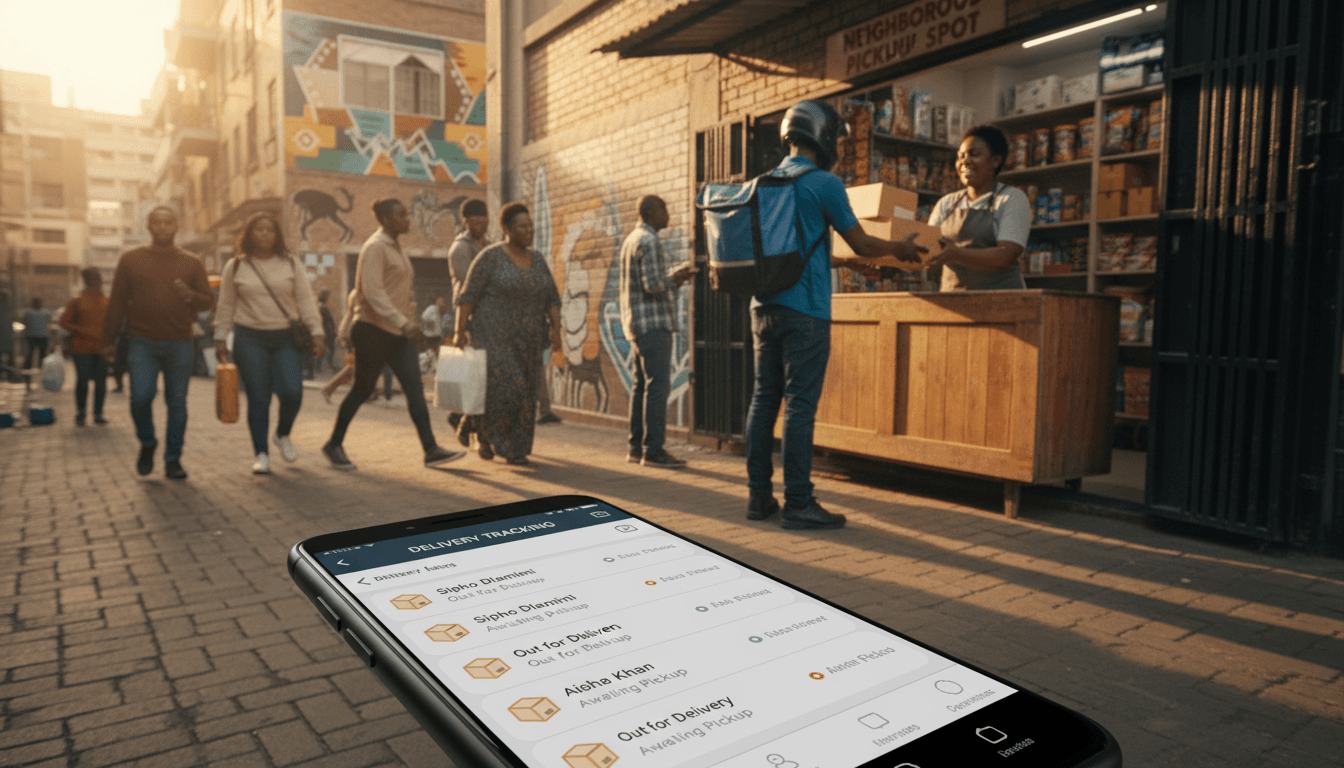
Pargo’s model is simple and effective: build a network of pickup points by partnering with existing stores—big chains like Clicks and smaller local shops, including spaza shops. With 4,500+ pickup points across Southern Africa, the pickup point becomes a mini logistics hub.
Operationally, this changes the last-mile math:
- Home delivery: a driver may need to visit ~100 addresses for 100 parcels
- Pickup delivery: a driver can visit ~25 addresses and drop 4–5 parcels per stop
That’s not a small improvement. It’s the difference between a last mile that bleeds cash and a last mile that scales.
Where the “AI” fits in pickup networks
A pickup point network succeeds or fails on coordination. That coordination is increasingly software-led:
- API integrations at checkout so the pickup option is a first-class choice, not an afterthought
- Automated customer notifications (WhatsApp/SMS) to reduce “where is my order?” queries
- Scan-and-handover workflows that tighten chain-of-custody and reduce shrinkage claims
Pargo’s platform approach—built in-house on cloud infrastructure—highlights the pattern: logistics businesses that look “physical” on the surface are often software companies with a delivery layer.
If you’re an online retailer, the takeaway is practical: the best delivery improvement might not be a new courier contract. It might be adding a pickup point option and automating the comms.
Township and rural delivery needs local trust—and better data
The key point: you can’t optimize routes you can’t map, and you can’t serve communities you don’t understand.
Delivery Ka Speed (DKS) is a clean example of what it takes to deliver where the normal playbook breaks. It started as a township-focused food delivery service during the pandemic and proved demand quickly—reportedly hitting R1 million in six months via a community WhatsApp ordering model. Then the business pivoted into logistics after corporates kept asking for help delivering successfully into townships.
DKS scaled hard: five warehouses in three provinces, about 150 drivers, and 10x volume growth.
But the real insight is how they made delivery work: by doing the unglamorous data work.
Why classic route optimization fails in under-mapped areas
Route optimization tools assume you have:
- clean address data
- reliable map coverage
- consistent points of interest
- predictable road access
When those assumptions don’t hold, “optimization” can become noise. DKS responded in the most effective way possible: they phoned customers for directions, plotted locations, and grew their own operational map over time.
That creates the foundation for AI later. AI doesn’t magically solve poor inputs—it amplifies what you feed it.
Local hiring is a delivery strategy, not just a social good
DKS also hired locally, and that’s not sentimental—it’s operationally smart.
- Local drivers know informal landmarks and community routing
- Local presence reduces the risk profile and improves cooperation
- Local jobs build legitimacy, which improves delivery success rates
If you’re building AI-powered logistics in South Africa, local context isn’t optional. It’s the dataset.
AI in digital services: fewer forms, faster quotes, higher conversion
The key point: AI improves delivery outcomes by removing friction before a vehicle even moves.
Not every “delivery” business is parcel logistics. Wise Move operates in the moving and removals space—still last-mile, still trust-heavy, still operationally complex. Their insight: people choose movers the way they choose doctors—through recommendations, reputation, and a clear sense of price.
Wise Move pulled the process into a single platform and then used AI where it counts: at the point where humans waste time.
A practical AI use case: turning photos into inventory lists
Wise Move integrated the ChatGPT API so users can upload a photo of a handwritten list and automatically populate an inventory. That collapses a painful step:
- Before: 30–60 minutes completing itemized forms
- With AI: seconds to create a usable inventory
That’s not “cool tech.” That’s conversion.
If you run an e-commerce store selling bulky goods (furniture, appliances, gym equipment), this idea translates well: let customers snap a photo of what they’re returning, exchanging, or bundling—then use AI to structure it into data your ops team can act on.
AI quoting: where margin and trust meet
Wise Move also uses data from 30,000+ home moves to predict better pricing and offer instant quote options to carriers.
This is what mature AI in commerce looks like:
- learn from historical transactions
- predict a fair price band
- reduce manual review time
- speed up response time (which directly increases close rate)
For e-commerce, the parallel is shipping cost estimation, delivery promise accuracy, and fraud-aware refund automation.
What to implement next: an AI + logistics playbook for SA retailers
The key point: AI should reduce delivery failures, support load, and “silent churn.”
Here’s a practical rollout plan you can apply without rebuilding your entire supply chain.
1) Fix address capture at checkout (before AI)
Bad inputs cause bad outcomes. Start with:
- Address autocomplete plus map pin-drop confirmation
- A required “delivery instructions” field with examples (landmarks, gate codes)
- Validation rules for suburb/postal code mismatches
2) Add delivery choice, not delivery hope
Offer at least two paths:
- home delivery for formal-address customers
- pickup points for customers who prefer convenience or have tricky locations
Choice reduces failed deliveries because customers self-select the option that fits their reality.
3) Automate customer comms where anxiety spikes
Use WhatsApp/SMS updates for:
- parcel received at hub
- parcel dispatched
- parcel ready for pickup
- pickup reminder after 24–48 hours
This is one of the fastest ways to cut support tickets. If you’re serious about AI-powered customer engagement, start here.
4) Apply AI where humans are slow
High-ROI automations in South African e-commerce logistics:
- extracting structured data from photos (IDs, invoices, handwritten notes)
- summarizing support chats into courier action items
- predicting delivery risk (based on area, prior failures, time-of-day)
- dynamic delivery promises (more honest ETAs = fewer angry customers)
5) Build a feedback loop you can measure
Track these metrics weekly:
- first-attempt success rate (by suburb/zone)
- cost per successful delivery (not cost per parcel)
- WISMO rate (“where is my order?” contacts per 1,000 orders)
- pickup adoption rate
If those four move in the right direction, your AI and logistics work is paying off.
Delivery reliability is the real growth hack
Most e-commerce teams treat delivery as an ops problem they outsource. I think that’s a mistake. In South Africa, delivery is part of your product—especially in December, when one failed parcel can erase a year of trust.
The strongest pattern across Pargo, DKS, and Wise Move is also the simplest: solve the core problem, then add technology that makes the solution scale. Pickup networks reduce failure. Community-based delivery builds local accuracy and trust. AI removes friction from forms, quoting, and customer communication.
If you’re working on AI-powered e-commerce and digital services in South Africa, your next win probably isn’t a flashy model. It’s a tighter loop between customer intent, accurate location data, proactive messaging, and delivery options that match how people actually live.
So here’s the question to plan your 2026 roadmap: where do customers lose confidence in your delivery journey—and what would happen to your revenue if that moment became boringly reliable?