UK startup marketing lessons from Olly’s olives: find a niche gap, validate fast, productise the offer, and scale via partnerships and systems.
From Side Hustle to Shelf: UK Startup Marketing Lessons
Most founders don’t fail because the product is terrible. They fail because they never find a real market gap, they don’t test it cheaply, or they can’t turn early buzz into repeatable distribution.
Olly Hiscocks did the opposite—starting in a GP surgery by day and marinading olives by night, then turning a niche obsession into a scalable FMCG brand. If you’re building a one-person business in the UK (or trying to grow past “just me”), his story is a clean case study in UK solopreneur business growth: validate offline, brand online, systemise fulfilment, and use credibility to win listings.
This post breaks down what’s actually worth copying—especially if your goal is leads: for your product, your newsletter, your consultancy, or your next funding conversation.
Spotting a market gap (and proving it’s real)
The simplest form of startup marketing is this: name a problem that customers already feel, then show a believable fix. Olly’s observation wasn’t abstract. It was specific: UK shelves had olives, but not exciting, flavour-led, brand-forward olives.
That matters because “the UK market is underrepresented” is still just a hunch until you can answer two questions:
- Is the gap visible in buying behaviour? (People are already buying the category.)
- Is the gap emotional? (People care enough to switch, pay more, or talk about it.)
A practical way to validate your niche in the UK
If you’re building a niche product or service, do what Olly did at markets—just translate it into a repeatable checklist:
- Shelf audit (30 minutes): visit 3 retailers (e.g., Tesco Express, Sainsbury’s Local, Waitrose). Photograph the category. Note price points, flavours, pack formats, and how many brands have a clear personality.
- Customer language capture (1 week): collect 25 verbatim comments from real people (markets, DMs, Reddit threads, TikTok comments). Don’t summarise—copy the exact words.
- Switching trigger test: ask, “What would make you swap from your usual?” If the answer is “nothing,” your gap isn’t strong enough.
Olly’s early advantage wasn’t a big budget. It was being close enough to customers to hear the truth.
Snippet-worthy rule: If you can’t describe your market gap in one sentence a stranger instantly understands, you don’t have positioning yet.
Start as a solopreneur, but design for scale
A common myth in UK startup culture: you should “go all in” on day one. I disagree. The smartest route for many founders is controlled part-time momentum until you can see demand and unit economics.
Olly’s “GP by day, olive seller by night” phase did two important things:
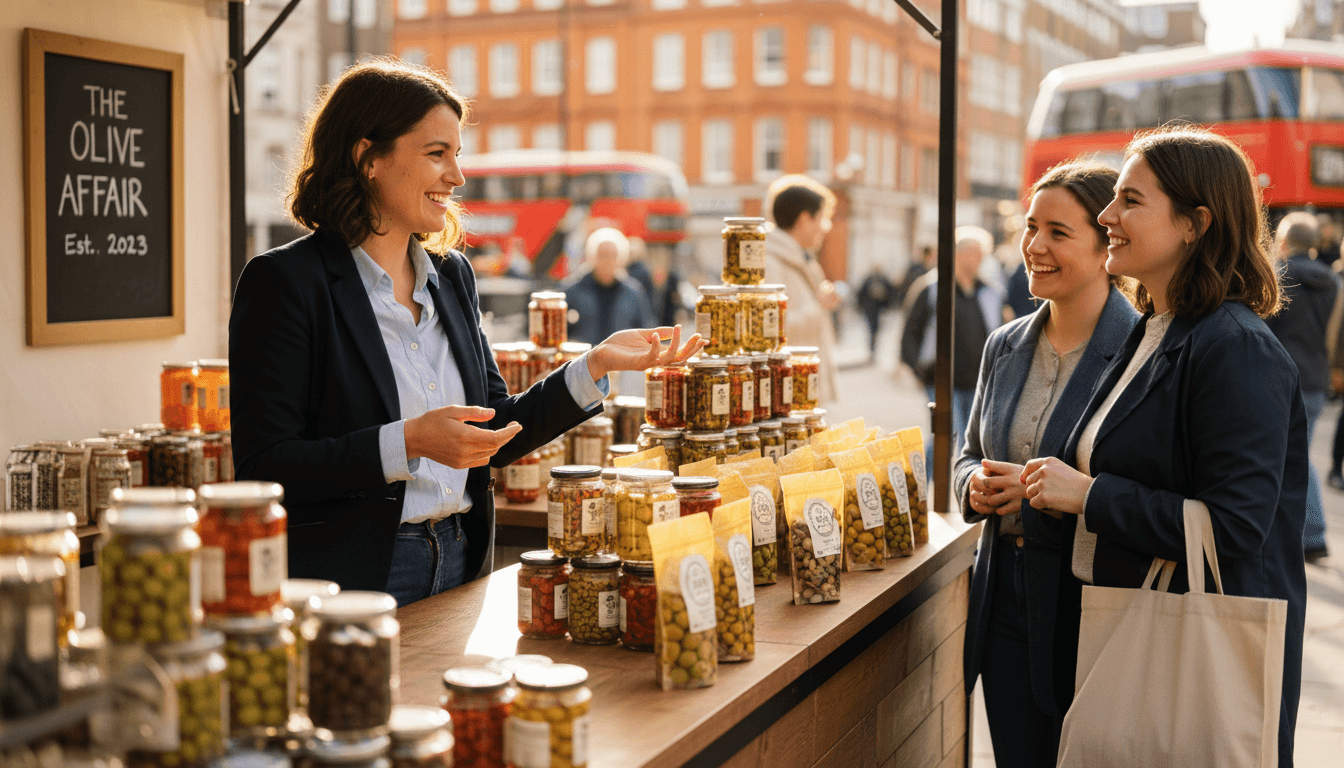
- It gave him time on the pitch—selling face-to-face at West London markets, collecting reactions and objections.
- It created constraints that forced clarity. When you only have evenings and weekends, you focus on what sells.
Your side-hustle marketing advantage: fast feedback loops
Markets are basically live A/B tests. If you sell online, you need to recreate that speed. Here’s what works for UK solopreneurs:
- Weekly offer cadence: one core offer, one seasonal/limited twist, one bundle.
- One metric that matters: not “followers,” but conversion rate (DM-to-sale, email-to-sale, or sample-to-repeat).
- A “why this exists” script: a 10-second version you can repeat in person, on video, and on your product page.
For FMCG, the “script” might be flavour + format (“unpasteurised snack olives in a pouch”). For services, it might be outcome + audience (“lead gen for UK SaaS under 20 staff”). Same logic.
“Trust your gut” is real—but only after you’ve earned it
Olly stepped back after 12 months and paused. That’s not failure; it’s pattern recognition. Early-stage building can feel isolating, and solo founders tend to carry everything—product, marketing, operations, fulfilment—until burnout forces a stop.
His reset led to a sharper insight: the product was right, but the format needed to match a growing behaviour—healthy snacking and convenience.
Turn product intuition into a testable hypothesis
“Trust your gut” becomes useful when you translate it into something measurable:
- Hypothesis: “People want olives as a snack, not just a side dish.”
- Test: sell an on-the-go format and compare repeat purchase intent.
- Proof signals: reorder rate, basket add-ons, and retailer interest.
If you’re a one-person business, this is the moment you shift from “maker” to “marketer.” You’re not abandoning craft; you’re designing demand.
A UK-specific angle: seasonality and snacking
It’s January 2026. Health goals are everywhere, and “better-for-you” snacks spike in attention this time of year. If your product can credibly play in that space, now is a good time to:
- refresh your homepage messaging to emphasise habit replacement (“swap the 3pm snack”),
- publish a short “why this is healthier” explainer (without making medical claims),
- create a simple “try 3 flavours” starter pack.
This is exactly the kind of seasonal relevance that improves conversion without spending more on ads.
The scary bit: committing cash and building supply
Olly eventually found a supplier, but the minimum order was £12,000 per flavour. That’s the moment many founders freeze. You can’t A/B test your way out of a large MOQ.
The marketing lesson is that distribution confidence comes from earlier proof. If you’ve already sold the concept at markets, you’re not betting on a fantasy—you’re scaling a pattern.
What to do before you place a big MOQ
If you’re approaching a high-commitment purchase—inventory, software build, hiring—borrow this pre-flight checklist:
- Pre-sell or pre-commit: letters of intent, waitlists, deposit-based preorders, or wholesale interest.
- Unit economics snapshot: margin per unit, fulfilment cost, expected wastage/returns.
- Channel plan for the first 90 days: where each unit will be sold (not “online,” but which campaigns, partners, events).
- Proof assets ready: product photos, founder story, reviews/testimonials, and a retail-ready sell sheet.
For FMCG, being “world’s first” (like unpasteurised snack olives) is a strong hook, but it still needs proof: taste, quality, and reliability.
Scale via partnerships, not heroics
Most solopreneurs try to scale by working harder. It rarely works.
Olly partnered with a fulfilment provider (Fodabox) to stop spending time packing boxes. That’s a classic one-person business growth move: remove operational drag so marketing can compound.
The growth stack that helps UK solopreneurs scale
You don’t need a huge toolset. You need the right sequence:
- Fulfilment/ops: shipping and returns that don’t consume your week
- Email marketing: a list you own (welcome flow + replenishment reminders)
- Content marketing: founder-led content that builds trust (short video, blog posts, behind-the-scenes)
- Retail/wholesale outreach: a simple pipeline (targets, contacts, follow-ups, samples)
Olly’s listings—Sainsbury’s, Eurostar, BrewDog—show what happens when brand + format + operations meet. Retailers want products that move quickly and don’t create headaches.
Why founder story is a marketing asset (not a vanity project)
“I told my parents I don’t want to be a doctor, I want to sell olives” is memorable because it signals:
- conviction (he’s serious),
- contrast (unexpected),
- credibility (science/health-adjacent background),
- humanity (family pressure, risk, ambition).
For lead generation, that’s gold. People don’t just buy products—they buy belief and taste. In services, they buy competence and clarity.
Snippet-worthy rule: A strong founder story doesn’t glorify hustle; it explains the customer problem in a human way.
People also ask: what can I copy from this if I’m not selling products?
If you run a service business, here’s the translation:
- Markets = discovery calls. Use them to capture language, objections, and buying triggers.
- On-the-go pouch = productised service. Package your offer so it’s easy to buy and easy to deliver.
- Retail listings = channel partnerships. Agencies partner with SaaS tools; consultants partner with accountants; creators partner with communities.
- Fulfilment partner = automation + SOPs. Standardise delivery so you’re not the bottleneck.
This is the heartbeat of the UK Solopreneur Business Growth series: simple systems that turn talent into predictable demand.
A tighter way to start (and a clearer way to grow)
Olly’s journey is inspiring, but the useful bit is structural: he found a gap, tested it with real people, changed format to match behaviour, then built operations that could support scale.
If you’re building a UK startup right now, don’t copy the surface-level story (“quit your job, follow your passion”). Copy the mechanics:
- Validate fast with real conversations.
- Write positioning people repeat back to you.
- Turn your offer into a format that fits the way people buy.
- Systemise fulfilment so your marketing doesn’t stall.
What are you currently doing manually that’s stopping you from selling—packing boxes, writing bespoke proposals, chasing invoices, rewriting the same emails? Fix that one bottleneck, and growth gets a lot less dramatic.
If you want help turning your niche insight into a repeatable acquisition system (content, email, partnerships, and simple automation), this is exactly the kind of work we do in Startup Marketing United Kingdom.