Learn UK solopreneur marketing lessons from a niche olive brand: positioning, packaging, feedback loops, and distribution tactics that drive leads.
UK Solopreneur Marketing Lessons from an Olive Brand
Most founders don’t fail because they picked the “wrong” product. They fail because they never get clear on who it’s for and why anyone should care.
That’s why I like Olly Hiscocks’ story: a neuroscience graduate on a post-grad medicine track who chose to build a snack brand instead. “I don’t want to be a doctor, I want to sell olives” sounds like a quirky career pivot—until you look at what’s actually happening underneath: classic UK solopreneur business growth, powered by tight positioning, relentless customer feedback, and smart distribution choices.
If you’re building a one-person business in the UK (or trying to turn a side hustle into something real), this is the kind of case study worth copying—not the olives, the approach.
“Always trust your gut when it comes to products.” — advice Olly heard from Pip Murray (Pip & Nut)
Start with a product truth, not a business plan
The fastest route to traction is having a clear, specific product truth that you can articulate in one line. In Olly’s case, it wasn’t “I’m passionate about food” or “I want to be an entrepreneur.” It was sharper:
- He loved olives (real enthusiasm)
- The UK shelves were bland (real market gap)
- There wasn’t a brand championing quality + flavour (real positioning opportunity)
This matters because early-stage marketing is mostly translation. You’re translating what you believe into a message someone else can repeat.
A practical test: can your customer explain you in 10 seconds?
If you’re a UK solopreneur doing online marketing, you don’t have the luxury of vague messaging. Try this:
- Write your product promise in one sentence.
- Remove every adjective that doesn’t change the meaning.
- Read it out loud. If it sounds like a brochure, rewrite it.
A strong version sounds like something a customer would say to a friend.
Example formulas that work well for product startups:
- “It’s like X, but for Y.”
- “Finally, a [product] that [solves a specific annoyance].”
- “The [category] option for people who care about [value].”
Olly’s internal version was essentially: bold, high-quality olives that don’t feel boring—then he shaped the format to match real behaviour.
Markets are still the best marketing lab (even in 2026)
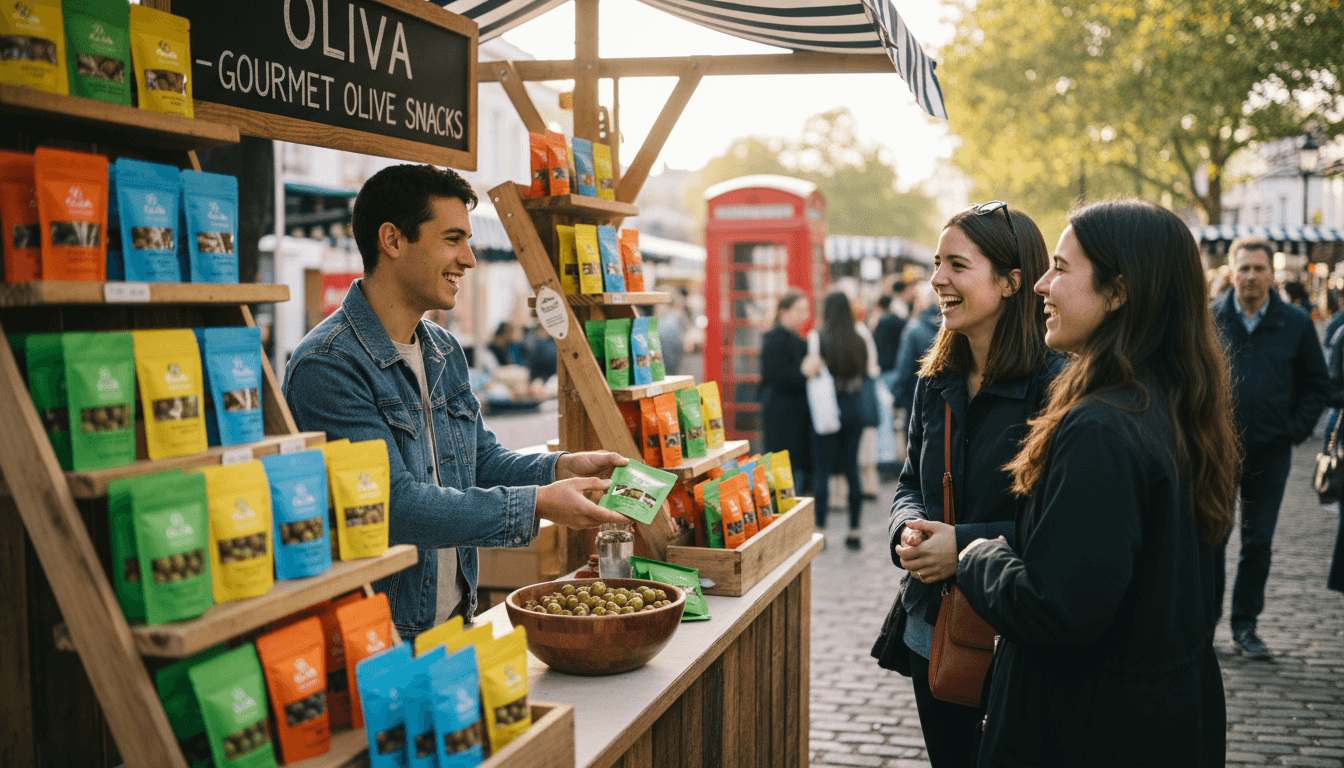
Olly started in 2018 the way a lot of UK founders quietly do: full-time job during the week, making product at night, selling at markets on weekends.
Here’s the point many people miss: a market stall is a live conversion funnel. It forces you to do the hard stuff:
- Stop strangers
- Explain value quickly
- Handle objections in real time
- Get brutally honest feedback (facial expressions included)
In a world of dashboards and attribution models, this kind of contact is still priceless. Especially for FMCG and consumer brands where taste, packaging, and “vibe” are everything.
Steal this: the “10-conversation” rule
Before spending weeks on branding, copy, or paid social, collect 10 real customer conversations. Ask:
- “What did you think this was when you first saw it?”
- “What would stop you buying it?”
- “When would you actually eat it?”
- “What would you compare it to?”
Write the answers down verbatim. Your best ad copy will come from those exact phrases.
Packaging is your first salesperson—treat it like performance marketing
Olly’s early insight wasn’t only that olives could be better. It was that the presentation in the UK market lacked colour, character, and flavour-led innovation.
For solopreneurs, packaging can feel like a “later” problem. I disagree. For physical products, packaging is often your highest-leverage marketing asset because it does three jobs at once:
- Stops the scroll (or the shopper)
- Explains value instantly
- Signals price and quality without saying it
What to bake into packaging for UK retail and DTC
Whether you’re selling in independent shops, marketplaces, or aiming for listings, the fundamentals are the same:
- One primary claim (don’t cram five benefits on the front)
- A clear usage moment (“on-the-go snack” beats “premium olives”)
- A memorable brand voice (consistent tone across pack, site, and socials)
- Proof cues (ingredients, origin, process, or “unpasteurised” if that’s meaningful)
Olly rethought the format into an on-the-go olive pouch, aligning the product with the healthy snacking trend and real lunchtime behaviour.
“Trust your gut” doesn’t mean ignore the economics
There’s a romantic version of startup life where you follow your passion and everything works out. The real version includes minimum order quantities.
Olly eventually found a supplier—then hit a common FMCG wall: large upfront inventory commitments. The article notes a minimum order of £12,000 per flavour.
This is where marketing and finance collide. If you’re a one-person business, you can’t treat growth like a vibe. You need a plan for:
- Cash tied up in stock
- How fast you can realistically sell through
- What channels will move volume
A simple stock-risk checklist for product founders
Before you place the big order, answer these:
- Channel fit: Are you selling where your customer already shops (markets, online, subscription boxes, retail)?
- Velocity plan: How many units per week do you need to sell to reorder safely?
- Message match: Does your positioning fit the channel? (Retail needs instant clarity; DTC can educate more.)
- Sampling strategy: What’s your cheapest credible way to let people try it?
Olly backed himself, placed the order, and then did something equally important: he improved operations so growth didn’t collapse under admin.
Growth often comes from boring partnerships (and that’s good)
One underrated moment in the story is partnering with a fulfilment provider (Fodabox) to handle packing and processing.
That’s not glamorous. It’s also exactly how solopreneur business growth happens: remove the work that doesn’t create differentiation.
If you’re building a UK startup and you’re spending nights printing labels, taping boxes, and doing customer service firefighting, your marketing will always be “when I have time.” You won’t have time.
The solopreneur rule: protect your selling hours
Here’s what I’ve found works: treat marketing time like your most important meeting.
Pick one:
- 5 hours/week protected for outreach + content
- Or 45 minutes/day for distribution (posting, emails, partnerships, sales follow-ups)
Then automate or outsource the rest as soon as you can do it without breaking quality.
What listings really signal: distribution is marketing
The article mentions flagship listings with Sainsbury’s, Eurostar, and BrewDog.
Beyond the revenue, listings act as trust accelerators:
- A retailer validates demand
- A recognisable brand reduces perceived risk
- Social proof becomes easier (“stocked by…”) without sounding braggy
For early-stage founders, this is the lesson: distribution is a marketing channel.
How to pitch partnerships when you’re still small
You don’t need a fancy deck. You need a tight story:
- What it is (one sentence)
- Who it’s for (specific customer)
- Why it sells (the usage moment)
- Why now (trend, behaviour shift, category gap)
- How you’ll support it (sampling, promos, content, in-store activation if relevant)
If you can’t explain “why it sells” without saying “it’s premium,” the pitch isn’t ready.
Three marketing lessons every UK founder can apply this week
You don’t need to launch the world’s first anything to learn from this. You need to build a repeatable marketing habit.
1) Build around a behaviour, not a demographic
“Healthy snacking” is behaviour. “Women 25–34 in London” is a demographic.
Behaviour wins because it tells you:
- When they buy
- What they’re replacing
- What message will resonate
2) Turn feedback into content (and leads)
If you’re trying to generate leads, document what customers ask and turn it into:
- Short posts answering objections
- A product comparison page (“X vs Y”)
- A founder email series (“here’s how we make it, here’s why it tastes different”)
This is content marketing that actually sells.
3) Treat your origin story as a positioning tool
A founder story isn’t a diary entry. It’s proof of intent.
Olly’s story works because it communicates:
- obsession with the product
- willingness to do the unglamorous early work
- a clear point of view about what the category lacks
If your story doesn’t make your product more believable, tighten it.
People also ask: “How do I market a niche food product in the UK?”
Answer: Start with local validation, then scale the message through repeatable channels.
A practical sequence that works for UK product startups:
- Validate in person (markets, events, independents) until you know your best-selling SKU and hook.
- Build a simple DTC engine (landing page + email capture + a few high-performing posts).
- Use partnerships to borrow trust (subscription boxes, cafes, breweries, gyms—anywhere your usage moment fits).
- Only then scale paid once your conversion story is stable.
Paid social doesn’t fix unclear positioning. It just helps you spend money faster.
Where this fits in UK solopreneur business growth
This story belongs in the “UK Solopreneur Business Growth” series because it shows the real path: small experiments, direct selling, ruthless clarity, and then operational upgrades that make marketing sustainable.
If you’re sitting on an idea you can’t stop thinking about, the hard part isn’t the logo or the website. It’s doing the first small, slightly uncomfortable test that proves someone will pay.
If you want help turning that first traction into consistent leads—through positioning, content, and a simple growth plan—start here: https://startups.co.uk/guides/how-to-start-a-business/
What would change in your business this month if you treated packaging, distribution, and customer conversations as your main marketing channels—not side tasks?