AB InBev’s Live Nation deal shows how event sponsorship drives visibility. Here’s how UK solopreneurs can copy the strategy and capture leads.
Event Sponsorship Lessons from AB InBev x Live Nation
Most startups think event marketing is “for big brands with big budgets”. Then a deal like AB InBev becoming Live Nation UK’s exclusive beer partner lands, and it’s a useful reminder of what’s really happening: the brands winning attention are buying (or building) distribution in real life.
For UK solopreneurs and one-person businesses, you’re not going to outspend a global brewer. But you can copy the underlying mechanics—own a moment, get repeated exposure, and turn attention into leads—without needing a stadium-sized cheque.
This post uses AB InBev’s Live Nation UK partnership as a case study in strategic brand activation and breaks it down into practical moves you can use to grow your business in 2026—especially if you’re relying on online marketing, social media, and automation tools to scale.
One-liner to steal: Event sponsorship works when it gives you repeated, contextual visibility—then you capture that attention with a simple, trackable offer.
What AB InBev is really buying with the Live Nation deal
An exclusive partnership isn’t mainly about “being the official brand.” It’s about controlling three assets that startups usually ignore.
1) Guaranteed, repeated reach (not one-off “brand awareness”)
Live Nation UK touches a huge number of high-intent moments: people have already paid, already travelled, and are in a social mindset. AB InBev isn’t buying impressions in the abstract; it’s buying repetition across a season—festivals and venues—so the brand becomes the default choice.
For a solopreneur, this is the equivalent of getting in front of the same audience 6–10 times in environments where they’re receptive (not doomscrolling). That’s why consistent partnerships (a venue, a community, a recurring event series) usually outperform one glamorous sponsorship.
2) Category ownership in a high-emotion environment
People remember brands more when there’s emotion involved—live music, big nights out, shared memories. AB InBev is tying product consumption to peak experiences.
You can’t replicate the scale, but you can replicate the pattern:
- Match your offer to a moment of high motivation
- Show up consistently in that moment
- Make the next step stupidly easy
3) On-site conversion infrastructure
Exclusive partner often means control over things like menus, bar placements, pouring rights, and on-site visibility. That’s a conversion machine: availability + salience + habit.
The startup version is: don’t just “sponsor”. Build a mini conversion funnel around the event.
- A clear offer
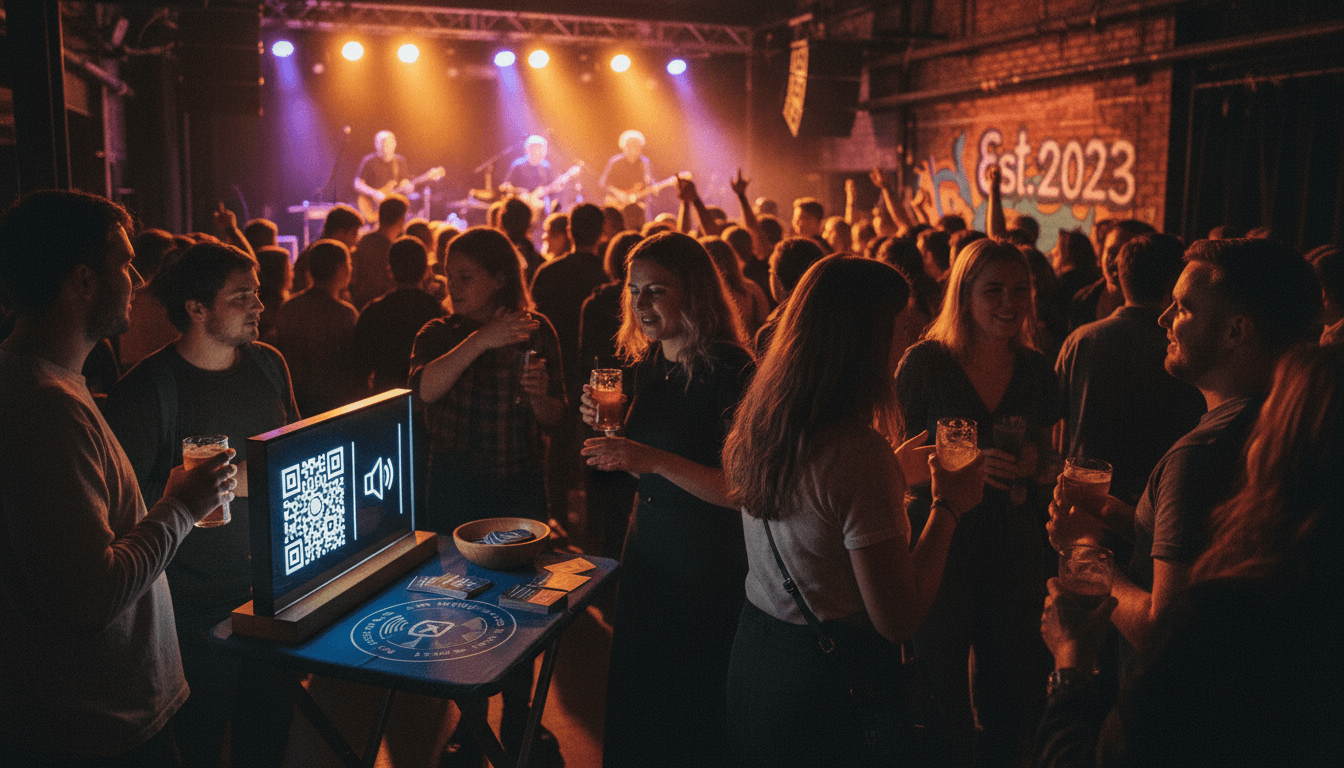
- A single QR destination
- A follow-up sequence
- A way to measure ROI
Why this matters for UK solopreneur business growth (especially in 2026)
If you’re growing a one-person business in the UK, you’re probably feeling two things at once:
- Paid social has become harder to rely on consistently.
- Organic reach is unstable—platforms change the rules whenever they feel like it.
Event-based marketing gives you a third lane: borrowed attention from someone who already has the crowd.
And January is the perfect time to plan it. UK events calendars, venue programming, and spring/summer community schedules are being locked in right now. If you wait until April, the good partnerships are gone—or they’re priced for brands with procurement teams.
Here’s the stance: events are not “offline marketing.” They’re top-of-funnel content engines that feed your online channels.
The partnership playbook startups can copy (without the AB InBev budget)
You don’t need exclusivity. You need clarity, a tight niche, and a repeatable activation.
Step 1: Choose “rooms” where your customers already gather
The fastest way to waste money is sponsoring an event because it’s popular.
Pick events where people are already in the mindset to buy what you sell. Some examples:
- B2B solopreneur services: coworking meetups, founder breakfasts, chamber events, niche conferences
- Consumer products: maker markets, fitness studios, weekend pop-ups, community festivals
- Local services: neighbourhood fairs, school events (where appropriate), local sports clubs
Rule of thumb: If you can’t describe the audience in one sentence (“indie beauty founders in Manchester doing £5–20k/month”), don’t sponsor it.
Step 2: Replace “logo placement” with one measurable behaviour
Big brands can afford vanity. You can’t.
Before you spend anything, decide what you want people to do:
- Scan a QR code
- Join your email list
- Book a call
- Take a sample + register
- Follow your Instagram + DM a keyword
Then design the sponsorship around that single action.
Snippet-worthy: If your event marketing can’t be measured in one behaviour, it will be measured in excuses.
Step 3: Build a “field funnel” you can run in 30 minutes
AB InBev wins because it has distribution and frictionless access. Your job is to reduce friction.
A simple solopreneur funnel that works:
- Offer: “Get the checklist / trial / consultation / sample”
- Trigger: QR code or NFC tap
- Landing page: one headline, one form, one thank-you
- Follow-up: 3–5 email sequence over 10 days
- Conversion: book a call / buy / refer
Keep the landing page event-specific so you can track it (e.g., /?utm_source=eventname).
Step 4: Create an activation that earns attention (not just presence)
AB InBev’s product is naturally part of the experience. Your product might not be.
So you need an interaction. A few formats that consistently work for small brands:
- Micro-audit booth (B2B): “Get a 5-minute homepage teardown”
- Try-and-vote (consumer): samples + quick vote, results posted on socials
- Photo moment (any): not cheesy, just useful—“before/after” demo, product-in-use
- Workshop corner: 15-minute mini session every hour
If you’re a one-person business, pick something you can deliver repeatedly without burning out.
Brand visibility through partnerships: what “exclusive” teaches you
You won’t be the “exclusive partner” of Live Nation. But you can be exclusive in a smaller pond.
The smart version of exclusivity for startups
Instead of paying for category exclusivity, negotiate for attention exclusivity:
- You’re the only sponsor doing a talk
- You’re the only vendor allowed to run a giveaway
- You’re the only brand placed in the welcome email
- You get the attendee list opt-in (GDPR-compliant)
Your goal is simple: be the obvious next step after the event.
Ask for assets that compound
Most sponsorship packages are built for brands chasing impressions. Ask for things that keep working after the room clears:
- A dedicated email feature to attendees
- A pinned post in the organiser’s community
- A short interview on their podcast/Instagram Live
- Permission to repurpose event photos/video
This is where “UK solopreneur business growth” becomes real: you’re not buying a day out; you’re buying content + distribution.
Consumer engagement tactics you can borrow from experiential marketing
Experiential marketing sounds fancy. The basics are straightforward.
Make the offer match the emotion
Live music is emotional. Beer fits. That’s why it works.
For you: tie your offer to what people feel right then.
- At a founder meetup: clarity, momentum, connection
- At a fitness event: confidence, energy, routine
- At a wedding fair: trust, reducing stress, making it “sorted”
Copywriting that works on-site is concrete:
- “Get the 10-minute pricing script I use with clients.”
- “Scan to see the exact setup checklist for your first pop-up.”
Use scarcity honestly
Events have natural scarcity: time-limited, location-limited, capacity-limited.
Good scarcity:
- “First 20 scans get a free upgrade.”
- “Book by Friday for the event-only rate.”
Bad scarcity:
- Fake countdown timers.
Capture leads without being awkward
If you’re solo, you can’t manually type emails all day.
Two low-friction methods:
- QR to a form with one field (email) + optional name
- QR to Instagram DM keyword (“DM ‘CHECKLIST’ and I’ll send it”)
Then automate delivery so you’re not stuck sending links at midnight.
Cross-industry collaboration: the startup version of AB InBev x Live Nation
A brewer partnering with live entertainment is a cross-industry growth play: one brand gets access to the other’s moments and audiences.
Here are realistic cross-industry collaborations for UK one-person businesses:
- A freelance web designer + a local photographer: “Launch Kit” bundle
- A nutrition coach + a gym studio: monthly workshop series
- A B2B accountant + a coworking space: quarterly “tax prep clinic”
- A candle brand + a yoga studio: “slow Sunday” pop-up
The point: you don’t need more tactics. You need one partner with a recurring audience.
“People also ask” style answers (because you’ll ask them anyway)
Is event sponsorship worth it for a startup?
Yes—if you can track a single action (scan, signup, booking) and you have follow-up. Sponsorship without lead capture is usually just expensive confidence.
What’s a good budget for a first sponsorship?
Start with what you can afford to lose while learning, then scale once you know your cost per lead. Many UK local/community partnerships can start in the low hundreds, especially if you bring value (talk, workshop, content).
How do you measure ROI from event marketing?
Measure: scans/signups, cost per lead, and conversion rate within 14–30 days. If you sell high-ticket services, track booked calls and close rate instead of purchases.
A practical 14-day plan to run your first “micro sponsorship”
If you want to test this fast, do it like a solopreneur: tight scope, tight timeline.
- Day 1–2: Pick one audience room (meetup, venue, market)
- Day 3: Draft a one-sentence offer + one measurable action
- Day 4: Build a simple landing page + email automation
- Day 5–6: Pitch three organisers with a clear value swap
- Day 7: Finalise activation (booth, mini-audit, samples, workshop)
- Day 8–10: Create event assets (QR sign, one-page handout, 3 social posts)
- Day 11–12: Rehearse your on-site script (15 seconds max)
- Day 13: Run the activation
- Day 14: Send follow-up + post recap content
Where AB InBev’s move leaves the rest of us
AB InBev partnering with Live Nation UK is a reminder that distribution beats cleverness. They’re buying repeated access to high-energy moments, not just placing a logo.
For your one-person business, the win isn’t copying the scale. It’s copying the strategy: attach your brand to a recurring event, make one action measurable, and run a simple follow-up system.
If you’re building your 2026 growth plan right now, what’s the one “room” you could show up in consistently for the next six months—and what would you want attendees to do in the first 10 seconds after they notice you?