Learn 5 timeless British ad lessons to market climate and net-zero startups with trust, clarity, and standout storytelling.
Timeless British Ads: Lessons for Net-Zero Startups
A 30-second ad can outlive the product it was made to sell.
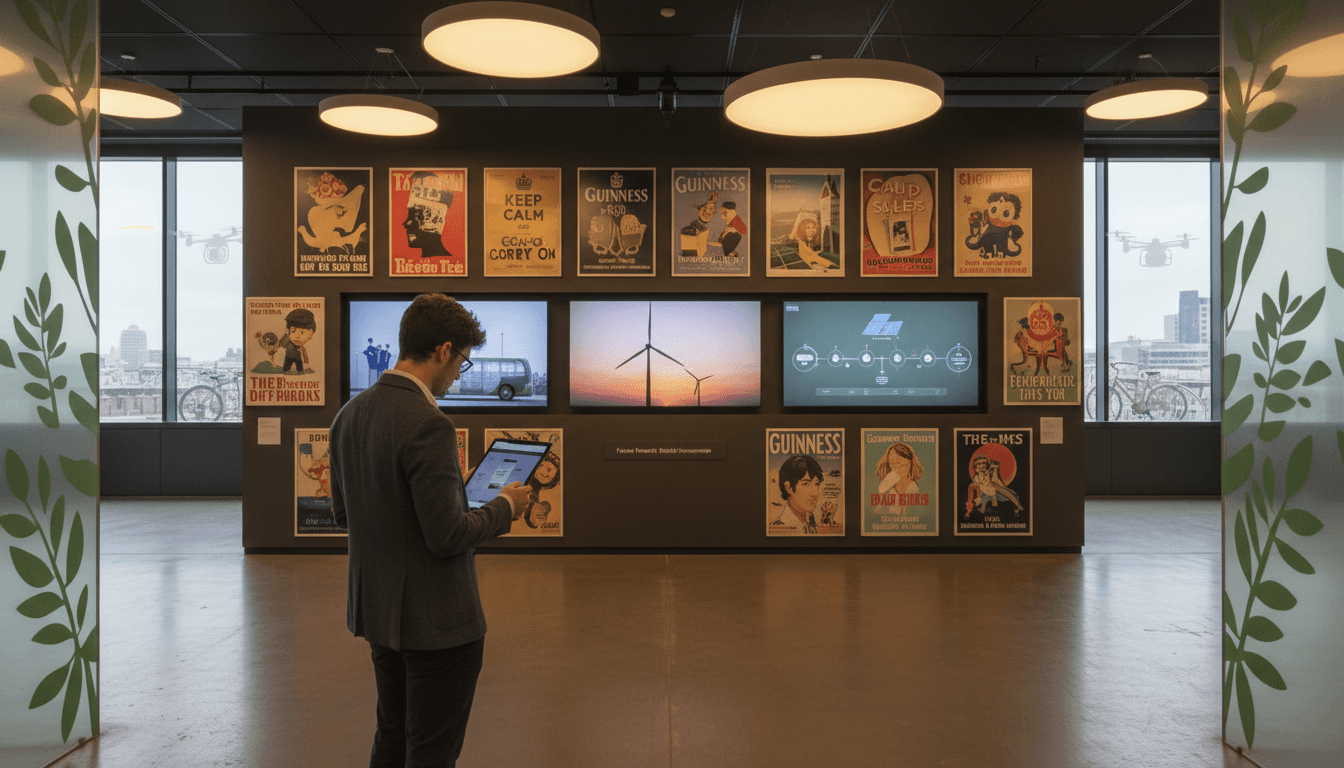
That’s the quiet reason the British Arrows matters to founders and marketers—not just agency folk. The awards organisation is marking its 50th anniversary with an exhibition at Outernet celebrating standout British advertising from the past five decades. It’s a reminder that the ads we still talk about didn’t “win” because they were flashy. They won because they made people feel something, remember something, and repeat something.
For UK startups building in the Climate Change & Net Zero Transition space—renewables, circular economy, sustainable transport, green jobs—this is timely. February is when many teams reset targets after January planning and before spring campaign launches. If you’re about to spend money on paid social, PR, outdoor, or a brand refresh, it’s worth stealing a few principles from 50 years of ads that cut through.
Why a 50-year ad exhibition matters to net-zero marketing
The point isn’t nostalgia. The point is signal.
A curated show of “best of” work is basically a dataset of what has historically earned attention in a crowded media environment. And crowded is an understatement in 2026: CPMs fluctuate, attribution is messier than most dashboards admit, and audiences are sceptical—especially about climate claims.
Here’s what I’ve found working with early-stage brands: most climate and net-zero messaging fails for the same reason. It tries to be correct instead of compelling. The British Arrows’ greatest hits are a masterclass in doing both.
The net-zero trust gap is real (and it’s expensive)
Sustainability marketing is operating under a permanent headwind: people expect greenwashing. Regulators and watchdogs do too. That changes the creative brief.
For climate tech and net-zero startups, brand growth isn’t only about awareness. It’s about credibility at speed—with customers, partners, investors, and future hires.
A strong net-zero brand doesn’t just state impact. It makes impact legible.
Five timeless storytelling principles (and how to apply them now)
These principles show up again and again in enduring British advertising. They translate cleanly to modern startup marketing—especially in sustainability, where the message is often complex.
1) Start with one human truth, not a mission statement
The best ads don’t open with what the brand wants to say. They open with what the audience already feels.
Net-zero founders often lead with “Our platform reduces emissions by X%.” Useful, but it’s rarely the hook. The hook is the human tension underneath: uncertainty about bills, guilt about waste, frustration with unreliable public charging, fear of regulation, worry about supply chains.
How to use this in a climate startup campaign
Write your opener as a sentence your customer would say:
- “We can’t keep missing delivery windows because routes change every week.” (sustainable logistics)
- “I’m done paying for heat I can’t control.” (home energy)
- “I want lower carbon materials without betting the site on an unproven supplier.” (construction)
Then earn the right to talk about your product.
Practical exercise (15 minutes):
- List the top 5 objections your buyers raise.
- Translate each into a feeling (stress, doubt, embarrassment, pride).
- Build creative around that feeling, then back it up with proof.
2) Make the benefit visible in under 5 seconds
Iconic ads are rarely confusing. They communicate a clear “this is for you” quickly.
Sustainability brands often bury the benefit under process: supply chain audits, lifecycle analysis, certificates, dashboards. Those matter—but they’re supporting actors.
A simple rule for net-zero messaging
Lead with a visible outcome:
- Save time (install faster, report faster, approve faster)
- Save money (lower energy cost, lower waste cost)
- Reduce risk (compliance, reputational, operational)
- Increase performance (range, reliability, yield)
Then add the climate impact as part of the value stack, not a separate sermon.
If you need a paragraph to explain the benefit, your ad is doing your onboarding’s job.
3) Use specificity as your anti-greenwashing shield
Old-school great advertising is full of memorable specifics—distinctive characters, concrete scenarios, repeatable phrases. That same specificity is exactly what climate marketing needs to stay compliant and trusted.
Replace vague claims with “auditable” language
Instead of:
- “Eco-friendly”
- “Sustainable solution”
- “Net-zero ready”
Try:
- “Produces an audit-ready emissions report in 24 hours.”
- “Cuts diesel generator runtime by 30% on typical sites.”
- “Tracks Scope 1 and 2 automatically; Scope 3 via supplier imports.”
You don’t need to overshare. You need to be testable.
Quick compliance checklist for climate ads
- Can we substantiate every environmental claim internally?
- Are we clear about scopes, boundaries, and assumptions?
- Are we avoiding absolute claims (“zero impact”) unless provable?
- Are we distinguishing “carbon neutral” (offsets) from “net zero” (reductions + residual removals)?
This isn’t just legal hygiene. It’s brand building.
4) Distinctive assets beat constant reinvention
The ads that last tend to have assets people recognise: a voice, a visual cue, a format, a tone. Startups often do the opposite—new look every quarter, new tagline every funding round.
For net-zero and climate change messaging, consistency is especially important because the category is noisy. Too many brands look like “green gradients + leaf icon + earnest promise.” You don’t want to blend in with your own sector.
Build 3–5 distinctive brand assets
Pick assets you can deploy across web, paid social, PR, events, and partnerships:
- A repeatable visual system (shapes, colour blocks, photography style)
- A memorable “promise line” (short, non-technical)
- A proof device (a recurring metric card or comparison chart)
- A character or recurring scenario (the same buyer situation, told differently)
- A sonic cue (useful for video/podcast placements)
Consistency isn’t boring. It’s how you compound attention.
5) Emotion gets you remembered; proof gets you chosen
The biggest myth in climate marketing is that rational arguments win. People say they make rational decisions. But attention is emotional, memory is emotional, and only then do we justify.
The British Arrows tradition celebrates work that makes you laugh, wince, or feel seen. Net-zero brands can do that too—without trivialising the stakes.
A better split for climate creative
- Top-of-funnel (attention): emotion, tension, humour, surprise, relief
- Mid-funnel (consideration): demos, comparisons, case studies, quantified outcomes
- Bottom-of-funnel (decision): risk reversal, references, procurement-ready docs
If you only run “proof” content, you’ll be trusted by the 2% already shopping—and invisible to everyone else.
What UK startups can copy from exhibition-grade advertising
You don’t need a big-budget film crew to apply these lessons. You need discipline.
A startup-friendly creative process (that doesn’t waste months)
Step 1: Write a one-sentence proposition. Format: For [buyer], who [pain], our product [outcome], because [mechanism].
Step 2: Pick one primary emotion per campaign. Relief, pride, frustration, hope, control—one, not five.
Step 3: Build a “proof stack.” A proof stack is the 3–7 items that back your claim:
- one quantified result
- one customer quote
- one methodology note (boundaries/assumptions)
- one third-party credential (if relevant)
- one operational detail (time to install, time to report, etc.)
Step 4: Ship three creatives, not thirty. Test:
- one direct benefit ad
- one founder-led explanation
- one story-driven scenario
Then iterate based on signal, not taste.
How this fits the net-zero transition narrative
The net-zero transition isn’t only engineering and policy. It’s mass behaviour change: buying heat pumps, switching fleets, retrofitting buildings, choosing low-carbon materials, rethinking food waste, investing in renewables. Marketing is how those choices become normal.
Exhibitions like the British Arrows’ 50-year celebration are useful because they show a consistent truth: culture moves faster than regulation. If you want adoption—of a cleaner product, a new habit, a new infrastructure—your brand has to feel like it belongs in everyday life.
That’s also why I like looking backward when planning forward. The channels have changed. The job hasn’t.
Practical Q&A founders ask (and straight answers)
“Should a climate brand use humour?”
Yes—if the joke is on the situation, not the planet. Humour is a trust accelerator when it signals confidence and empathy.
“Do we need to lead with net-zero claims?”
Not always. Lead with the outcome your buyer is paid to achieve (cost, time, risk). Then show the emissions reduction as an additional win.
“How do we avoid looking like every other sustainability startup?”
Stop borrowing category aesthetics. Build distinctive assets and repeat them. Consistency will do more for recall than another round of rebranding.
Next steps: turn inspiration into a campaign you can measure
If you’re planning Q1–Q2 growth, treat the British Arrows exhibition as a prompt: what would your company make that people still remember in five years? Not because it won awards—because it made your product feel obvious.
I’d start with a simple internal workshop: pick one customer segment, write the one-sentence proposition, choose one emotion, and design three creatives with a clear proof stack. Run them for two weeks, then decide what to scale.
The net-zero transition will be won by teams who can build trust quickly and tell the truth memorably. What’s one piece of your story you can make clearer—and more human—before your next campaign goes live?