Human-centred design is the 2026 antidote to generic marketing. Practical trend-based ideas UK solopreneurs can use to earn trust and leads.
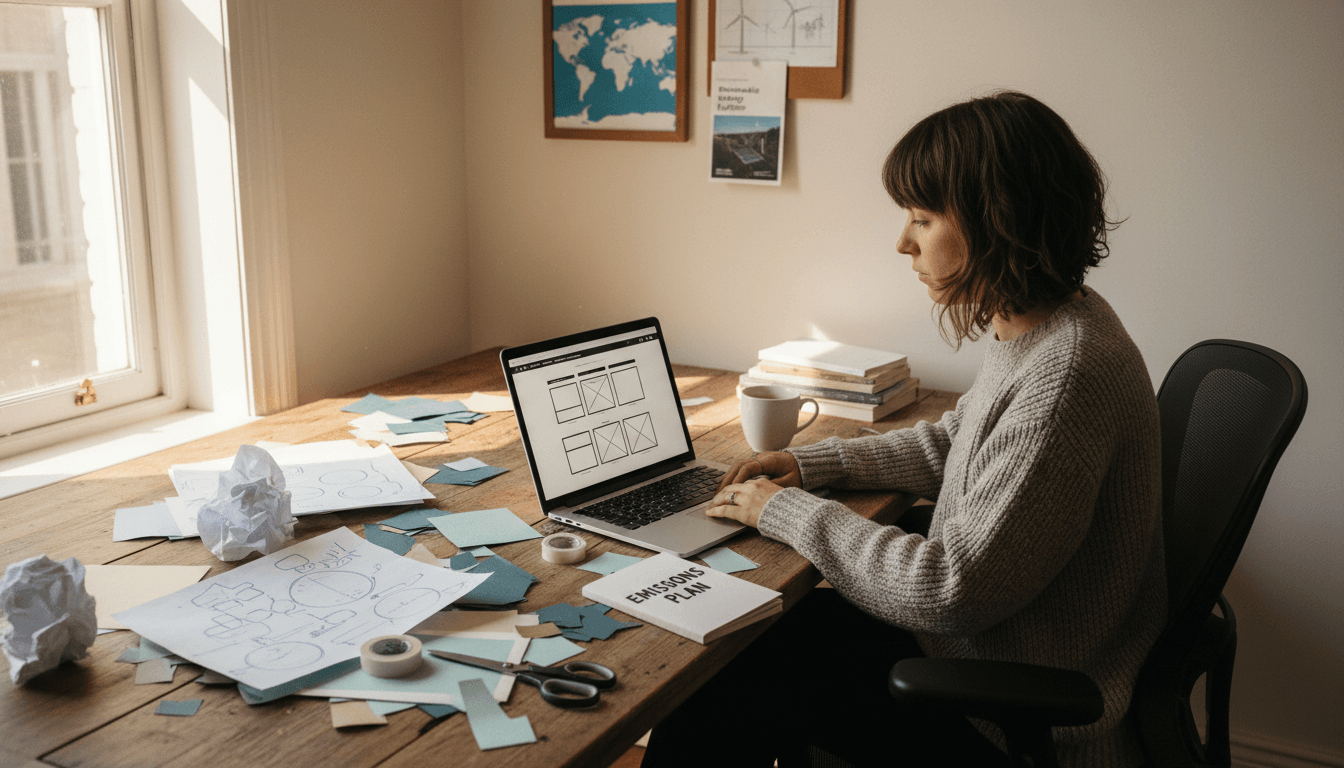
Human-Centred Design Trends UK Solopreneurs Can Use
People are getting better at spotting “template marketing”. Not because they’re design critics, but because they’re tired. Tired of the same polished AI headshots, the same sterile Canva layouts, the same identical stock photos turning up in ten competitors’ ads.
Stills’ 2026 trends report (covered in Creative Boom) lands on a simple truth: the work that wins attention now looks and feels human—texture, imperfection, colour, personality, and a point of view. If you’re a UK solopreneur trying to generate leads, this matters because attention is the first hurdle. Trust is the second.
And in the Climate Change & Net Zero Transition series, it matters for another reason: the green economy has a credibility problem. Consumers, clients, and procurement teams are wary of vague claims and “eco” branding that feels performative. Human-centred design is a practical way to communicate authenticity, clarity, and proof—the three things you need to grow without drifting into greenwashing.
Human-centred design in 2026: less perfection, more proof
Human-centred design in 2026 is about designing for how people actually behave online—fast scrolling, low trust, high stress—not how we wish they behaved. The Stills trend list is visual, but the business lesson is bigger: your marketing needs to look like it was made by a real person for real people.
Here’s what I’ve found works for solopreneurs: instead of asking “does this look premium?”, ask:
- Does this feel true? (real photos, real scenes, real constraints)
- Is this easy to understand in 3 seconds? (clear hierarchy, fewer words)
- Does it reduce cognitive load? (one action per screen, one message per asset)
- Does it build trust? (specifics, evidence, process, outcomes)
That’s human-centred design as a growth tool. It helps you:
- Increase engagement (people stop scrolling for something that feels different)
- Improve conversions (clearer pages, clearer CTA, less confusion)
- Support net-zero messaging (show your work; don’t just claim it)
The 2026 look that cuts through (and how to use it without looking “try-hard”)
You don’t need to adopt every trend. You need one or two signature moves that fit your audience and your offer. Below are the most useful trends from the report—translated into solopreneur marketing actions.
Scrapbook/scanner: the fastest route to “real”
This trend works because it signals effort and craft. The slightly wonky edges and scan artefacts communicate “someone made this” in a way perfect vector graphics don’t.
How to use it for lead gen:
- Print a one-page “mini-audit” or “framework” (even a rough one), mark it up by hand, scan/photograph it.
- Turn it into a carousel post: Problem → Diagnosis → Fix → CTA.
- Offer the clean template as a free download in exchange for an email.
Net-zero tie-in: if you sell sustainability services (carbon reporting, retrofit coordination, ethical supply chain work), this is brilliant for showing process—which is what credibility is made of.
Scribbles: visible thinking beats perfect branding
Scribbles are not decoration; they’re a trust signal. People associate hand-drawn marks with brainstorming, teaching, and “behind the scenes”.
Practical applications:
- Add one hand-drawn circle/arrow per graphic to highlight the key point.
- Use scribbles to annotate a real photo: “Here’s where heat loss happens” / “This is the metric we improved”.
- Create a simple “before/after” graphic where the ‘after’ is the only thing neatly typeset.
If you’re in the climate and net zero space, scribbles work especially well for explaining things like:
- emissions scopes (1, 2, 3)
- retrofit priorities
- EV charging decisions
- solar payback logic
Index/catalogue: clarity for sceptical buyers
Catalogue layouts convert because they help people self-select quickly. Instead of one hero image and a wall of text, you present options, proof points, or examples in a structured way.
Try this on your website and LinkedIn:
- “Choose your starting point” grid: I need more leads / I need better conversions / I need to fix my messaging.
- Proof grid: 6 tiles, each a mini case study with one metric (even if it’s small).
- Service grid: packages with a clear outcome, timeframe, and who it’s for.
This is human-centred UX: reduce decision fatigue and make the next click obvious.
Maximalism: use it as an accent, not a personality transplant
Maximalism grabs attention, but it can also confuse. For solopreneurs, the sweet spot is controlled maximalism: one “loud” asset per week that pulls people into your calmer core pages.
A safe approach:
- Keep your landing page clean.
- Make your social promo bold: saturated colour, layered imagery, big headline.
- Use one strong CTA repeated consistently.
If you’re marketing around sustainable transport, renewables, or green jobs, maximalism helps when you’re competing against bland corporate posts. The rule: one message, one action.
Direct flash and grunge: the anti-stock-photo play
Direct flash and grunge aesthetics work because they look documentary, not manufactured. They’re a response to AI-smoothed “perfection”.
How to apply without a big shoot budget:
- Use a phone camera and flash for real working moments: site visits, tools, notebooks, prototypes, workshop spaces.
- Add grain intentionally, but keep faces recognisable and lighting readable.
- Prioritise context: a retrofit consultant in a loft beats a generic “professional smiling at laptop” every time.
For net-zero businesses, this supports the bigger story: transition work is physical, practical, and specific.
Human-centred marketing for solopreneurs: a simple 4-part system
Trends are useless unless they change what you do on Monday morning. Here’s a system you can run in a few hours a month.
1) Build a “proof-first” content bank
Most solopreneurs post opinions and forget evidence. Flip it.
Collect:
- 10 real photos (phone is fine)
- 5 screenshots (analytics, invoices, dashboards, anonymised)
- 5 mini case notes (problem → intervention → result)
- 10 customer phrases (exact wording from emails/calls)
This bank makes your content more human-centred because it starts from real life, not imagined personas.
2) Pick two signature styles from the 2026 trend list
Don’t copy everything. Choose two and commit for 90 days.
Good pairings:
- Scrapbook/scanner + index/catalogue (human + clear)
- Direct flash + scribbles (real + explained)
- Maximalism (social) + catalogue (website) (attention + conversion)
Consistency beats novelty. Your audience should recognise you in half a second.
3) Make your website more human-centred (quick UX wins)
Human-centred UX is mostly subtraction. If your goal is leads, your website needs to be easy to understand and easy to act on.
Three high-impact tweaks:
- One primary CTA per page (book a call / request a quote / download guide). Not three.
- Replace vague claims with specifics: “Net-zero strategy support” becomes “12-week plan to reduce operational emissions and meet procurement requirements.”
- Add a proof block above the fold: one metric, one testimonial line, one recognisable client type.
4) Use “sensory storytelling” to make climate work feel real
Sensory storytelling sells because it turns abstract claims into felt experience. In sustainability and net zero transition work, abstraction is a conversion killer.
Examples of sensory assets:
- close-up of insulation texture, draft-proofing strips, or a thermal camera image
- water droplets, steam, condensation (for building performance stories)
- hands installing, measuring, testing, labelling
Pair each image with one concrete line:
“This is the gap that caused a 19% heat-loss spike in the survey. Sealing it took 40 minutes.”
You don’t need big numbers. You need believable ones.
“Isn’t this just design trends?” A quick Q&A solopreneurs actually need
Does human-centred design help SEO?
Yes—because it improves engagement signals (time on page, bounce rate, click-through) and encourages backlinks when your content is genuinely useful. Also, clearer pages make it easier for search engines to understand your offering.
Will bold visuals hurt trust in a B2B market?
Only if your message stays vague. Bold visuals plus specific language is a strong combination: attention first, then credibility.
How does this connect to net zero transition and climate action?
The transition economy is full of uncertainty and jargon. Human-centred design is the antidote: it makes your work understandable, verifiable, and relatable—which is what gets buy-in from customers, teams, and stakeholders.
What to do next (and a simple lead-gen CTA)
Your competitors can buy the same AI tools you can. They can copy the same templates too. They can’t copy your lived experience, your process, your proof, and your voice—unless you hide it behind generic design.
Pick one trend from the Stills list and apply it to one asset this week:
- a scrapbook/scanner carousel explaining your method
- a catalogue-style grid of “starting points” on your homepage
- direct-flash photos of real work, annotated with scribbles
If you want a second set of eyes, download the Stills report for visual examples and direction here: https://campaigns.stills.com/design-trend-report
The bigger question for 2026 is simple: as the net-zero transition accelerates, will your marketing feel like a human helping another human—or like a brand trying to sound green?