Instagram product demos can be cheap and effective. Learn the Magnum and PerfectDraft approach, plus a 7-day Reel plan for UK small businesses.
Instagram Product Demos: 2 Big-Brand Plays You Can Copy
Kantar’s latest UK testing on Instagram ads shows something that’ll feel familiar to any small business owner: product demos are everywhere (76% of ads include one), and most of them are forgettable. That “bad reputation” isn’t because demos don’t work. It’s because too many brands treat a demo like an instruction manual.
Magnum and PerfectDraft did the opposite. Their Reels-style ads ranked among the UK’s top-performing Instagram campaigns in Kantar’s The Works study (750 consumers reviewing the period’s leading Instagram ads). They’re very different brands with very different creative choices—and that’s the point.
This post is part of the British Small Business Digital Marketing series, and I’m going to translate what these campaigns did into budget-friendly Instagram product demo tactics you can use this week—without a studio, without an agency, and without a massive ad spend.
Why Instagram product demos fail (and how to fix them)
Most Instagram product demos fail for one simple reason: they show the product, but they don’t create meaning. Viewers see what it is, but they don’t feel why it matters.
Kantar’s view (summed up by Lynne Deason, head of creative excellence) is blunt: demos can be “immensely powerful” when they’re distinct, enjoyable, and relevant enough to earn attention and build memory.
Here’s the fix in plain English:
- Distinctive: it doesn’t look like every other Reel in your category.
- Enjoyable: it’s satisfying, funny, impressive, calming—something people actually want to watch.
- Newsworthy: it teaches something new or clarifies the value fast.
- Brand-coded: viewers don’t just remember the video—they remember who it was for.
If you nail those four, a demo stops being “salesy” and starts being useful entertainment.
Case study #1: PerfectDraft proves “simple” can win on Instagram
PerfectDraft’s ad is a straight product-and-app demonstration—and Kantar still rated it highly effective.
What made it work (in Kantar’s numbers)
Kantar’s testing found PerfectDraft performed strongly on the things small businesses usually struggle with:
- Top 5% for delivering newsworthy information (people felt they learned something)
- Top 16% for meeting people’s needs
- Top 14% for relevance
- 52% of viewers said they couldn’t forget the ad was for PerfectDraft (fast memory building)
That last stat is gold. Plenty of ads get views; far fewer get attributed memory (people remember the brand name attached to the idea).
The “small business version” of the PerfectDraft approach
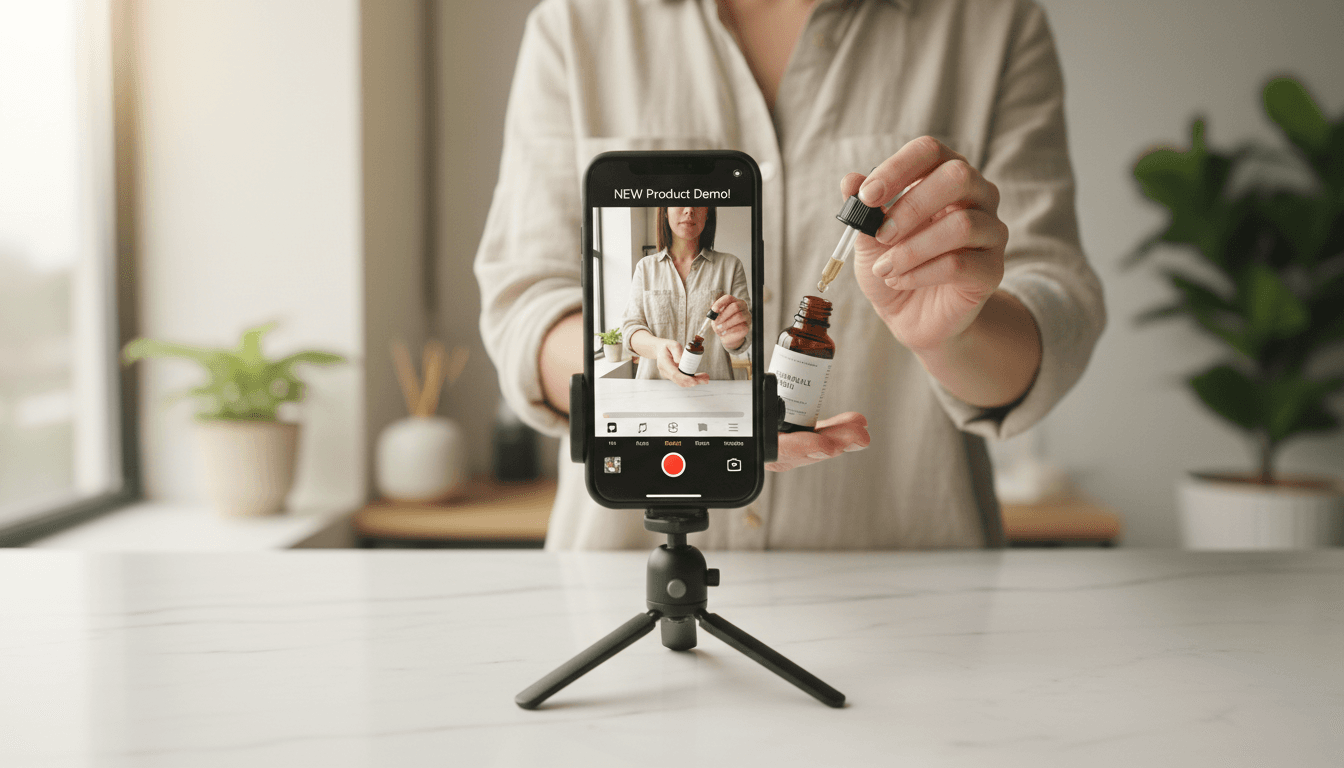
You can recreate this format with a phone, a window for natural light, and a clear script.
1) Win the first five seconds PerfectDraft used an attention-grabbing hook early. For your business, your hook doesn’t need to be flashy. It needs to be specific.
Try hooks like:
-
“Here’s how to get
[result] in 30 seconds with this.”
-
“Most people use this wrong. Do this instead.”
-
“Three features nobody notices until they try it.”
2) Demo the moment of value, not every feature If you sell a service, “demo” can mean showing:
- the before/after,
- the process step that removes effort,
- the output someone takes home.
Example: A local accountant doesn’t need to demo tax law. Demo the client experience: “Send your receipts like this → we categorise → you get a clean report.”
3) Use a presenter (yes, even if you hate being on camera) PerfectDraft’s expressive presenter helped delivery. You don’t need to be a natural performer; you need to be clear.
If you really won’t be on camera, use:
- hands-only demo (top-down),
- voiceover,
- on-screen captions with quick cuts.
4) Design for “sound off” Instagram is often watched silently. Even the source study flags this: Kantar data suggests only 16% watch with audio enabled. That means your demo must be understandable with captions alone.
Practical checklist:
- Add burned-in captions (not just auto-captions—edit them)
- Put 3–5-word labels on key steps (“Step 1: Measure”, “Step 2: Fit”, “Result”)
- Use visual proof (timer, close-up texture, screen recording, packaging labels)
Case study #2: Magnum shows the power of sensory demos (with a warning)
Magnum’s demo leaned into ASMR—built around the brand’s signature “crack” when the chocolate shell breaks. The creative idea is simple: make the product feel irresistible through sound and texture.
What made it work (and what you should copy)
Kantar’s results highlight two big wins:
- Top 3% for strong branding
- Top 6% for clear brand cues (the “crack” helped identification)
A key respondent quote in the study basically tells you why this works: “the sounds” and “the satisfying breaks” helped them imagine taste.
That’s not a feature. That’s simulation. People can almost experience the product through their screen.
The warning: don’t bet everything on audio
Magnum’s concept is sound-led, but the platform reality is harsh: most people aren’t listening. If you’re using audio cues (ASMR, satisfying clicks, pouring sounds), you need a visual fallback.
The “small business version” of the Magnum approach
Any small business can use sensory marketing. You just need to identify your product’s “signature moment.”
Examples:
- Bakery: the crust crack, steam, chocolate pull
- Trades: the “snap” of a perfect fit, smooth sealant line, straight grout finish
- Beauty: texture swipe, foam lather, colour shift
- Retail: unboxing, packaging tear, satisfying close of a magnetic box
- Services: the “before/after” scroll (messy → tidy), inbox chaos → calm dashboard
And then film it properly:
- Close-up (macro if your phone supports it)
- One clean background (wood, slate, neutral fabric)
- One strong light source (face a window)
- One hero action (break, pour, peel, click, reveal)
Add on-screen text that states the sensory promise without being cringe:
- “Listen for the crunch” becomes “Crunchy outside. Soft inside.”
- “That snap tells you it’s sealed” becomes “Leak-proof fit in 10 seconds.”
The formula behind both winners: Stop the scroll, then build memory
These two ads look different, but the mechanics are the same:
1) Stopping power
On Instagram, you’re not competing with other businesses. You’re competing with someone’s mate’s holiday Reel.
Your demo needs a pattern interrupt:
- unusual angle (top-down, extreme close-up)
- a bold claim you can prove quickly
- a “satisfying” action (cut, peel, click, transform)
- a presenter with energy (or a clear voiceover)
2) Meaningful information (fast)
PerfectDraft scored in the top 5% for “newsworthy information.” That doesn’t mean you need a “new product.” It means viewers should feel: “Ah, that’s useful.”
For small businesses, “newsworthy” often looks like:
- a clearer way to choose (size guide, skin type fit, room measurement)
- a myth-bust (“You don’t need X; you need Y”)
- a time saver (“Book in 20 seconds”, “setup takes 2 minutes”)
3) Distinctive + enjoyable
Kantar found both ads scored highly on being distinctive (PerfectDraft top 12%, Magnum top 16%) and enjoyable (PerfectDraft top 10%, Magnum top 17%).
Enjoyable doesn’t mean comedy. It means the experience of watching is pleasant: calm, satisfying, impressive, relatable.
4) Brand cues that appear early
Magnum’s branding strength (top 3%) is a reminder: don’t hide your brand until the end card.
For a small business, brand cues can be:
- your packaging in the first frame
- your uniform/van signage
- the product name spoken once (and captioned)
- a consistent filming setup (same background/colour palette every time)
A blunt rule I use: if someone screenshots your Reel, your business name should still be there.
A budget-friendly Instagram product demo plan (3 Reels, 7 days)
If you want leads and sales (not just views), consistency beats a one-off “perfect” video.
Reel 1: “How it works” (PerfectDraft style)
Goal: clarity.
- Hook: “Here’s how to get [result] in under a minute.”
- 3 steps on screen
- End: “DM ‘INFO’ and I’ll send pricing/availability.”
Reel 2: “Signature moment” (Magnum style)
Goal: desire.
- Close-up sensory shot
- 1–2 benefit captions
- End: “Order by [day] for [outcome].”
Reel 3: “Objection buster”
Goal: remove friction.
Common objections to script:
- “Is it hard to use?”
- “Will it fit my space/skin/budget?”
- “Is it actually worth it?”
Structure:
- Objection as on-screen text
- Quick proof (demo, comparison, testimonial clip)
- Clear CTA (book, buy, message)
Keep each Reel 10–25 seconds. One idea per video.
What to measure (so you don’t waste money boosting the wrong Reel)
Small business social media marketing lives or dies by what you measure.
Track these per Reel:
- 3-second view rate (your hook is working or not)
- Average watch time (your pacing is working or not)
- Saves (people intend to come back)
- Profile visits (your branding and curiosity are working)
- DMs or link clicks (it’s creating leads)
If you’re running ads, don’t optimise for vanity. Optimise for actions that create leads: DM, WhatsApp click, booking form start.
Snippet-worthy rule: A great Instagram product demo doesn’t “show everything.” It proves one useful thing fast, with your brand visible early.
Your next step: make one demo this week
Magnum and PerfectDraft didn’t win because they had expensive cameras. They won because they respected how people actually watch Instagram: quickly, silently, and with ruthless scrolling.
If you’re a UK small business trying to generate leads, start with one Reel that does one job: show the moment your product solves a problem—clearly, quickly, and with your brand cues visible.
What’s your product’s “signature moment” that would make someone stop scrolling: a transformation, a satisfying action, or a surprisingly simple setup?