AI is making TV ads realistic for UK SMEs by cutting production cost and time. Here’s how to run a first TV test without losing creative control.
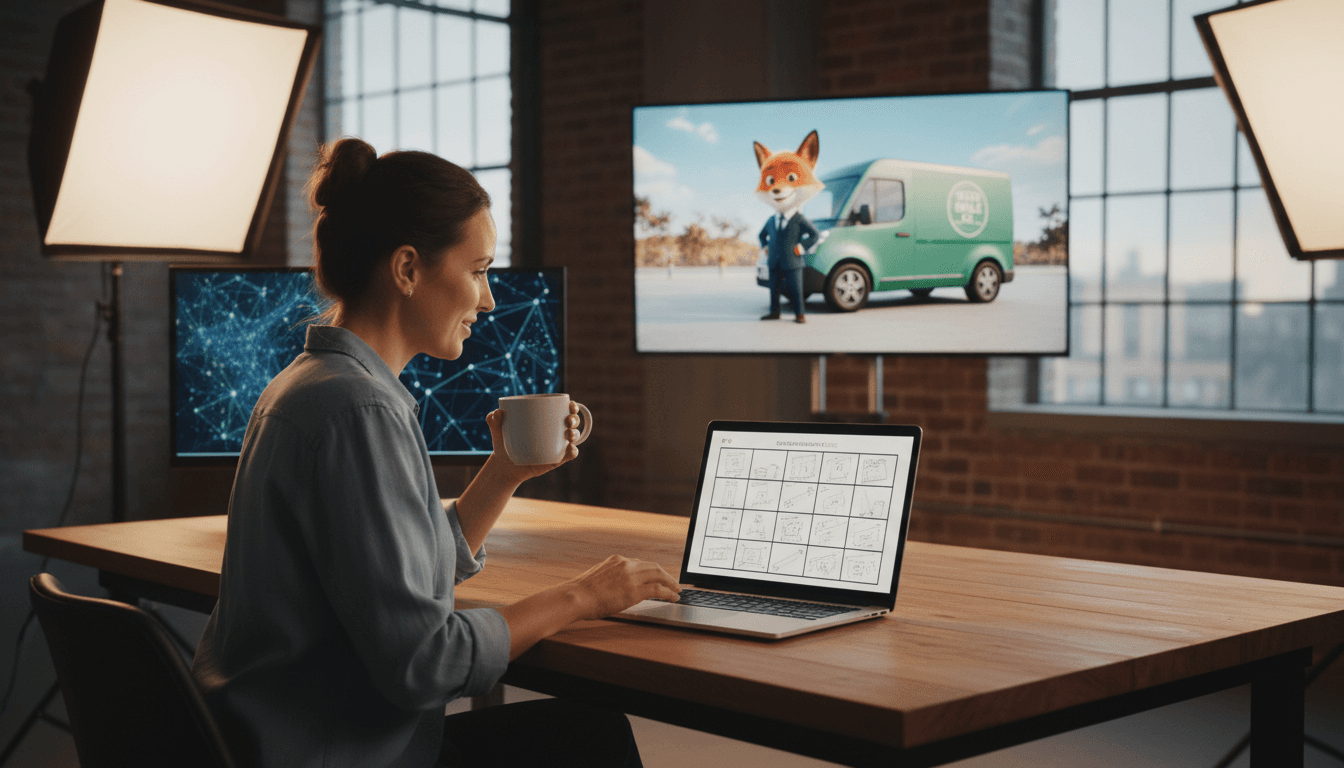
AI TV Ads for UK SMEs: Big Reach, Smaller Budgets
TV used to be the marketing channel you graduated into after you’d “made it”. If you didn’t have a chunky production budget, agency support, and the confidence to buy airtime without wasting money, you stayed on social and search.
That wall is cracking. Not because TV has suddenly become cheap, but because AI is stripping cost and time out of TV ad production—and broadcasters are actively building on-ramps for smaller brands.
For this instalment of our “AI Tools for UK Small Business” series, here’s the practical view: what’s actually changing, what still trips SMEs up, and how to run a first TV test without handing over control of your brand.
AI is making TV ads accessible by reducing production costs
The main shift is simple: AI is lowering the cost and complexity of producing TV-ready creative. Historically, production was the bit that priced SMEs out before they even got to media buying.
Marketing Week reports that adoption is already mainstream: 57.5% of brand marketers were using AI to generate content in 2025 (Marketing Week, Language of Effectiveness research). The IAB numbers in the same piece show momentum too: 30% of ads/social video/online video in 2025 were built or enhanced using generative AI, up from 22% in 2024, and expected to hit 39% in 2026.
That matters for small business marketing because it changes the question from:
- “Can we afford to make a TV ad?”
to:
- “Can we afford to place the ad where it will work?”
Or as Spirit Studios’ Matt Campion puts it in the article:
“The focus of your budget is now where you spend it rather than how you spend it — that changes everything.”
What AI actually does in a TV workflow (and what it doesn’t)
AI can speed up and reduce the cost of production tasks, especially early-stage and mid-stage work:
- Script options, hooks, and 30-second cut-down structures
- Storyboards and animatics
- Style frames and concept visuals
- Basic motion/animation and scene generation (especially non-realistic styles)
- Multiple versions for different audiences or offers
But AI doesn’t remove the need for judgment. You still need someone to:
- protect brand consistency (tone, claims, disclaimers)
- make the ad feel human and credible
- keep the message simple enough for TV
- ensure compliance (especially in regulated categories)
A strong stance: AI is best treated as a production assistant, not the creative director. When SMEs hand the wheel over completely, quality drops—and TV is not forgiving when something looks “off”.
Proof points: SMEs are already using AI to get on TV
This isn’t a theoretical future trend; UK broadcasters and agencies are already running AI-supported ad creation for smaller brands. The RSS source highlights several examples worth borrowing from.
Case study: March Muses used AI to get its first ITV campaign live
March Muses (inclusive Christmas decorations) launched its first TV campaign on ITV with AI used throughout the creative process and a reported production timeline of around four weeks from inception to delivery.
The founders’ takeaway is the mindset shift many SMEs need: TV felt like a £100,000+ world with unfamiliar acronyms and technical requirements. AI didn’t just cut costs—it made the whole process feel less “unattainable”.
A useful detail for small businesses: the ad deliberately avoided hyper-realistic humans (an “uncanny valley” trap). They leaned into an animated style—described as “more Pixar than AI”—which is a smart move if you want AI assistance without inviting scrutiny.
Case study: Channel 4’s Smart Ad Engine and a tiered model
Channel 4’s Smart Ad Engine (as referenced in the article) uses different tiers with varying levels of human creative oversight versus automation.
This tiered approach is important: SMEs shouldn’t assume “AI-made” means no humans. In practice, the best outcomes often sit at the higher end—human voiceover, human creative lead, and AI used to speed up execution.
Case study: Vistry used AI-assisted TV to support a brand refresh
Vistry used Channel 4’s Smart Ad Engine to launch its first TV advertising campaign for Countryside Homes, using existing website material as source content and keeping human intervention at key stages for accuracy and compliance.
Even if you’re not in property, there’s a transferable lesson: AI works best when you already have decent first-party assets—product pages, brand guidelines, customer FAQs, reviews, photography, and a clear offer.
The real opportunity: TV + digital targeting is now a small business play
The growth channel here isn’t “old-school linear TV” alone—it’s the blend of TV credibility with digital targeting and measurement. Connected TV, broadcaster streaming platforms, and addressable placements make TV feel more like digital marketing: audience selection, testing, and iteration.
The RSS source cites a major Thinkbox study (Profit Ability 2, 2024) that analysed £1.8bn of UK media investment across 10 channels and found TV remains the most profitable medium. It reports:
- TV accounts for 54.7% of total advertising-generated profit
- Average ROI of £5.61 for every £1 spent
- With 46.6% from linear TV and 8.2% from BVOD
For SMEs, the most useful interpretation is this: TV is still a trust amplifier, and trust is a performance lever. When someone sees your brand on a broadcaster platform, they often Google you, compare you, and buy later—especially for higher-consideration categories.
When TV makes sense for an SME (and when it doesn’t)
TV is a good fit when:
- you have a proven offer already converting via paid social/search
- you can handle a spike in demand (stock, staffing, customer service)
- your product benefits from demonstration or emotional storytelling
- you want to build brand memory, not just capture existing intent
TV is a poor fit when:
- your website conversion rate is weak (TV will just send expensive traffic)
- your positioning is fuzzy (“we do a bit of everything”)
- your offer relies on long explanations or heavy terms and conditions
A blunt rule I use: if you can’t explain the offer in one sentence, don’t buy TV yet. Fix the message first.
Risks and ethics: quality control matters more on TV than anywhere
AI lowers barriers, but it also increases the odds of “samey” creative and brand-damaging mistakes. The RSS article points to real backlash examples (including criticism of obvious AI errors in a McDonald’s Christmas ad in the Netherlands) and wider ethical concerns around AI image manipulation.
For UK small businesses, the practical risk list looks like this:
1) The “AI slop” effect (your ad looks cheap)
TV audiences are ruthless about production errors—warped hands, odd physics, strange faces. If you must use generative video, avoid realism.
What to do instead:
- choose animation, collage, stop-motion-style, or stylised product visuals
- use real product shots and real customers, then use AI for transitions/backgrounds
- keep scenes simple; fewer moving elements means fewer weird artifacts
2) Creative control drift (the tool starts steering the brand)
Broadcaster tools and templated services can push you toward what’s easy to generate rather than what’s distinctive.
Guardrails that work:
- a one-page brand sheet: colours, fonts, “we never say”, “we always say”
- locked product claims and disclaimers (especially health/finance/property)
- one clear objective per campaign: awareness, leads, or sales (not all three)
3) Compliance and claims (ASA risk)
TV and BVOD ads sit in a stricter environment than most paid social. That’s good for trust, but it means you must be careful.
Non-negotiables:
- substantiate any claim (“save £X”, “rated #1”, “results in 7 days”)
- keep records of approvals and source assets
- use human review for final cut, captions, and on-screen supers
A practical 30-day plan: your first AI-assisted TV test
The fastest path is to treat TV like performance creative testing—just with higher production standards. Here’s a realistic plan for an SME team.
Week 1: Nail the offer and measurement
- Define one action: branded search uplift, website visits, lead form completions, or store footfall
- Confirm you can attribute impact: trackable landing page, call tracking, promo code, or brand search monitoring
- Audit your website conversion path (speed, mobile UX, checkout, enquiry form)
Week 2: Build creative that’s “TV simple”
Write a script that hits:
- Problem (5 seconds)
- Promise (10 seconds)
- Proof (10 seconds)
- Action (5 seconds)
AI can help you generate script variations, but don’t let it invent claims.
Week 3: Produce 2–3 versions, not 1 perfect ad
You’ll learn more from multiple cuts than one expensive hero film:
- Version A: product-led (demo, features, offer)
- Version B: customer-led (testimonial vibe, social proof)
- Version C: founder-led (authority and trust)
Keep the visual style consistent, and test one variable at a time (hook, offer, or CTA).
Week 4: Launch small, learn fast, iterate
- Start with a short burst (1–2 weeks) on a narrow audience or region if possible
- Monitor: branded search, direct traffic, assisted conversions, enquiry quality
- Pull learnings back into paid social and search creative (TV often improves performance elsewhere)
A strong position: TV shouldn’t replace your digital marketing; it should make your digital marketing cheaper. If it’s not improving downstream conversion efficiency, something is off.
Where this fits in your broader SME AI toolkit
AI-assisted TV ads sit alongside the other “AI Tools for UK Small Business” staples: AI for ad creative testing, AI for landing page copy, AI for customer support, and AI for content repurposing. The businesses that win don’t treat these as separate projects—they build a system.
A practical way to connect the dots:
- Use AI to turn your best-performing Meta/TikTok hooks into TV script options
- Use your TV edit to create 6-second and 15-second cut-downs for paid social
- Use AI to analyse call transcripts and enquiries to refine the next TV flight’s message
The reality? AI isn’t making small businesses “big brands”. It’s making them faster learners. And speed of learning is what closes the gap.
What to do next if you’re considering TV in 2026
If you’re a UK SME and you’ve written TV off as “not for us”, revisit that assumption. The production barrier has dropped, broadcaster tooling is improving, and the trust effect of being seen on TV is still real.
Start with a simple question: If 10,000 more people Googled your business next week, would your website and offer convert them? If the answer is yes, an AI-assisted TV test could be your next sensible experiment.
And if the answer is no, that’s not a reason to ignore TV—it’s a reason to fix the fundamentals first, then bring TV in as an accelerator.