AI in Trinidad’s offshore oil and gas is shifting from efficiency to proof. See how compliance, drones, robotics, and governance fit together for 2026.
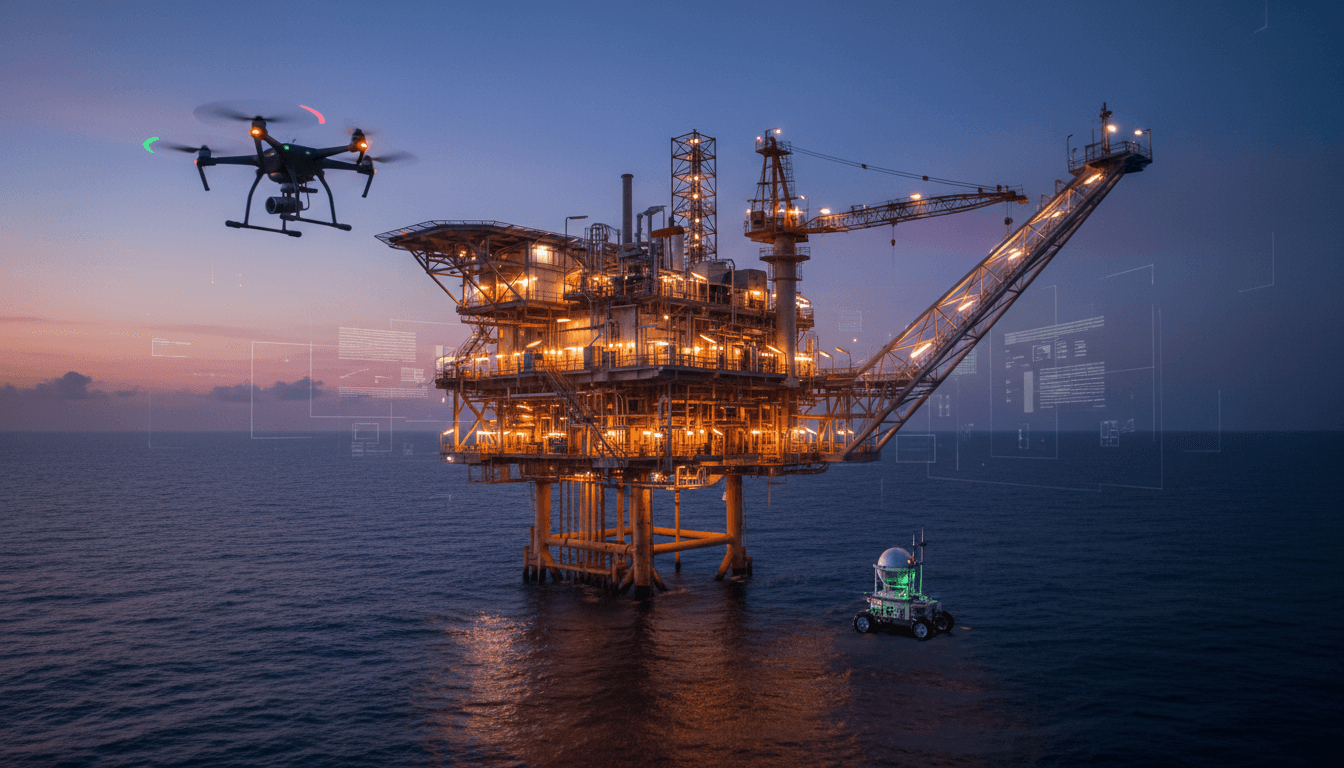
AI Compliance for Offshore Oil & Gas in Trinidad
Regulators don’t slow your offshore operation down—your internal proof does.
That’s the real lesson I took from the latest Offshore Technology Focus issue centered on rigs, productivity, robotics, drones, and end‑of‑life infrastructure. The industry conversation keeps drifting toward bigger production numbers and more automation. But the friction point is increasingly simple: can you show your work—safely, consistently, and fast—when auditors, partners, or boards ask?
For Trinidad and Tobago’s energy sector, this is timely. December is when budgets reset, annual HSE reporting wraps, and 2026 project plans harden. If you’re working offshore—production, drilling, marine, integrity, HSE, or supply chain—AI in oil and gas is no longer just about efficiency. It’s about making compliance and operational decisions defensible.
What “rigs and regulations” really signals for Trinidad and Tobago
The headline theme—rigs and regulations—points to a global shift: operators are being measured as much on governance and reporting quality as on barrels and uptime.
Even when the article focuses on the US (rig counts, policy direction, energy independence), the implication travels well: policy and regulatory pressure changes how technology gets deployed. And the more automation you add—robot dogs, autonomous subsea vehicles, drone surveys—the more you need a strong compliance backbone.
In Trinidad and Tobago, offshore teams face similar operational realities:
- Distributed assets and contractors across marine logistics, platforms, and onshore support
- High-consequence safety environments where documentation quality matters
- Growing scrutiny on emissions, flaring, methane management, and incident response readiness
- Aging infrastructure where integrity and end‑of‑life planning can’t be handled with spreadsheets alone
Here’s the stance I’ll take: Most companies treat AI as a productivity tool first. They should treat it as a compliance and decision-quality tool first. Productivity follows when the foundation is solid.
AI for regulatory compliance: turn reporting into a daily byproduct
The best compliance system is the one that runs while people do real work. If compliance depends on end‑of‑month heroics, it will fail under pressure.
AI helps when it’s used to convert operational exhaust—sensor readings, inspection notes, work orders, shift logs—into structured evidence.
What AI can automate (without creating audit nightmares)
Think in terms of repeatable “compliance moments,” not flashy pilots.
- Auto-classification of documents: permits, isolation certificates, toolbox talks, SIMOPS plans, PTW attachments
- Logbook standardization: turning free-text shift handover notes into consistent fields (equipment tag, event type, severity, time window)
- Exception detection: flagging missing signatures, expired certifications, incomplete JSA fields, or out-of-range readings
- Evidence packaging: one-click generation of an “audit-ready bundle” per event, job, or asset
A practical pattern that works:
- Capture data once (on device, in the workflow)
- AI structures it (tags, fields, metadata)
- Humans approve exceptions (not everything)
- Systems store immutable evidence trails
The KPI that matters: time-to-proof
Offshore teams already measure downtime, NPT, and safety metrics. Add one more: time-to-proof.
Time-to-proof = how long it takes to produce credible evidence for a decision, event, or task.
If it takes days to reconstruct why a valve was isolated, why a vessel was delayed, or why a flare event occurred, the organization is operating on weak governance—no matter how “digital” it appears.
Robotics and drones: the AI value isn’t the robot—it’s the data pipeline
The magazine’s focus on autonomous robotics and drone-enabled methane detection highlights a trend that’s already relevant to Trinidad and Tobago: inspection is shifting from episodic to continuous.
Robotics and drones reduce exposure hours and speed up coverage. But the real win is when inspection outputs flow into integrity decisions automatically.
Where AI fits in offshore inspections
AI becomes useful in three specific steps:
- Perception: detect corrosion, coating failure, hotspot anomalies, leaks, unusual vibration signatures
- Prioritization: rank findings by consequence and likelihood (not just “number of defects”)
- Closure: create work orders, link photos/video to equipment tags, and track remediation to completion
If your drone survey creates a folder of images that nobody reconciles to an asset register, you bought a camera system, not an integrity system.
Methane detection is becoming a board-level issue
The article mentions a large drone-based methane detection campaign in the North Sea. Whether you’re measuring methane via drones, fixed sensors, or handheld surveys, the governance challenge is the same:
- Data must be comparable over time
- Methods must be explainable to stakeholders
- Findings must translate into actions (repairs, changes in procedures, equipment upgrades)
A smart approach for Trinidad and Tobago operators is to treat methane management as an operational program, not a PR exercise.
- Define a baseline (by asset, by month)
- Use AI to spot recurring patterns (same flange family, same compressor train, same weather/operating conditions)
- Tie detection to maintenance closure times
Offshore automation that actually works: start with 3 “boring” use cases
Automation fails offshore when it’s introduced as a “platform” instead of a solution to a measurable pain.
If you want AI in offshore operations to stick, start with use cases that are boring, repeatable, and expensive when done manually.
1) Predictive maintenance for rotating equipment (but scoped)
Answer first: Predictive maintenance works when you choose a narrow equipment class and a clear decision.
Pick one: gas compressors, seawater lift pumps, or power generation auxiliaries. Define the decision AI will support:
- “Do we pull the unit at the next shutdown?”
- “Do we reduce load and monitor?”
- “Do we run and schedule a planned intervention?”
Then connect:
- Vibration + process parameters + maintenance history
- Operator rounds (yes, the handwritten notes matter)
- Failure modes and thresholds that engineers agree to
2) AI-assisted permit-to-work quality control
Answer first: PTW systems improve when AI checks completeness and conflicts before a supervisor sees it.
Common offshore issues are predictable:
- SIMOPS conflicts that aren’t flagged early
- Missing isolations or inconsistent equipment tags
- Risk controls copied forward without thinking
AI can highlight:
- Contradictory fields (job location vs equipment tag vs isolation point)
- High-risk combinations (hot work near hydrocarbon lines, lifting near live process)
- “Template drift” where old controls are reused without relevance
The goal isn’t replacing authorization. It’s reducing preventable rework and improving control quality.
3) Integrity backlogs and end-of-life planning
Answer first: Aging assets need AI to rank integrity work by consequence, not by whoever shouts loudest.
The magazine’s look at end-of-life rigs and repurposing is a reminder: decisions about decommissioning, repurposing, or life extension are data-heavy and political.
AI can help you:
- Consolidate inspection findings into a single asset health view
- Forecast backlog growth under different budget scenarios
- Compare life-extension capex vs decommissioning pathways
For Trinidad and Tobago, where offshore infrastructure maturity varies by field and operator, this is where AI delivers strategic value, not just operational convenience.
Governance: the fastest way to derail AI is weak data ownership
AI introduces a new kind of operational risk: confident answers built on messy inputs.
If you want AI adoption without reputational surprises, set governance rules before you scale.
A practical AI governance checklist for offshore teams
You don’t need a 40-page policy to begin. You need clarity on five items:
- Data ownership: who owns tag hierarchies, equipment criticality rankings, and master data changes?
- Model boundaries: what decisions can AI recommend vs what decisions require human sign-off?
- Audit trails: can you reproduce inputs and outputs for a given recommendation?
- Cybersecurity: are inspection devices, drones, and robotics integrated with secure identity and patching?
- Change management: how will offshore crews be trained and how will feedback be captured?
A sentence worth repeating internally:
If AI can’t be explained to an auditor, it won’t survive a real incident review.
“People also ask” (and the answers that matter offshore)
Is AI in oil and gas mostly about cost reduction?
No. Cost reduction is a side effect. The primary value offshore is decision quality—fewer unplanned events, faster evidence production, and tighter integrity control.
Will regulators accept AI-generated reports?
They’ll accept your process if it’s controlled. That means human accountability, traceable data sources, and a clear method statement for how outputs are generated.
Where should Trinidad and Tobago operators start with AI?
Start where you already have recurring pain:
- Inspection reporting backlogs
- PTW rework and SIMOPS conflicts
- Rotating equipment downtime
- Emissions measurement and remediation tracking
What to do next if you want AI that improves compliance (not just dashboards)
If you’re reading this as part of our series on how AI is transforming the energy and oil & gas sector in Trinidad and Tobago, here’s the practical next step: pick one compliance-heavy workflow and redesign it so reporting becomes automatic.
A simple approach I’ve seen work is a 30-day “proof sprint”:
- Week 1: map one workflow (PTW, inspection, emissions survey, or maintenance)
- Week 2: identify 10 fields that must be captured consistently
- Week 3: automate extraction and exception checks
- Week 4: run a mock audit—time how fast you can produce evidence
If your team can cut time-to-proof from days to hours, you’ll feel the impact immediately—less firefighting, fewer meetings, better trust.
So here’s the forward-looking question: If an offshore incident review happened tomorrow, how quickly could you produce a clean, defensible story from your data—without calling in five people to rebuild it by hand?