AI methane emissions measurement helps Trinidad and Tobago operators find leaks faster, verify fixes, and report defensible numbers. Start with a baseline plus routine verification.
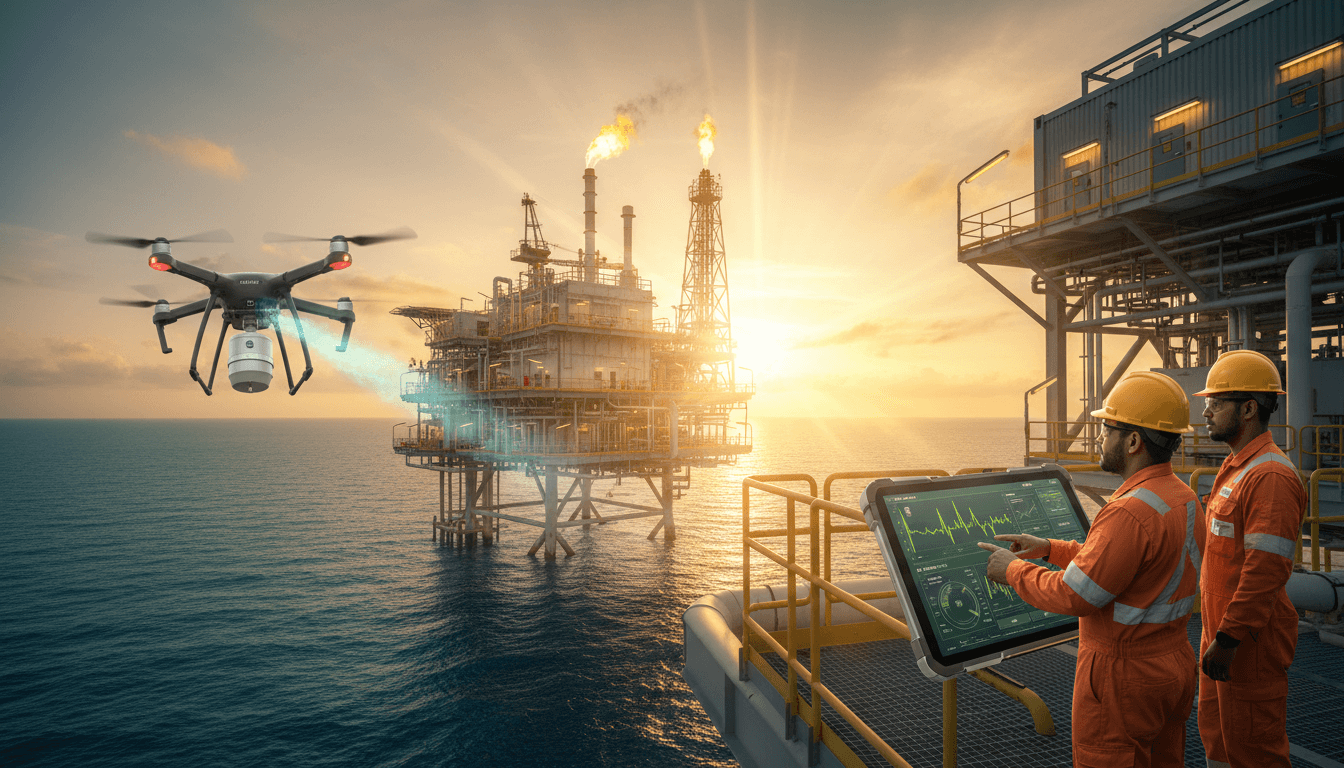
AI Methane Monitoring for Trinidad & Tobago Oil & Gas
Methane isn’t a “nice-to-have” climate topic anymore—it’s the fastest credibility test the oil and gas sector will face in the next few years. The reason is simple: the energy sector holds about 72% of methane mitigation potential, so if emissions data is wrong (or unverifiable), everything downstream gets harder—reporting, financing, operational decisions, even licence-to-operate conversations.
Here’s the part most companies get wrong: they treat methane measurement as a compliance chore and rely on estimates because “measurement is hard,” especially offshore. But recent campaigns offshore have shown that measured emissions can be materially different from operator-reported values. When the gap is that large, the problem isn’t just leaks—it’s the measurement system.
For Trinidad and Tobago, this matters right now. We’re an energy economy with offshore complexity, tight operating margins, and rising expectations from customers and regulators. The good news: AI methane emissions measurement is finally practical. Not magic. Practical. And it’s one of the clearest ways AI is transforming the energy and oil & gas sector in Trinidad and Tobago—because it turns raw sensor signals into decisions crews can act on within days (and increasingly, within 24 hours).
Why accurate methane measurement is the real bottleneck
Accurate methane monitoring is the bottleneck because you can’t reduce what you can’t reliably locate, quantify, and verify. Everyone knows the mitigation playbook—repair leaks, replace components, improve flaring performance, plug wells. The sticking point is proving where methane is coming from and how much is escaping.
Methane is also powerful on climate timescales that matter to policy and corporate targets. Over a 30-year period, methane is around 83 times stronger than CO₂, and it’s linked to roughly 30% of the rise in global temperatures since the Industrial Revolution. That’s why international pressure keeps intensifying—from global pledges to new satellite programs that make “out of sight, out of mind” a risky strategy.
Offshore reality: why estimates persist
Offshore platforms are dense, multi-level industrial environments. Sightlines are blocked, deck space is limited, and wind changes quickly over open water. Those conditions create three practical problems:
- You miss intermittent leaks with periodic surveys (especially short-lived high-volume events).
- Wind-driven plume dispersion makes quantification tricky without good meteorological context.
- Traditional tools are either too bulky or too expensive to deploy frequently at scale.
If you’re operating offshore assets connected to Trinidad and Tobago’s gas value chain, this is familiar. And it’s exactly why AI belongs in the methane conversation: AI doesn’t replace sensing—it makes sensing repeatable, scalable, and fast enough to drive operations.
What “AI methane monitoring” actually means (and what it doesn’t)
AI in methane measurement isn’t a single tool. It’s a workflow that combines sensors with automated processing, quality checks, and decision support.
A plain-English definition you can use internally:
AI methane monitoring is the use of machine learning and automated analytics to convert sensor observations (concentration + wind + location) into verified emission rates, likely sources, and actionable repair priorities.
What it doesn’t mean:
- It doesn’t mean a model “guesses” emissions without data.
- It doesn’t mean you can skip calibration, QA/QC, or field validation.
- It doesn’t mean the tech works if operations can’t act on the results.
Where AI does shine is in the steps that used to slow everything down:
- Automating repeatable analysis steps so reporting time drops from months to weeks—or even ~24 hours in advanced programs.
- Classifying plume patterns to reduce false positives and improve confidence.
- Fusing multiple data sources (drone + satellite + fixed sensors + maintenance logs) into one picture a reliability team can use.
Drones, satellites, and lasers: the measurement stack that fits T&T
The most effective methane programs don’t pick one method—they build a stack. Offshore operators in harsh environments have already demonstrated that scaled campaigns are possible when the methodology is built for repeatability.
One major offshore campaign in the Norwegian North Sea measured emissions across 33 platforms, ran for 353 days, and involved 701 flights. The lesson isn’t “copy Norway.” The lesson is that industrial-scale methane measurement offshore is doable when flight planning, data-quality checks, and analytics are designed together.
A practical monitoring design (baseline + routine verification)
For a typical offshore asset, a responsible approach looks like this:
-
Annual baseline measurement
- Goal: establish a high-confidence emissions inventory.
- Methods: aircraft and/or satellite screening plus targeted drone or on-platform measurement.
-
Quarterly or semi-annual verification
- Goal: detect changes, confirm repairs, find new sources.
- Methods: drone surveys, scanning lasers, and continuous area monitoring where appropriate.
-
Event-driven measurement
- Triggered by compressor maintenance, upsets, flaring anomalies, or process changes.
- Goal: catch “short, big” emissions that inventories often miss.
For Trinidad and Tobago, this stack is compelling because it fits how offshore operations already run: planned shutdowns, maintenance windows, and verification cycles.
Where AI delivers value: speed, accuracy, and source attribution
AI earns its keep in methane monitoring when it improves three things at once: accuracy, time-to-insight, and source attribution.
1) Better accuracy through wind-aware quantification
Offshore quantification fails when wind is treated as an afterthought. Modern drone methodologies increasingly measure wind variation with similar granularity as methane concentration. AI helps by:
- Learning relationships between plume shape and wind field
- Flagging unstable conditions that reduce confidence
- Producing consistent emission-rate estimates across repeat flights
A simple stance: if your vendor can’t explain how wind uncertainty is handled, you don’t have “measurement,” you have a nice picture.
2) Faster reporting that operations teams can use
I’ve found that methane programs fall apart when results arrive too late to matter. If analytics and reporting land months later, you’ve already lost the operational moment.
Automation is closing that gap. In the last 18 months, some operators have seen reporting timelines shrink to as little as 24 hours. That’s the point where methane monitoring stops being “ESG reporting” and becomes maintenance intelligence.
3) Source attribution: turning “a plume” into “a work order”
Finding methane isn’t enough. You need to tie it to likely equipment and prioritize action. AI can support:
- Plume-to-source mapping (valves vs tanks vs compressors)
- Asset-level ranking of emission contributors
- Repair verification (did the fix reduce the measured rate?)
This is where Trinidad and Tobago operators can gain real efficiency: fewer blind inspections, fewer wasted maintenance hours, and clearer justification for targeted capex.
The path to autonomy: what to automate first (and what blocks it)
Autonomous measurement is where the industry is heading—unmanned flights, data streaming to servers, automated processing, and rapid reporting to local teams. It’s attractive because it lowers cost per survey and increases frequency.
But “autonomous” offshore runs into real constraints:
- Regulations for autonomous flights and beyond-visual-line-of-sight operations
- Airspace safety around busy platform operations
- Battery and weather limits offshore
- Data quality requirements (repeatability, calibration, audit trails)
A better approach is staged automation.
A staged automation roadmap for offshore T&T
Start with automation that reduces cycle time without increasing operational risk:
-
Automate QA/QC and anomaly detection
- Auto-flag bad wind conditions, sensor drift, or incomplete coverage.
-
Automate reporting and work-order creation
- Output: “Probable source + estimated rate + confidence + recommended follow-up.”
-
Introduce semi-autonomous flight patterns
- Consistent flight paths improve repeatability—one of the biggest drivers of comparable data.
-
Move to autonomous missions where regulations allow
- Treat autonomy as a safety and governance project, not just a tech upgrade.
If you’re trying to build AI capabilities in Trinidad and Tobago’s energy sector, this roadmap also creates a clear internal capability ladder: data governance → analytics → integration with maintenance → autonomy.
Measurement and verification: how to make results defensible
Methane measurement becomes valuable when it’s defensible to auditors, regulators, partners, and leadership. That’s “measurement and verification” in practice.
Here’s what defensible looks like for offshore methane monitoring:
- Repeatable flight paths and consistent methodology
- Calibration and traceability of sensors
- Clear uncertainty bounds (not just a single number)
- Audit-ready data lineage: raw data → processing steps → final estimate
- Independent verification options via a second method (e.g., satellite screening + drone quantification)
A blunt truth: transparent uncertainty beats overconfident numbers. Operators get into trouble when they publish precise-looking estimates that can’t be reproduced.
What Trinidad and Tobago companies should do in Q1–Q2 2026
If you’re responsible for operations, HSSE, sustainability reporting, or digital transformation, the next six months are the ideal time to move from “methane is important” to “methane is operational.”
A practical starter plan
- Pick 1–2 pilot assets (preferably one complex, one simpler)
- Run a baseline measurement campaign and build an initial emissions inventory
- Set a verification cadence (quarterly is a good starting point)
- Define action thresholds
- Example: “Any confirmed source above X kg/hr triggers an investigation within Y days.”
- Integrate outputs into maintenance workflows
- If findings don’t become work orders, the program will stall.
- Stand up a simple methane data model
- Asset, timestamp, method, estimated rate, uncertainty, source category, repair status
What to ask vendors (or your internal team)
Use these questions to separate real capability from marketing:
- How do you quantify emissions under variable offshore wind?
- What’s your typical time from measurement to report?
- How do you ensure repeatability across surveys?
- Can you provide uncertainty and confidence scoring?
- How do you support repair verification?
- What does integration into CMMS or maintenance planning look like?
Where this fits in the broader “AI in T&T energy” story
This blog is part of our series on How AI Is Transforming the Energy and Oil & Gas Sector in Trinidad and Tobago. Methane monitoring is a great example because it forces AI to prove itself in the real world: messy data, harsh environments, operational constraints, and the need for auditability.
The companies that win won’t be the ones with the fanciest dashboards. They’ll be the ones that can say, with evidence: “We measured it, we fixed it, and we verified the reduction.” That’s how you build trust with stakeholders while also saving money through targeted maintenance.
If you’re thinking about an AI methane emissions measurement program for Trinidad and Tobago—drones, satellite analytics, continuous monitoring, or all three—start small but insist on measurement quality and operational integration. The next question to answer isn’t “Can we detect methane?” It’s: how fast can we turn detection into verified reductions?