Learn Singapore SME digital marketing lessons from teen barbers who grew with TikTok, trust content, and smart ops. Turn attention into leads.
Digital Marketing Lessons from Singapore’s Teen Barbers
S$195 in a day, earned by a teen with clippers and a phone, is the kind of number that makes SME owners pay attention. Not because everyone should become a barber—but because it shows how fast a traditional trade can grow when it’s packaged for the internet.
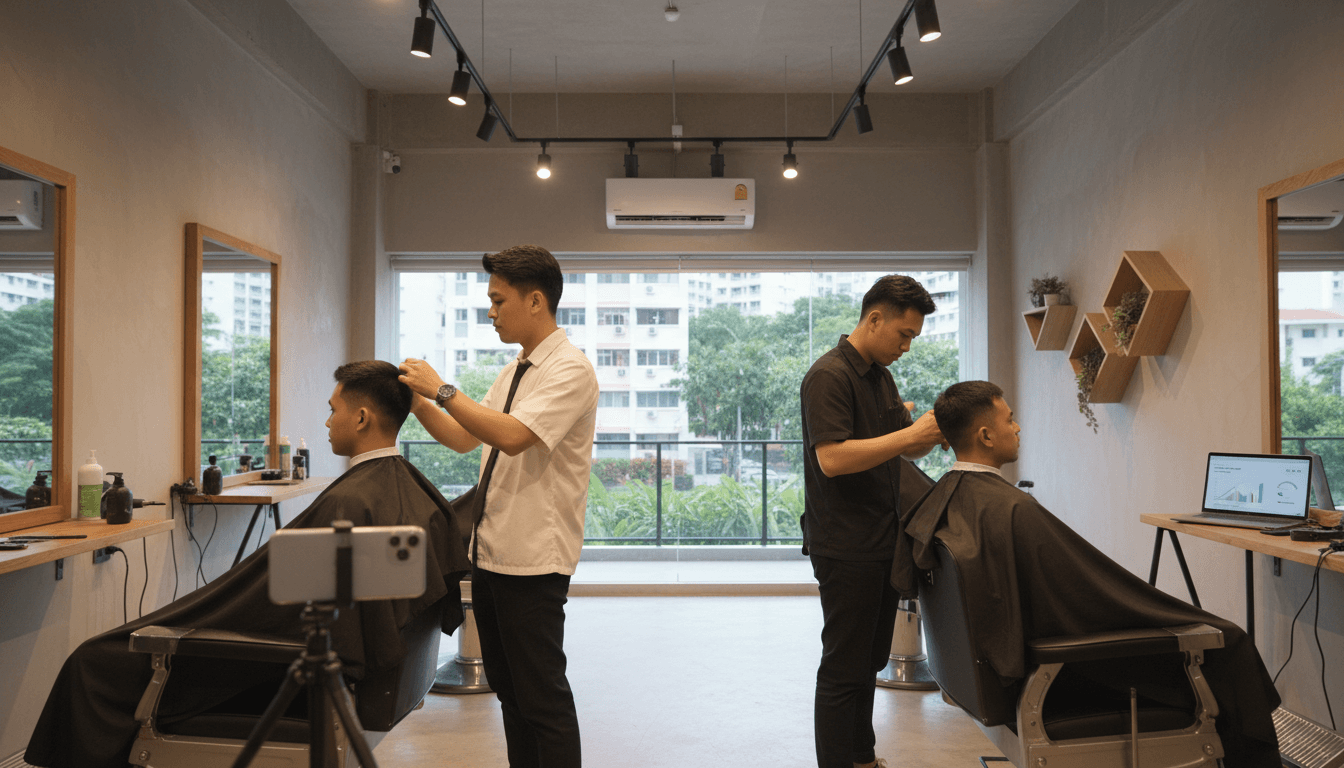
A recent Singapore story from Vulcan Post followed two young barbers—19-year-old Sujaish Kumar and 14-year-old Keanu Akbar—who built real demand from humble setups (think HDB corridors and staircases) and then used TikTok and messaging channels to scale. What they did isn’t “youth luck” or a one-off viral moment. It’s a repeatable playbook that plenty of Singapore SMEs can borrow.
This post is part of our Singapore SME Digital Marketing series, and I’m going to treat these teen barbers like a case study: what worked, what broke, and what most businesses should copy (and what they shouldn’t).
The real shift: barbering didn’t change—distribution did
Barbering is still barbering. The difference is that younger operators are treating it like a modern consumer brand: visible, documented, reviewable, and shareable.
Sujaish started because “good” haircuts felt overpriced for a secondary school budget—S$30 was too steep, S$10–S$12 often meant uneven results. So he bought clippers with about S$50, practised on friends for free, then began charging S$5, then S$8 as quality improved. Keanu followed a similar pattern, training from online tutorials and charging S$3 after a year of practice.
The business lesson for SMEs: pricing power comes after proof. And proof is easier to show than ever.
What Singapore SMEs should copy
- Build visible proof of quality: before/after, short process clips, reactions, and repeat-customer moments.
- Start narrow, get specific: “skin fade for students” beats “haircuts for everyone” when you’re building early traction.
- Treat content as distribution, not decoration: the content is the sales engine.
They didn’t “go viral.” They engineered trust at scale.
Most companies obsess over virality. The smarter move is to obsess over trust—because trust is what converts, retains, and justifies higher prices.
Sujaish’s TikTok video (“How much I make as a 17-year-old barber in Singapore”) reportedly showed S$195 earned in a day. That kind of transparency is catnip to viewers because it feels real. It also earned him attention from mainstream outlets.
Keanu’s exposure came through an interview that increased demand: his Telegram subscribers doubled from ~150 to 350, and his TikTok following tripled from ~400–500 to ~1,200.
Here’s the marketing principle: social proof compresses time. It shortens the journey from “who are you?” to “where do I book?”
An SME checklist for “trust content”
If you run a Singapore SME—F&B, home services, tuition, clinics, renovation, retail—these formats work across categories:
- Price transparency (selectively)
- Not always full pricing, but at least clear starting prices and what affects cost.
- Process transparency
- “How it’s done” content reduces buyer anxiety.
- Outcome proof
- Before/after, results, timelines, and what customers should realistically expect.
- Personality + principles
- What you won’t compromise on (hygiene, punctuality, materials, service standards).
Snippet-worthy truth: “Virality gets you attention; operational clarity keeps customers.”
Word-of-mouth still matters. Digital just makes it measurable.
Both barbers started with the oldest growth channel in Singapore: word-of-mouth. The difference is how quickly it can now be amplified.
When your “referral” happens on TikTok or Instagram Reels, it doesn’t just reach one friend—it reaches a neighbourhood, a school cohort, and eventually a whole segment.
For SMEs, the goal isn’t to replace word-of-mouth. The goal is to systemise it.
What systemised word-of-mouth looks like
- A single booking link (WhatsApp/Telegram/form) placed everywhere
- A consistent content rhythm (e.g., 3 short videos a week)
- A simple referral trigger (“Tag a friend who needs this”) that’s relevant, not desperate
- A repeatable customer journey: discover → proof → book → show up → follow-up
If you can’t describe your customer journey in one breath, your marketing will always feel expensive.
The scaling moment: demand is easy—operations are hard
The story also shows where many fast-growing small businesses stumble: operations and compliance.
Sujaish had to move from corridor cutting after HDB flagged potential disturbance to neighbours. He shifted operations into his home, increased pricing (starting at S$30), and added higher-value services like house calls at S$50. Eventually, he opened a small studio space (around 100 sqft) at Potong Pasir, investing over S$1,000 into rental and upgrades.
Keanu moved into his home setup partly due to comfort and practicalities—rain and wet staircases are not a premium experience.
Here’s the blunt takeaway: marketing can’t fix a fragile operating model.
Practical scaling advice for Singapore SMEs
If you’re using social media marketing to grow, put these in place early:
- Capacity rules: max bookings/day, buffer time, cut-off hours
- Deposit/no-show policy: simple, polite, clearly stated
- Service menu clarity: “what’s included” prevents conflict later
- Location and compliance: home-based rules, noise, hygiene, licensing where relevant
- Upgrade roadmap: what you’ll buy next when revenue hits milestones
Another quotable stance: “If your content works, your backend will be tested within weeks.”
Audience targeting: teens selling to adults (and winning)
One of the most interesting parts of this case is audience segmentation.
You’d think teen barbers only attract teen customers. In practice, their audience spans:
- Students who want trend-forward cuts
- Young working adults who discover them online
- Parents booking for sons (especially if safety, hygiene, and comfort are clear)
Their marketing isn’t “for everyone,” but it is discoverable by everyone.
How to apply this to your SME targeting
Most Singapore SMEs either:
- Target too broadly (“Singaporeans”), or
- Target by demographics only (“women 25–45”), without intent.
A better approach is intent-based targeting:
- “People who need a haircut before CNY visits”
- “Parents booking weekend slots”
- “Working adults who want after-office appointments”
Seasonality matters right now too. Early February is peak relevance for:
- CNY-related grooming and services
- Family gatherings, visiting, and photo-heavy social events
SMEs should plan content and offers around real calendar behaviour, not generic monthly posting.
A 30-day digital marketing plan inspired by these teen barbers
If I were advising a small service business in Singapore (barber, nails, tuition, cleaning, fitness, repair), here’s a realistic 30-day plan that borrows what worked in this story.
Week 1: Build a “proof library”
- Film 10 short clips: process, outcomes, your tools, your space, your standards
- Collect 10 testimonials (text or video)
- Create a simple service menu + starting price
Week 2: Post for discovery (not vanity)
- 3 short videos + 3 stories a week
- Each post answers one practical question:
- “How long does it take?”
- “Who is this good for?”
- “What should I prepare?”
Week 3: Convert attention into bookings
- Add a booking system (even if it’s just WhatsApp with a template)
- Create a pinned post: services + price range + how to book + location
- Use limited slots (real scarcity) instead of discounts
Week 4: Improve retention
- Follow-up message after service
- Offer a next-appointment recommendation (“Come back in 3–4 weeks”)
- Create a simple referral offer that doesn’t cheapen your brand
This is how you turn “content” into lead generation.
What most SMEs get wrong when copying TikTok success
Some businesses see this story and think, “We need to post more.” That’s not the point.
The point is to build a brand people can quickly understand and trust.
Common mistakes I see in Singapore SME digital marketing:
- Posting only promotions (no proof, no personality, no standards)
- Inconsistent pricing (customers sense chaos)
- No clear booking path (people give up fast)
- Chasing trends that don’t match your customer intent
A small business doesn’t need to be everywhere. It needs to be easy to choose.
The bigger lesson for Singapore SMEs: trades win when branding is modern
These teen barbers prove something practical: traditional industries don’t have a demand problem—they have a storytelling problem.
Sujaish and Keanu didn’t wait for a shopfront, a big budget, or perfect equipment before putting themselves out there. They built skills, documented progress, used social media to create reach, and then reinvested into better customer experience.
If you’re running an SME in Singapore, this is the stance I’ll take: your digital presence is part of your product. People judge your reliability from your content, your replies, and your booking flow.
If you want help turning your service into a steady lead pipeline (not random spikes), start by auditing two things: your proof and your process. Then make them visible.
What would happen to your business if your best customer story became discoverable to 50,000 locals—tomorrow?