CNY digital marketing doesn’t need big budgets. Learn practical seasonal campaign tactics from 5 Singapore home-based SMEs—story, drops, and lead capture.
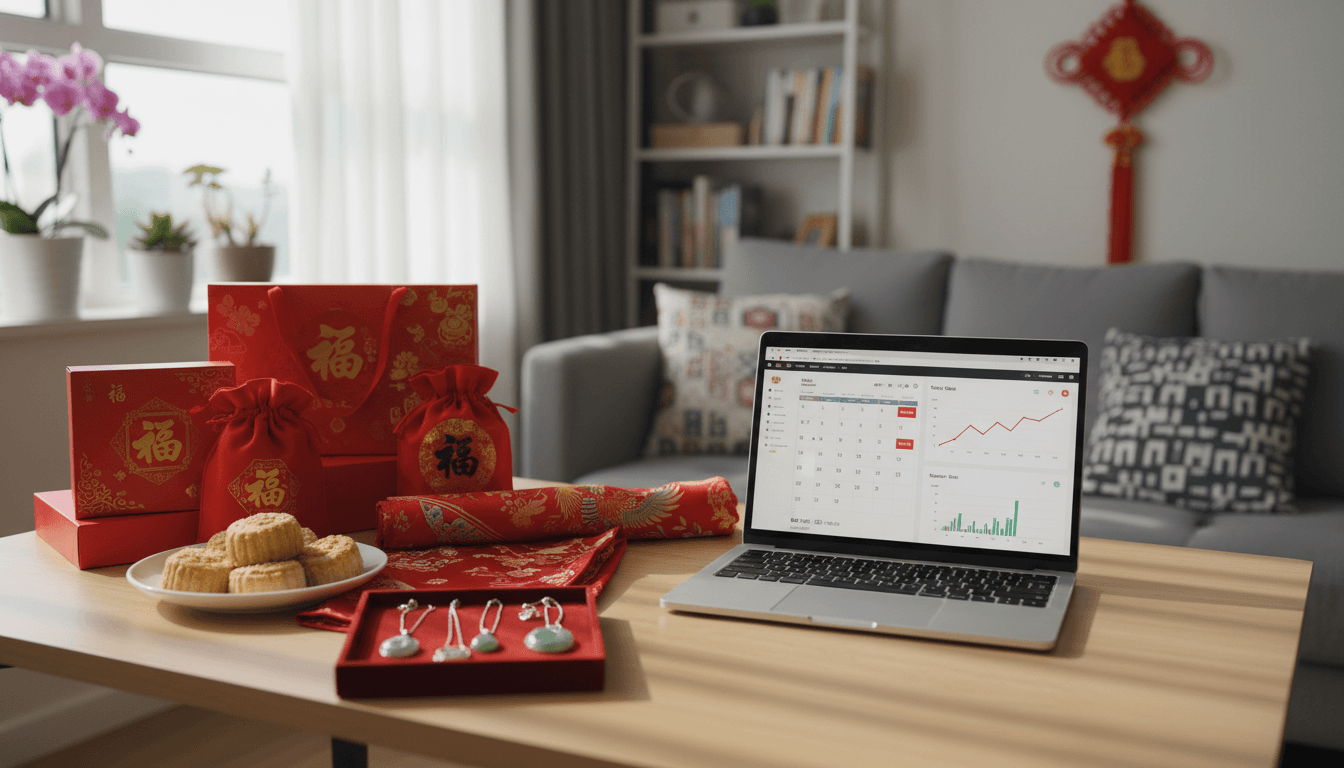
CNY Digital Marketing Lessons from 5 S’pore SMEs
CNY season in Singapore isn’t “just a holiday spike”—it’s one of the few moments in the year when customers actively want to discover new brands, pay a premium for convenience, and share purchases socially. For home-based businesses and SMEs, that’s a rare advantage.
Most companies get this wrong by treating Chinese New Year marketing as a last-minute promo blast. The reality? The winners run a short, disciplined digital campaign: clear product story, pre-orders with deadlines, and content that’s built for sharing.
Vulcan Post recently highlighted five Singapore home-based businesses selling CNY goodies—from pineapple tarts to cheongsams and silver jewellery. I’m using them as mini case studies for this Singapore SME Digital Marketing series: what they’re doing (intentionally or not) that makes their festive marketing work, and what you can copy for your own seasonal campaign.
What these 5 home-based businesses get right (even without big budgets)
They’re not competing like big brands—they’re competing like specialists. That’s the core advantage of home-based SMEs: you can win on personality, story, craft, and scarcity.
Across the five businesses, three patterns show up repeatedly:
- A clear “why this, why us” story that makes the purchase feel personal (not transactional).
- A simple buying path (DM, website order form, timed drops, appointments).
- Built-in urgency through limited slots, collection windows, or launch dates.
These are digital marketing fundamentals. You don’t need a huge ad budget; you need fewer steps between “I saw this on Instagram” and “my order is confirmed.”
Here’s the practical lens: If your CNY campaign doesn’t have (a) a shareable hook and (b) a deadline, you’re leaving demand on the table.
Case studies: 5 Singapore SMEs and the digital tactics you can borrow
Answer first: Each business below demonstrates one “repeatable” festive marketing move—story, scarcity, community, or product positioning—that Singapore SMEs can apply to CNY-themed products.
1) Knead Kopi: community storytelling that sells without screaming “sale”
Knead Kopi started as a personal project and became a neighbourhood hangout—run from a front porch at Watten Rise, with the founder’s grandmother involved in the baking. That story does something paid ads struggle to do: it creates emotional relevance.
What to copy for your SME marketing:
- Turn your origin story into content pillars. Don’t write a long “About Us” page and call it branding. Build 3–5 repeatable themes: founder routine, behind-the-scenes prep, customer moments, and product testing.
- Use CNY as a reason to reintroduce the brand. Festive products (pineapple tarts, honeycomb cookies, even bakkwa cookies) become a seasonal “excuse” for customers to try you.
- Make ordering feel frictionless. A simple online ordering page + clear self-collection instructions beats complicated multi-step checkout.
If you’re running a home-based F&B SME, your best-performing content usually isn’t a polished product photo. It’s the process, the people, and the proof that others are buying.
2) The Jomu Co: personalised gifting wins CNY because it’s social
The Jomu Co focuses on keepsakes and personalised gifts, with a CNY decor collection featuring auspicious phrases like 福 (fortune) and 出入平安 (peace and safety in and out). CNY decor isn’t just a product category—it’s a share category. People show their home setup, visiting photos, table arrangements, and gift exchanges.
What to copy:
- Design for the camera. A product that looks good in a home, on a door, or in a flat-lay has higher organic reach on Instagram and TikTok.
- Create a “small yes” price point. For seasonal campaigns, a lower-priced hero item increases conversion and gifting volume.
- Product naming matters for SEO. Use real query language: “CNY door hanging ornament,” “Chinese New Year home decor Singapore,” “CNY personalised gift.” These phrases help both Google and AI search find you.
If you sell lifestyle products, CNY is your chance to build a content loop: inspiration → purchase → customer posts → reposts → more inspiration.
3) SG Brisket Kitchen: scarcity and timed drops turn demand into discipline
SG Brisket Kitchen has fans queueing online at a specific time to secure slots. That’s not an accident—it’s controlled supply meeting predictable demand. For CNY, they offer festive specials with clear prices (e.g., radish cake with lap yok at S$88; smoked & braised poulet set at S$108) and defined delivery/pick-up windows.
What to copy:
- Run “drop-style” pre-orders. Instead of leaving orders open endlessly, use a weekly release time. It creates a habit.
- Publish a capacity statement. Example: “50 sets/week” or “orders close when sold out.” Customers respect boundaries when you communicate clearly.
- Build a waitlist before you sell. A simple Google Form or landing page can capture leads 7–14 days before your drop.
This is one of the cleanest lead generation plays for Singapore SMEs: collect leads first, sell second. Your email/WhatsApp list becomes an asset you can use beyond CNY.
4) Golden Scissors Cheongsam: appointments create premium positioning
Golden Scissors Cheongsam shifted from a public Chinatown stall to a home showroom model, with visits by appointment. This is a powerful lesson for service-led SMEs: “appointment only” isn’t a limitation; it’s a positioning tool.
What to copy:
- Use scheduling to qualify leads. If your product needs fitting, consultation, or browsing time, appointment booking filters serious buyers.
- Turn the visit into content. With permission, share “trying session” clips, fabric close-ups, and styling tips. These videos often outperform static posts.
- Local SEO still matters. Even if you’re home-based, you can optimise your web presence with service area descriptions (e.g., “cheongsam Singapore,” “cheongsam fitting appointment”).
A lot of SMEs in Singapore underprice because they fear losing customers. Appointment-based selling is one way to justify premium pricing—by making the experience feel curated.
5) WhoWantSayNow: product drops + creator proof build hype fast
WhoWantSayNow is a home-based silversmith brand with hand-sculpted jewellery and a Lunar New Year collection launch date and time. They’ve also built credibility through offline markets and creator/music links.
What to copy:
- Announce a launch time like it matters. “Feb 6, 9pm” is a simple tactic, but it trains customers to show up.
- Borrow trust from communities. Pop-ups, markets, collaborations, and creator placements give you social proof that ads can’t buy.
- Make your product story concrete. “Hand-sculpted silver” is a differentiator. Say it early, say it often, and show it in close-up video.
For DTC SMEs, this is the modern CNY play: small batch + clear craft identity + drop-style selling.
A practical CNY digital marketing plan (that fits home-based SMEs)
Answer first: A strong Chinese New Year digital marketing plan has four parts—offer, content, conversion, and follow-up—and can be executed in 14–21 days.
Here’s a campaign structure I’ve found works for Singapore SMEs without a big team.
Phase 1 (Day 1–5): Build the offer and the buying path
You need one main offer and one backup offer.
- Hero product: the easiest-to-explain, most giftable item (or set).
- Upsell: add-on items (e.g., extra jars, bundles, premium packaging).
Lock the basics:
- Prices
- Cut-off dates
- Collection/delivery windows
- Payment method
- Refund/substitution policy
If customers must DM you, use a template:
“Hi! To order: 1) item name 2) quantity 3) collection date/time 4) contact number. We’ll confirm within 12 hours.”
That single message reduces back-and-forth and increases conversions.
Phase 2 (Day 6–14): Content that answers objections
Your content shouldn’t just look nice. It should answer: Is it worth it? Can I trust you? Can I get it in time?
Post ideas that convert during CNY:
- Behind-the-scenes production (proof of effort and hygiene)
- Packaging and gifting walkthrough (reduces uncertainty)
- Delivery/collection clarity post (cuts pre-sale questions)
- Customer review screenshots (high trust, fast)
- Limited slots countdown (ethical urgency)
A simple weekly cadence:
- 2 Reels/TikToks (process + product)
- 2 carousel posts (pricing, menu, FAQs)
- 3–5 Stories/day (stock updates, polls, Q&A)
Phase 3 (Day 15–18): Run a tight lead capture + retarget loop
Even if you’re not running ads, you can still do “retargeting” manually:
- Create a waitlist (email or WhatsApp)
- Send a launch reminder 24 hours before
- Send a final call on cut-off day
If you do run ads, keep it simple:
- One campaign objective: messages or conversions
- One audience: Singapore + interests (CNY, gifting, baking, home decor)
- One creative: your best-performing short video
SMEs burn money by creating five ad sets with tiny budgets. One tight loop beats messy experimentation during peak season.
Phase 4 (Day 19–21): Post-CNY follow-up (where the real leads are)
CNY buyers can become year-round customers—if you keep talking to them.
Do these within 7 days after fulfilment:
- Thank-you message + review request
- “What should we launch next?” poll
- Offer for non-festive items or upcoming dates (Valentine’s, Hari Raya, Mother’s Day)
Seasonal marketing shouldn’t be a once-a-year panic. It should be a repeatable system.
FAQ: what Singapore SMEs ask about CNY marketing
How early should I start Chinese New Year marketing?
Start 3–4 weeks before CNY if you rely on pre-orders, especially for home-based F&B and customised goods. The earlier you start, the less you need to discount.
Should I focus on Instagram, TikTok, or both?
If you can only do one, pick the platform where you can post consistently. For most Singapore SMEs, Instagram (Stories + Reels) is the fastest to execute; TikTok can add reach if you have the time to test formats.
What’s the simplest way to generate leads for festive products?
A waitlist plus a clear drop time. Collect WhatsApp numbers or emails, then send reminders before launch and before cut-off.
Where this fits in the “Singapore SME Digital Marketing” series
This post is a reminder that festive marketing doesn’t need complicated automation stacks or expensive agencies. The basics—story, scarcity, and a frictionless buying path—are what make CNY campaigns work for home-based businesses and SMEs in Singapore.
If you’re planning your next seasonal push, steal the strongest moves from these five brands: community storytelling (Knead Kopi), camera-ready gifting (The Jomu Co), controlled drops (SG Brisket Kitchen), appointment-based premium positioning (Golden Scissors Cheongsam), and timed launches with craft proof (WhoWantSayNow).
Your next step is simple: pick one seasonal moment on the calendar and build a 21-day campaign around it. If you had to choose—will you win CNY this year with more posting, or with a better ordering system and clearer deadlines?