Yum China’s Q4 results show how to spot early demand recovery in APAC. Learn the metrics, localisation moves, and AI tactics Singapore startups can copy.
Read the Market Early: Yum China’s Playbook for APAC
China’s biggest signal right now isn’t a headline about GDP—it’s a 3% same-store sales lift.
That’s what Yum China (KFC, Pizza Hut and more) reported for Q4 2025, marking its third straight quarter of positive same-store sales growth, alongside a 24% jump in Q4 net profit (to US$140 million) and 9% revenue growth (to US$2.82 billion). For operators living and dying by footfall and basket size, those are “early signs” you can act on.
If you’re a Singapore startup expanding into APAC—especially in retail, F&B, and e-commerce—this matters because your timing rarely fails because of product. It fails because you misread consumer appetite: when people are willing to try, trade up, or even just buy without a discount.
This piece sits in our “AI dalam Peruncitan dan E-Dagang” series, so we’ll treat Yum China as a case study in something practical: how to detect a demand rebound early, localise fast, and use AI-driven retail analytics to scale without burning cash.
What Yum China is really measuring (and why you should care)
The clearest lesson from Yum China’s update is this: “consumer sentiment” is a lagging story; transactions are a leading signal.
Yum didn’t claim the market is “back.” CEO Joey Wat used careful language—“early signs of improving consumer sentiment”—but the company is acting like a rebound is possible and wants to be positioned to capture it. That’s a very specific posture: cautious optimism with operational aggression.
The KPI that matters: same-store sales (and what it hides)
Same-store sales (SSS) is the easiest comparable metric across quarters because it strips out growth from opening new outlets. Yum China’s Q4 SSS:
- KFC: +3%
- Pizza Hut: +1%
That looks modest until you pair it with the context: China has been dealing with sluggish consumption, property weakness, and deflationary pressure. In that environment, even flat-to-positive SSS is a strategic green light.
But SSS hides the more important operational truth: you can grow sales while average ticket falls.
- KFC’s average ticket was flat.
- Pizza Hut’s average ticket was 11% lower (value-for-money behavior).
For startups, this is the difference between saying “demand is improving” vs “demand is improving only at the right price architecture.” If you don’t model that, your CAC and margin plans get wrecked.
The startup translation: build a “demand recovery dashboard”
If you sell online or run physical retail, you can build a simple dashboard that mimics how mature operators read appetite changes:
- Transactions / orders (leading)
- Conversion rate (leading)
- Average order value (AOV) (lagging-ish, but crucial for margin)
- Discount depth needed to convert (leading indicator of price sensitivity)
- Repeat rate within 30 days (early loyalty signal)
AI in peruncitan dan e-dagang comes in when you stop eyeballing these metrics and start forecasting them—by city tier, customer cohort, and channel.
Yum China’s growth engine: local formats, not loud branding
Yum China’s most interesting move isn’t a new campaign. It’s a new store model designed for lower-tier cities and high-competition markets.
The “Gemini store” idea is a scaling hack
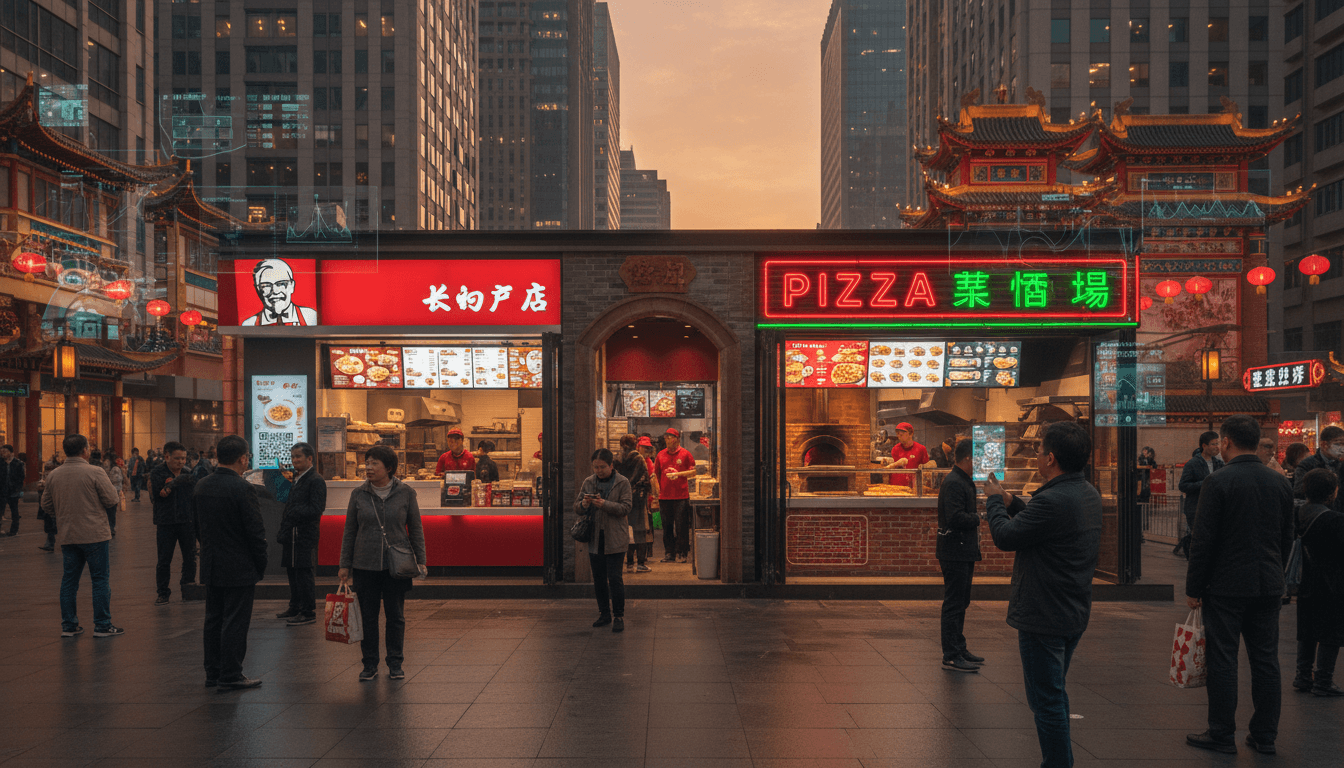
Yum is testing “Gemini stores”: a KFC and Pizza Hut Wow side-by-side, separate entrances, shared kitchen and back-end infrastructure.
Key details that should make any founder pay attention:
- Capex per pair: about 700,000–800,000 yuan (roughly US$100k–115k)
- Payback period: around 2 years
- Current scale: 42 pairs (still testing)
This is a classic “unit economics first” strategy. They’re reducing cost per new market entry and making it easier for franchisees to say yes.
For a Singapore startup, the analog might be:
- A shared dark-store + showroom concept
- A dual-brand kiosk (two menus, one kitchen)
- A modular pop-up footprint that can be replicated across secondary cities
The point is blunt: Yum is treating format design as marketing. Because accessibility, menu simplicity, and price cues are part of the customer’s decision long before the first ad impression.
Value wins in deflationary conditions—so design for it
Yum kept promotions like “Crazy Thursday,” while calling delivery price increases a “mild adjustment” and leaving dine-in/takeaway unchanged.
That’s not a messaging trick; it’s segmentation.
- Delivery customers absorb cost changes differently.
- Dine-in traffic is more sensitive to visible price jumps.
If you’re building an e-commerce brand, the equivalent is:
- Raising prices quietly via bundles, not single-SKU stickers
- Using personalised offers for price-sensitive cohorts
- Keeping one “hero” price point stable to anchor perception
AI-driven recommendations and personalised pricing (within ethical and regulatory bounds) are how modern retailers protect margin without scaring off demand.
Early signs don’t mean “go big”—they mean “test smarter”
A lot of founders hear “early signs of recovery” and think: time to scale spend. Most companies get this wrong.
Early signs are exactly when you should:
- Tighten your experimentation loop
- Widen your sensing network
- Invest in distribution options that reduce risk
Yum is doing this via multiple micro-formats (Gemini, KCoffee, KPro) rather than betting everything on one big repositioning.
Yum’s adjacent formats show how to increase frequency
Two moves stand out:
- KCoffee (cafes blended with KFC): 2,200+ locations
- KPro (light meals next to KFC): 200+ outlets
Why it matters: if consumers are cautious, you don’t win by forcing bigger baskets. You win by increasing occasion coverage—breakfast, afternoon coffee, lighter meals—so the brand fits more moments.
For startups, this is a practical growth lever:
- Add a lower-commitment entry product (trial SKU)
- Introduce “repeatable” categories (consumables, refills)
- Launch a sub-brand that targets a different occasion without diluting the flagship
AI demand forecasting helps decide which occasions to chase, and where.
How to use AI to spot “city-tier” opportunity (without guessing)
Yum’s lower-tier city push is a reminder that APAC demand is uneven. Singapore founders expanding into Indonesia, Vietnam, Thailand, or China often over-focus on capital cities.
A practical AI approach:
- Cluster markets (cities/regions) by behavioral signals: conversion, AOV, repeat rate, delivery adoption, promo responsiveness.
- Predict payback by market cluster, not by country averages.
- Test formats per cluster: pop-up, reseller, marketplace-first, or owned retail.
Snippet-worthy truth: Country-level insights are for PR. City-tier insights are for growth.
A pattern across brands: optimism is real, but it’s value-led
Yum China isn’t alone. Other consumer-facing brands have started to sound more optimistic—carefully.
- Starbucks China reported 7% same-store sales growth (three consecutive quarters of growth).
- Carlsberg said China performance improved in the final quarter, with 4% volume growth in Q4 and 1% full-year volume growth in China.
But Carlsberg’s CEO was explicit about not getting euphoric. That restraint is useful: it tells you the recovery (if it’s happening) is likely fragile and segmented.
For startups, the implication is straightforward:
- You can’t “brand” your way out of weak sentiment.
- You can win with distribution, pricing architecture, and local relevance.
And that’s where AI in retail and e-commerce stops being a buzzword and becomes operational:
- Personalised recommendations to lift conversion without blanket discounts
- Basket analysis to build bundles that feel like value
- Inventory optimisation to prevent stockouts in high-response pockets
- Customer behavior analytics to reduce churn and improve repeat rate
The APAC expansion checklist (steal this and use it)
Here’s a practical checklist I’ve seen work for Singapore startups entering new APAC markets when signals are mixed.
1) Decide what “improving appetite” means for your business
Define 3–5 numbers that, if they move for 6–8 weeks, justify expansion.
Examples:
- Conversion rate +15% in a target city cluster
- Repeat purchase rate +5 points for first-time buyers
- Discount depth needed to convert drops from 25% to 15%
2) Build a value story that doesn’t destroy margin
Yum’s Pizza Hut ticket drop (‑11%) is a warning: value can become a race to the bottom.
Safer plays:
- Tiered bundles (good / better)
- Loyalty mechanics that reward frequency, not one-time discounting
- Free delivery thresholds tuned via experimentation
3) Localise the product and the operating model
Yum’s Gemini stores are localisation at the unit economics level.
For you, that could be:
- Cash-on-delivery or e-wallet priorities by market
- Smaller pack sizes for price-sensitive cities
- Marketplace-first entry where logistics are uncertain
4) Use AI to shorten the learning cycle
If you’re in retail or e-commerce, AI should reduce two risks:
- Demand risk: forecasting what will sell and where
- Execution risk: ensuring inventory and promotions match the forecast
A simple starting stack:
- Cohort-based CRM segmentation
- Next-best-offer recommendations
- Basic demand forecasting by SKU x city x channel
What to do next (if you’re a Singapore startup)
Yum China’s results show a specific kind of opportunity: early recovery signals plus intense price sensitivity. That combination rewards companies that are fast at reading behavior and disciplined about cost.
If you’re planning APAC expansion in 2026, treat “early signs” as a call to instrument your growth, not just increase spend. The winners will be the teams that can answer, weekly, “Where is demand improving first—and what format wins there?”
What market are you watching right now—and which single metric would convince you it’s time to scale?