Living Labs in Singapore help startups prove energy, robotics, and AI EdTech in real environments. Learn a 90-day playbook to pilot and scale in APAC.
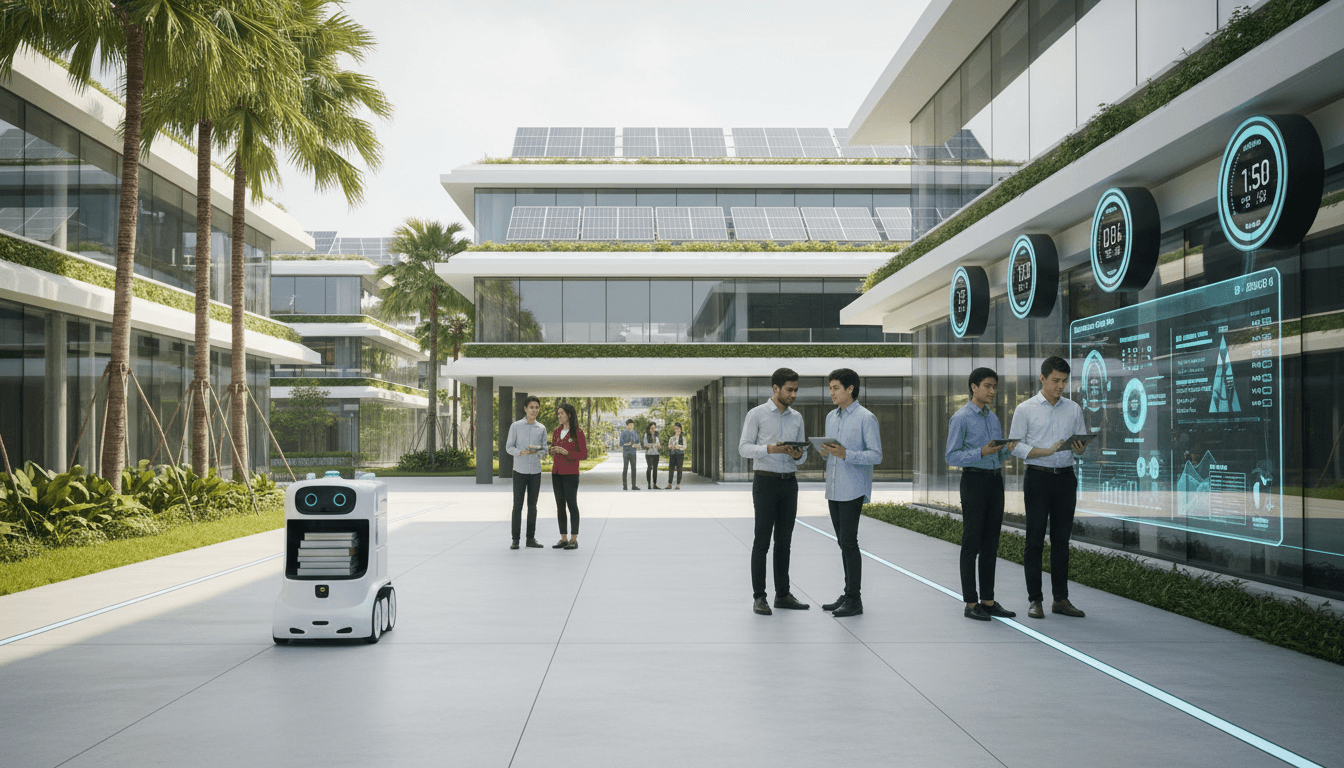
Living Labs in Singapore: Faster Proof for Startups
A lot of startups don’t fail because the tech is bad. They fail because the tech never gets proven in the real world.
That’s why Singapore Institute of Technology (SIT) turning its Punggol campus into a “Living Lab” for energy systems and robotics is more than a campus upgrade—it’s a playbook. SIT is designing the university itself as a test environment where companies can trial new technologies with real users, real infrastructure, and real constraints. Hitachi and Hyundai Motor planning collaborations with SIT is the tell: serious industry players want controlled-but-real testing grounds, not just slide decks and pilot promises.
For founders building in energy, robotics, or AI-driven EdTech, this matters because it shows how Singapore’s innovation ecosystem is shifting: from “R&D happens somewhere else” to “validation happens here.” In this post (part of our AI dalam Pendidikan dan EdTech series), I’ll unpack what Living Labs actually do, why they’re so effective for APAC go-to-market, and how startups can use similar models to shorten the path from prototype to revenue.
Living Lab: the fastest path from prototype to proof
A Living Lab is a real operational environment—like a campus, hospital, port, or housing estate—where new technology is tested while the place continues to function normally.
That sounds simple. The impact isn’t.
The reality? Most pilots are either too “lab-like” (no messy reality, no operational risk) or too “production-like” (too risky to test anything meaningful). A Living Lab sits in the middle: it’s real enough to generate credible results, but structured enough to run safe experiments.
SIT’s campus approach—physically connected to neighboring offices by a bridge to encourage collaboration—is a small design detail with a big signal: the institution wants industry partners on-site, not on a mailing list. For startups, that physical closeness often turns into faster iteration loops: engineering hears feedback sooner, product decisions get made with actual usage data, and partnership conversations happen in weeks rather than quarters.
Why energy and robotics are perfect Living Lab domains
Energy systems and robotics are unforgiving in “fake” environments.
- Energy tech needs real load profiles, peak/off-peak behavior, equipment constraints, and safety requirements.
- Robotics needs real foot traffic, changing lighting, uneven surfaces, network dropouts, human behavior, and operational edge cases.
A campus gives you exactly that: buildings, micro-mobility patterns, facilities teams, security requirements, and a diverse mix of users. If your system works there, it’s a much more credible story for a hospital group, logistics hub, or municipality.
What startups can learn from SIT’s Living Lab strategy
The most useful lesson isn’t “partner with a university.” It’s this:
Design your go-to-market so validation is built into the environment, not bolted on later.
Here are the tactical pieces founders can copy.
1) Turn infrastructure into a product-testing asset
SIT is effectively treating its campus infrastructure as a platform for experimentation—power systems, building operations, and robotics-friendly spaces.
Startups can do the same at smaller scale:
- If you sell energy management, create a “mini Living Lab” with a building owner: submeters, dashboards, and a clear measurement plan.
- If you build robotics, partner with a facility that has predictable operations but real variability (campuses, business parks, warehouses with mixed inventory).
- If you build AI for education, use a real learning environment (polytechnics, training centers, corporate academies) and test against operational KPIs like instructor time saved or assessment turnaround time.
A pilot that’s instrumented like a Living Lab produces evidence you can reuse in sales: baselines, before/after deltas, and documented operating conditions.
2) Make “work-ready talent” part of the product loop
SIT’s stated aim includes fostering work-ready talent—and that’s not just an education goal. It’s also a commercialization advantage.
When students and researchers are embedded in pilots:
- data collection becomes easier (more hands, better labeling discipline),
- iteration cycles shrink (prototype changes don’t wait for vendor schedules),
- and adoption friction drops (users are trained on-site).
For AI dalam Pendidikan dan EdTech, this is especially relevant. If your product needs behavior change (teachers using analytics, students trusting feedback, administrators changing workflows), you want a learning institution that treats experimentation as normal.
3) Treat APAC expansion as a sequence of “proof environments”
Many Singapore startups talk about “going regional” as a single leap. It’s not. In practice, APAC expansion works better as staged proof:
- Singapore for measurable validation (tight regulations, high infrastructure reliability).
- A second market for robustness (more variation in procurement, staffing, or building standards).
- A third market for scalability (multi-site rollouts, localization, partner networks).
A Living Lab gives you step one with credibility—especially when recognizable partners (like Hitachi or Hyundai Motor) are in the picture. Even if you’re not working with those companies, the ecosystem signal helps: buyers are more willing to take meetings when they know similar tech is being tested locally under serious conditions.
Where AI fits: energy, robotics, and EdTech converge
AI isn’t the headline of the Nikkei story, but it’s the connective tissue. A campus Living Lab becomes powerful when it’s instrumented: sensors, logs, building management systems, robotics telemetry, and human feedback loops.
Here’s how that translates into concrete, fundable startup opportunities.
AI in energy: from dashboards to decisions
Most energy “AI” products stop at visualization. The winning products go further: they recommend actions, quantify risk, and learn from outcomes.
A campus environment can support:
- Predictive maintenance for electrical systems (anomaly detection on load patterns)
- Demand forecasting at building or zone level
- Optimization for HVAC and lighting schedules tied to occupancy patterns
- Carbon reporting automation (data pipelines that survive audits)
Snippet-worthy truth: If your model can’t survive missing data, sensor drift, and schedule changes, it’s not ready for enterprise energy operations. Living Labs expose those weaknesses early.
AI + robotics: reliability beats cleverness
Robotics pilots often die from operational reality: elevators, narrow corridors, wet floors, or human unpredictability.
A Living Lab is where you prove:
- navigation performance across time-of-day variability,
- human-robot interaction safety,
- uptime and maintainability under limited technician support,
- and network resilience.
The stance I’ll take: Founders should market robotics around reliability metrics, not novelty. If you can say “we achieved X hours mean time between interventions in an active campus environment,” buyers listen.
AI dalam Pendidikan dan EdTech: a campus is the perfect testbed
In our EdTech series, we keep returning to the same bottleneck: schools don’t buy “AI.” They buy outcomes—better learning, lower admin burden, faster assessment, more consistent quality.
A Living Lab campus can test:
- pembelajaran diperibadikan (personalized learning) that adapts to student mastery,
- analisis prestasi pelajar (student performance analytics) that teachers actually use,
- AI-assisted feedback loops that reduce grading time,
- and even robotics-enabled learning spaces (labs that teach automation, mechatronics, and energy management).
A strong Living Lab pilot in education produces two assets founders can reuse:
- Proof of efficacy (learning gains, retention, completion rates)
- Proof of adoption (teacher usage rates, time saved per week, workflow fit)
A practical Living Lab playbook for Singapore startups (90 days)
Most teams overcomplicate pilots. Don’t.
If you’re in Singapore and want to use the Living Lab mindset—whether with a university, a building owner, or an industry partner—here’s a 90-day structure that works.
Phase 1 (Weeks 1–2): Define the “proof” in one sentence
Write a single sentence that includes:
- the operational setting,
- the metric,
- the time window.
Examples:
- “Reduce after-hours HVAC energy use by 12% in one campus building over 6 weeks, without increasing comfort complaints.”
- “Achieve 95% successful autonomous deliveries across three connected buildings during peak traffic hours for 30 days.”
- “Cut grading time by 2 hours/week per instructor in two modules over one term, while maintaining assessment quality.”
If you can’t define proof simply, you’re not ready to pilot.
Phase 2 (Weeks 3–6): Instrumentation and baseline
Living Labs win because they measure reality.
Do these basics before you claim outcomes:
- establish a baseline (2–3 weeks of “before” data),
- agree on data access and retention,
- define what counts as a failure or intervention,
- and set a weekly review cadence.
Phase 3 (Weeks 7–10): Controlled experimentation
Change one major variable at a time. If you tweak model thresholds, schedules, and user flows simultaneously, you’ll never know what worked.
Use a simple experiment log:
- What changed?
- Why?
- What did we expect?
- What happened?
- What will we do next?
Phase 4 (Weeks 11–13): Turn results into sales collateral
This is where many pilots die: results stay in a shared drive.
Package outcomes into:
- a 1-page case study with baselines and deltas,
- a buyer-facing risk and rollout plan,
- and a technical appendix for IT/security.
The goal is repeatability. A Living Lab pilot is only valuable if it becomes a template for the next site.
What to watch in Singapore next (and why it matters)
SIT’s Living Lab move fits a bigger Singapore pattern: the country keeps building “testable” environments—smart districts, advanced manufacturing spaces, and digital government systems—because it attracts companies that need proof fast.
For founders, the opportunity is clear: market your product as something that can be validated quickly under real constraints, not as something that’s “innovative.” Buyers in 2026 are fatigued by innovation theatre. They want evidence.
SIT partnering with global firms also suggests another trend: Living Labs are becoming part of how large companies scout and de-risk new tech. If you can position your startup as “Living Lab-ready” (measurable, safe to pilot, clear ROI logic), you’ll win more enterprise conversations.
What you should do this week
Pick one operational environment you can access—campus, training center, business park, warehouse, or co-working space—and draft your one-sentence proof statement. Then make a list of what you need to measure it (data, permissions, safety constraints, user workflow).
The broader theme of AI dalam Pendidikan dan EdTech is that AI succeeds when it’s grounded in human systems: teaching practices, facilities operations, and day-to-day constraints. Living Labs are how you ground it.
If Singapore is where you plan to test, iterate, and then scale into APAC, the question isn’t whether you can build a great product. It’s whether you can build a proof environment that makes the market believe you.