Semiconductor supply chains now shape AI in logistics and SME marketing promises. Learn what Singapore SMEs should do to stay resilient and credible.
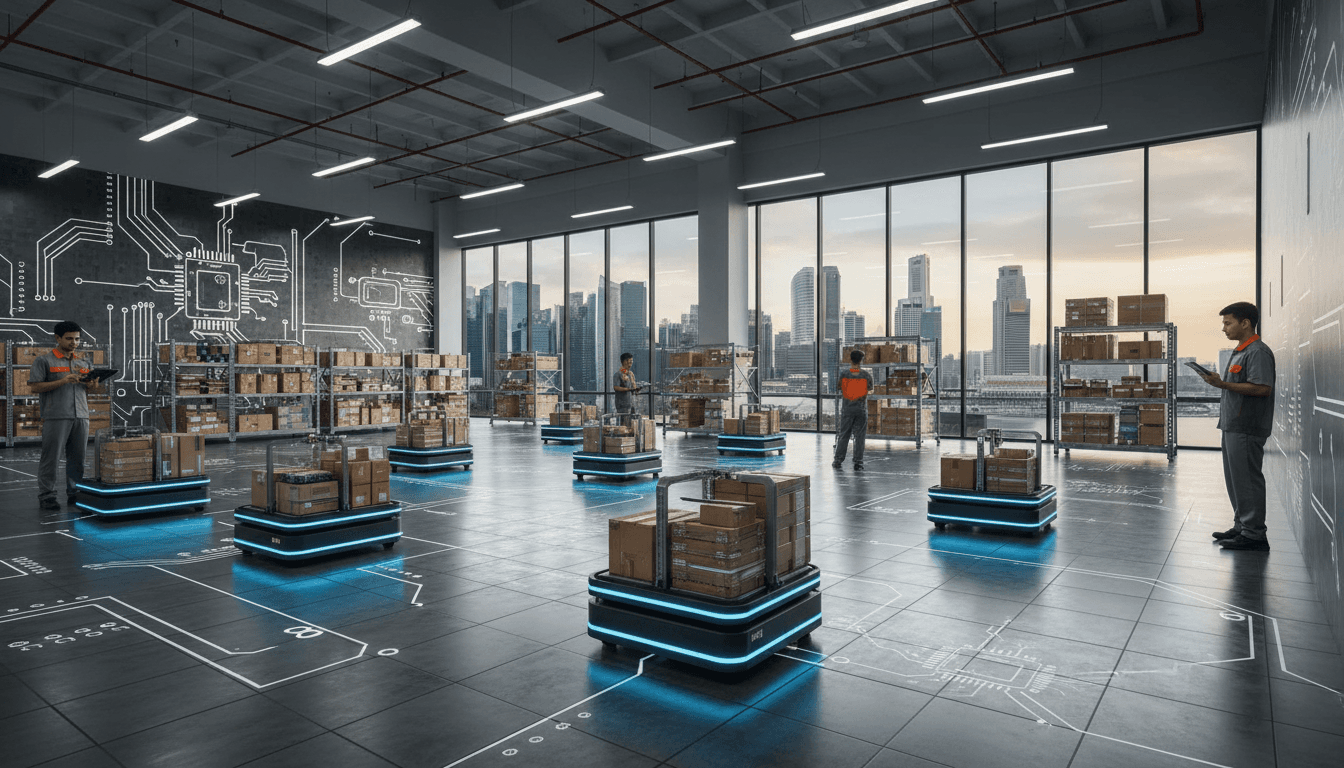
Semiconductor Supply Chains: What Singapore SMEs Should Do
A single missing chip can stall an entire product launch, delay a warehouse automation rollout, or push your customer delivery SLA from “next-day” to “next-week”. That’s not a hardware founder problem anymore. It’s an operations problem, a cash-flow problem, and—quietly—a digital marketing problem too.
For Singapore SMEs, the semiconductor supply chain revolution matters because it’s shaping the tools you use to grow: AI servers, edge devices, scanners, sensors, POS systems, robotics, and even the networking gear that keeps your e-commerce and CRM humming. And as this series—“AI dalam Logistik dan Rantaian Bekalan”—keeps coming back to, AI only helps when it’s deployed reliably in the real world.
Here’s the stance I’ll take: Most SMEs react to supply disruptions too late. The better move is to treat semiconductor supply chain shifts as an early signal—so you can plan procurement, redesign processes, and adjust marketing promises before your customers feel the impact.
The semiconductor shift is now an SME growth constraint
The direct answer: semiconductors have become a bottleneck for AI adoption in logistics and supply chains, and that bottleneck affects SME competitiveness.
Semiconductors power the “physical layer” of digital transformation—automation, sensing, connectivity, compute. When chip supply is tight or lead times stretch, three things happen to SMEs:
- Projects slip: warehouse scanning upgrades, automation pilots, fleet telematics, CCTV analytics, edge AI for QA.
- Costs creep: expedited shipping, alternative parts, smaller production runs, higher service contracts.
- Marketing gets riskier: your ads promise speed and reliability, but operations can’t consistently deliver.
The original e27 piece frames this as a founder’s guide to the semiconductor supply chain revolution—especially relevant in Southeast Asia, where the region plays a large role in assembly, testing, and packaging (ATP), while cutting-edge fabrication is still dominated by Taiwan and South Korea.
For SMEs, the practical takeaway is simpler: your vendors’ vendors matter now. If you’re buying smart devices, automation equipment, or AI-enabled platforms, you’re already in the semiconductor ecosystem.
Why Southeast Asia’s ATP strength matters to Singapore businesses
Answer first: SEA’s strength in ATP increases options for sourcing and resilience—if you build relationships early.
Malaysia and Vietnam are repeatedly cited as rising semiconductor hubs, driven by infrastructure, policy support, and workforce depth. For a Singapore SME, that creates a nearby advantage:
- Regional suppliers can reduce time-zone friction and speed up issue resolution.
- You may find better availability for specific components or sub-assemblies.
- Partnerships across SEA can support multi-country scaling when you outgrow a Singapore-only footprint.
If your business depends on devices (inventory scanners, industrial PCs, sensors, smart meters), it’s worth asking procurement to map where assembly/testing happens—not just where you buy the finished product.
AI in logistics runs on chips—and the trend is moving to the edge
Answer first: AI in logistics and supply chains is shifting from “cloud-only” to a hybrid of cloud + edge, because edge AI cuts latency, improves reliability, and reduces connectivity dependence.
In practice, that looks like:
- Computer vision for pallet counting and damage detection
- Edge analytics for cold-chain compliance
- Predictive maintenance for conveyors and forklifts
- Route optimisation with real-time fleet data
The e27 article highlights industrial AI players (like Innowave Tech) focusing on predictive maintenance, quality assurance, process automation, and supply chain optimisation. That’s aligned with what I see work best: AI tied to measurable operational KPIs (downtime, scrap, pick rate, OTIF).
What this means for your digital marketing (yes, marketing)
Answer first: as AI hardware becomes more embedded in operations, your marketing claims must match operational reality.
Singapore SMEs often run ads with promises like:
- “Same-day delivery”
- “Real-time tracking”
- “Guaranteed freshness”
- “Zero stock-outs”
Those are operational promises dressed as marketing copy. If your sensors, scanners, or automation upgrades are delayed due to component constraints, your brand takes the hit.
Two practical moves:
- Align campaigns to capacity: Don’t run aggressive promos when your replenishment or fulfilment systems are in flux.
- Market the system, not the miracle: Customers trust transparency like “next-day delivery for West + same-day for Central (cut-off 12pm)” more than blanket claims.
Strategic partnerships beat “shopping for components”
Answer first: semiconductor-era resilience is built through partnerships, not transactional purchasing.
The e27 piece makes a clear point: navigating the semiconductor age takes more than sourcing. You need strategic partners that bring technology depth, integration support, and long-term roadmap alignment.
Infineon is used as an example of a semiconductor leader positioned around power systems and IoT solutions—areas that show up directly in energy management, mobility, and industrial digitisation. Even if you’re not buying directly from a global chipmaker, the principle holds:
- Prefer vendors who can explain their component roadmap (next 12–24 months)
- Ask for documented alternatives (second-source components)
- Choose platforms with modularity (swap devices without rewriting everything)
A simple “resilience checklist” for SME buyers
Answer first: you can reduce supply chain risk by changing your buying criteria, not just your budget.
Use this checklist when evaluating AI/logistics tech vendors:
- Lead time clarity: Do they quote realistic lead times and commit to updates?
- Second-source design: Can the device run with alternative chipsets/modules?
- Spare strategy: Do they recommend holding spares for critical nodes (gateways, scanners)?
- Firmware support: Will they support updates across component variants?
- Local support: Do they have SEA support coverage for downtime events?
If a vendor can’t answer these cleanly, your “AI pilot” becomes a fragile science project.
Capital flows tell you what will get cheaper (and what won’t)
Answer first: where investors deploy capital signals which parts of the supply chain will mature—and which capabilities will become standard.
The article points to Vertex Ventures Southeast Asia and India (VVSEAI) as an example of capital plus strategic support—network access, talent, customer introductions. Even if you’re not fundraising, this matters because funded ecosystems move faster:
- Better-funded industrial AI vendors improve product reliability and integrations.
- Competition pushes prices down on mature modules.
- Standards emerge, making interoperability less painful.
For SMEs allocating marketing budgets, there’s a useful parallel: don’t spend like it’s 2021. Spend like it’s 2026.
- Put money into first-party data (CRM, email, loyalty) because ad targeting is tightening.
- Automate what’s repeatable (lead qualification, follow-ups, forecasting).
- Invest in operational visibility (inventory accuracy, delivery ETA), because it directly improves conversion and retention.
A practical rule I like: If a tech investment improves delivery reliability, it improves marketing ROI. Fewer refunds, fewer angry tickets, better reviews, better repeat purchases.
How Singapore SMEs can act this quarter (not “someday”)
Answer first: you don’t need a semiconductor strategy deck—you need a 30-day plan that connects procurement, ops, and marketing.
1) Map your “chip dependency” in plain English
List the systems that break when devices fail or can’t be procured:
- Inventory scanning / barcode devices
- Warehouse Wi‑Fi / routers
- POS terminals
- Cold chain sensors
- CCTV analytics
- Fleet trackers
Then label each as critical / important / replaceable.
2) Update your operational promises in marketing assets
Pick one channel to fix first (usually your website homepage or top-performing ad set):
- Replace vague delivery claims with capacity-based promises.
- Add cut-off times and serviceable zones.
- Create a small “service status” process for disruptions.
This isn’t pessimism. It’s trust-building.
3) Use AI where it reduces downtime or variability
In the context of AI mengoptimumkan laluan pengangkutan, automasi gudang, ramalan permintaan, prioritise use cases with fast payback:
- Demand forecasting for top 20 SKUs
- Route optimisation for repeat delivery routes
- Predictive maintenance for one critical asset line
- Computer vision for one high-error process (picking/packing)
4) Build one partnership that improves resilience
Choose one of these and execute:
- A secondary hardware distributor in SEA
- A managed service provider for networking + device lifecycle
- A systems integrator who can support multi-vendor environments
One solid partner beats five random suppliers.
What to watch heading into mid-2026
Answer first: the next wave is AI moving deeper into physical operations, and that will raise customer expectations again.
By mid-2026, customers won’t be impressed by “we use AI.” They’ll care about outcomes:
- accurate ETAs
- fewer substitutions
- instant returns processing
- consistent product availability
Semiconductor supply chain capacity—and the partnerships behind it—will influence how quickly those capabilities become affordable for SMEs.
If your business is already exploring AI in logistics and supply chain management, treat the semiconductor story as your early-warning system. It tells you when to accelerate, when to buffer inventory, and when to stop overpromising in your ads.
The forward-looking question worth asking your team this month: Which customer promise would break first if your core devices doubled in lead time—and what would you change before that happens?