Ho Chi Minh City’s drone delivery tests signal a shift in SEA logistics. Here’s how Singapore startups can use AI to enter Vietnam with a focused, profitable play.
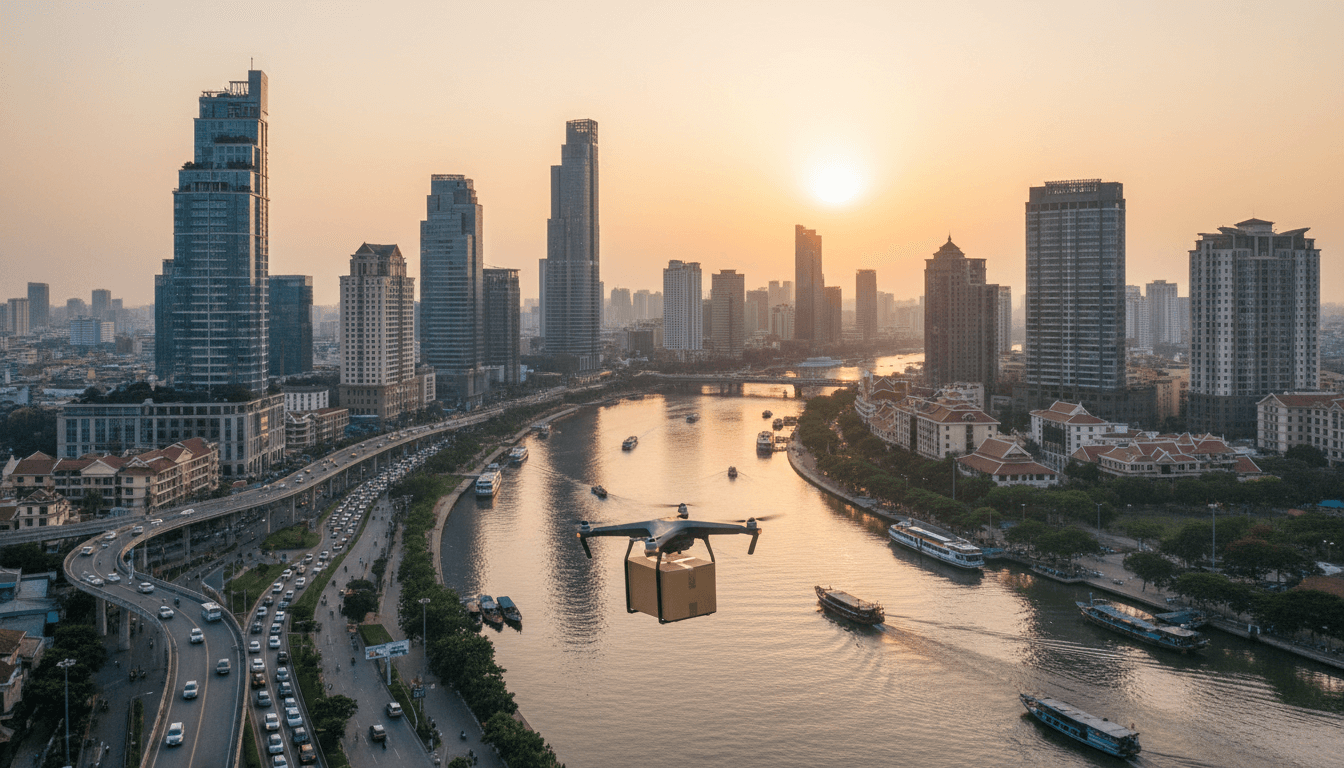
Drone Delivery in Vietnam: A Playbook for SG Startups
Ho Chi Minh City is testing drones for deliveries, with local officials signaling that couriers could take to the sky as soon as March 2026. That timeline matters more than the headline. It’s a clear sign that big Southeast Asian cities are getting serious about last-mile innovation—and they’re willing to run real trials, not just pilots-for-PR.
For Singapore startups building in AI dalam logistik dan rantaian bekalan, Vietnam’s move is a useful benchmark. Drone delivery isn’t “future tech” anymore—it’s becoming a regulated operational option in dense urban environments. The question for founders isn’t “Will drones happen?” It’s “Where do drones make economic sense, and what capabilities do we need to win when they do?”
This post breaks down what Ho Chi Minh City’s drone tests imply for Southeast Asia’s logistics landscape, where AI fits (and where it doesn’t), and how Singapore startups can turn this into a concrete regional expansion strategy.
What Ho Chi Minh City’s drone tests really signal
Ho Chi Minh City’s tests are less about novelty and more about city readiness. When a major metropolis puts drones into workshops and trials, it usually means three things are moving in parallel: regulation, infrastructure planning, and commercial interest.
1) Urban logistics is hitting a ceiling on the ground
Ho Chi Minh City traffic congestion is notorious, but the bigger pattern is regional: as Southeast Asian cities densify, road-based last-mile delivery starts to face diminishing returns.
Here’s the operational reality I’ve seen repeatedly in urban logistics:
- Adding more riders doesn’t linearly improve delivery times—it often increases pickup congestion.
- Peak-hour delivery promises become expensive because they require idle capacity.
- Customer expectations keep rising anyway (same-day, 2-hour windows, instant returns).
Drones are one of the few tools that can bypass road constraints entirely—but only for specific lane types (more on that below).
2) Drones are becoming a policy tool, not a toy
City-led trials usually aim to answer practical questions:
- Where can drones fly safely without disrupting other airspace users?
- What are acceptable noise levels over residential zones?
- What operating procedures reduce risk (geofencing, remote ID, fail-safes)?
- Who is liable when something goes wrong?
When governments test early, they’re also shaping the rules. For startups, that’s a major window: the companies that help define operating standards often become default partners later.
3) Southeast Asia is building a “multi-modal last mile”
The winning delivery networks in 2026 won’t be purely riders, vans, lockers, or drones. They’ll be multi-modal, orchestrated by software.
Drone delivery is not a replacement for ground delivery. It’s an add-on lane that changes the network math.
That’s exactly why this topic belongs in an AI logistics series: drones are an execution layer; AI is the coordination layer.
Where drone delivery actually works (and where it doesn’t)
Drone delivery is often marketed as universal. It’s not. The business case only holds when a shipment lane has the right mix of distance, urgency, payload, and operational friction.
The high-ROI use cases in Southeast Asian cities
These are the lanes where drones tend to make sense first:
-
Medical and lab logistics
- Blood samples, diagnostics, temperature-sensitive items
- High urgency, high cost of delay
-
Inter-facility transfers (hub-to-spoke)
- Between micro-fulfillment centers, pharmacies, retail outlets
- Predictable routes that can be mapped into “air corridors”
-
High-value, low-weight parcels
- Electronics accessories, luxury add-ons, critical spare parts
- Better margin buffer for premium delivery pricing
-
Hard-to-reach pockets
- River-crossing areas, construction zones, places with weak road access
The use cases that usually disappoint founders
If you’re a startup thinking “drones for food delivery,” be careful. It can work, but it’s rarely the first sustainable wedge.
Common blockers:
- Payload limits (many meals + packaging quickly become too heavy)
- Noise + safety around dense residential drop points
- Handover complexity (where does the drone land, who receives it, what if they’re not there?)
- Weather (tropical rain and wind variability reduce availability)
The stance I’ll take: start with B2B lanes, earn reliability, then expand to consumer delivery.
AI’s role: the part most drone stories skip
Most drone headlines focus on aircraft. But in real operations, drones fail or succeed because of planning and orchestration. That’s AI territory.
AI route optimization becomes 3D, not just “shortest path”
Traditional route optimization in last-mile delivery is already hard: traffic, batching, time windows, driver shifts. Drone routing adds new constraints:
- Battery and payload performance curves
- No-fly zones and altitude restrictions
- Wind and rainfall nowcasting
- Emergency landing points
- Fleet charging schedules
A practical definition worth stealing:
Drone fleet optimization is a constrained scheduling problem where safety constraints dominate cost constraints.
AI models—especially combinations of heuristics + optimization solvers + predictive models—are what make those constraints operationally manageable.
Demand forecasting determines whether drones are profitable
Drones are capital-intensive compared to onboarding riders. You can’t “just add more drones” overnight. That changes the planning model.
AI demand forecasting helps you answer:
- Which neighborhoods justify drone coverage?
- Which SKUs should be eligible for drone delivery?
- What service-level (30 min / 60 min / same-day) can be supported profitably?
If you’re building in this space, profitability comes from eligibility rules and forecast accuracy, not from marketing.
Computer vision and risk scoring reduce incident rates
Urban drone delivery needs robust sensing and compliance:
- Visual landing zone verification
- Obstacle detection and avoidance
- Package drop confirmation (proof of delivery)
- Anomaly detection (unexpected crowds, animals, construction)
The startups that win will treat safety as a product feature with measurable metrics: abort rates, incident rates, false positives, and mean time to recovery.
A Singapore startup’s playbook to enter Vietnam (without burning cash)
Vietnam is attractive, but it’s not plug-and-play. Regulatory posture, operating environments, and local partnerships matter. Here’s a practical sequence I’d use if I were planning an expansion.
Step 1: Start as the “brains,” not the aircraft
If you’re a Singapore startup, competing directly in drone hardware is expensive and crowded. A more realistic wedge:
- Fleet orchestration software for mixed ground + drone operations
- AI dispatch and dynamic eligibility engines
- Compliance tooling (flight logging, remote ID integration, geofencing policies)
This lets you partner with whoever supplies the drones locally, while you own the operational layer.
Step 2: Pick one narrow lane and dominate it
The fastest path to traction is choosing a lane with clear ROI and low chaos. Examples:
- Hospital-to-lab transfers within a defined radius
- Pharmacy chains with predictable SKU profiles
- Spare parts delivery for industrial parks
Success metrics to lock early:
- On-time rate (OTD)
- Cost per successful delivery
- Abort rate and recovery time
- Customer wait time distribution (not just the average)
Step 3: Build a regulatory narrative around safety and public value
Regulators don’t approve drones because a startup wants growth. They approve drones because the operation is controlled and beneficial.
Your go-to positioning (because it’s true):
- Reduced road congestion for priority shipments
- Better emergency responsiveness (medical logistics)
- Transparent compliance logs and traceability
This is where Singapore startups have an edge: Singapore’s operating culture around governance and process can travel well—if you present it as reliability, not bureaucracy.
Step 4: Plan for monsoon reality from day one
For Vietnam (and much of SEA), weather is not an edge case—it’s a core input.
Design requirements that separate serious teams from demo teams:
- Weather-based SLA tiers (e.g., “drone eligible unless wind exceeds X”)
- Fallback routing (auto-switch to ground courier)
- Customer communication that sets expectations clearly
A useful rule: if your system can’t gracefully degrade to ground delivery, you don’t have a drone product—you have a drone demo.
People also ask: “Will drone delivery replace riders?”
No. In Southeast Asia, riders remain the backbone because they’re flexible, cheap to scale, and good at doorstep handoffs.
What drones will do is reshape the premium segment:
- Urgent deliveries
- Fixed corridors
- B2B time-critical transfers
Think of drones as a new service class inside a broader network, not a total replacement.
What to watch next in Southeast Asia’s drone delivery race
Ho Chi Minh City’s tests are one city, but the regional pattern is bigger. Here are the signals that tell you drone delivery is crossing from “trial” to “market.”
Signals that mean “commercialization is close”
- Published operating guidelines (air corridors, licensing, insurance norms)
- Named partnerships (retailers, hospitals, logistics operators)
- Repeatable routes with measured performance over weeks, not days
- Clear rules for incident reporting and liability
Signals that mean “still early”
- One-off demos with no operational dashboard
- No defined handover method (landing pads, lockers, tether drops)
- No plan for weather downtime
- No integration with inventory and order management systems
If you’re building products for AI dalam logistik dan rantaian bekalan, the biggest opportunity is being the system that ties it all together: forecasting, dispatch, compliance, and customer promise management.
The practical next step for Singapore founders
Drone delivery in Vietnam is a reminder that regional expansion isn’t only about translating your app or hiring a local sales team. Sometimes it’s about aligning with the next infrastructure shift before it becomes obvious.
If you’re a Singapore startup, pick a lane where drones have a real economic advantage, build an AI-driven orchestration layer that can prove reliability, and partner aggressively on execution. That’s how you turn a city test into a scalable business.
The forward-looking question that matters: When Vietnam’s urban logistics networks become multi-modal by default, will your product be the coordinator—or just another courier option?