AI talent systems can cut turnover and speed product launches. Learn how the Wuhan model maps to Singapore smart factories and supply chains.
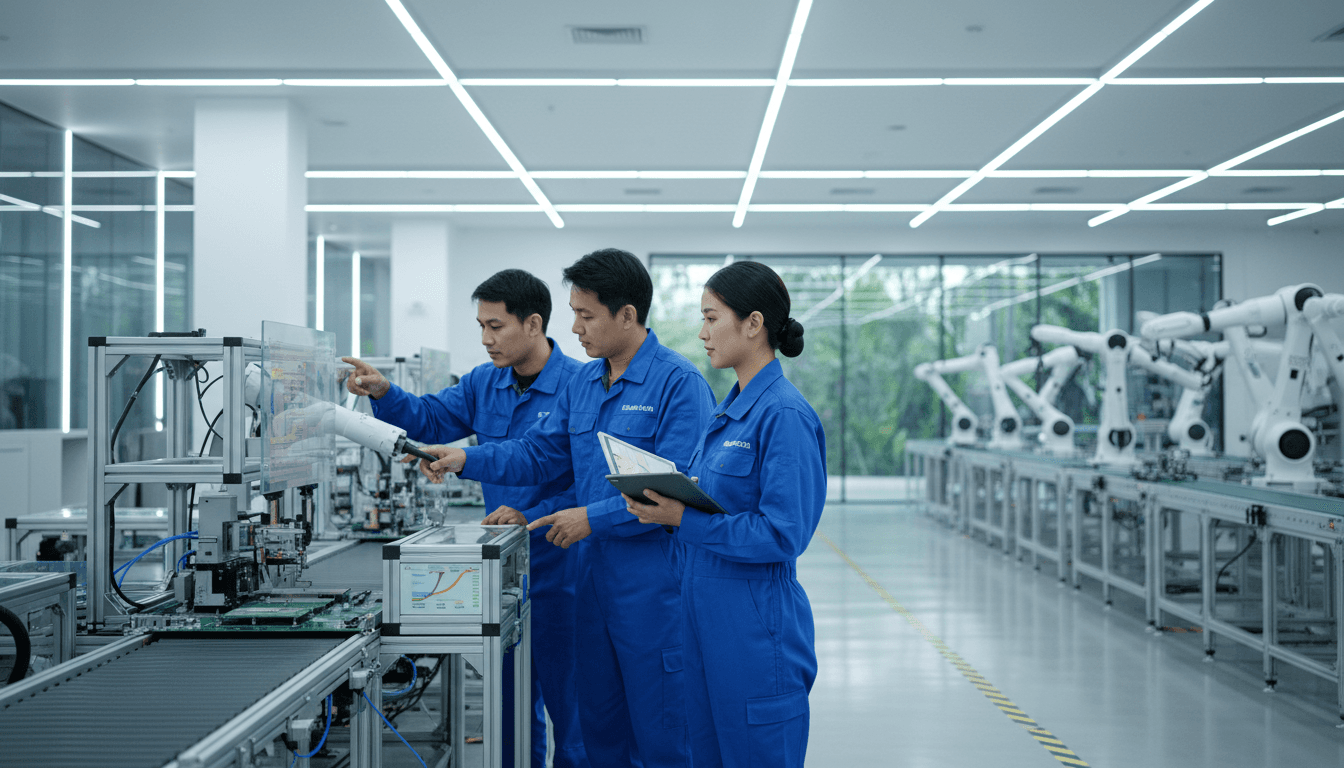
AI Talent Playbook for Smart Factories in Singapore
Most factories don’t have an “AI problem”. They have a skills and workflow problem that AI exposes.
That’s why Schneider Electric’s Wuhan factory getting named a World Economic Forum (WEF) “Global Lighthouse for Talent” is more than a nice trophy. It’s a practical case study on how to keep a manufacturing workforce stable while your operations get more automated, your product mix explodes, and your best technicians are tempted to leave.
For readers following this series—“AI dalam Logistik dan Rantaian Bekalan”—this matters because supply chain performance lives or dies on shopfloor execution. Forecasting and routing mean little if you can’t introduce new products quickly, maintain assets reliably, and keep throughput steady. Wuhan shows a clear pattern: AI works when it’s tied to training, scheduling, and incentives—not when it’s bolted onto a broken HR process.
Snippet-worthy takeaway: The fastest way to improve operational resilience is to treat talent like a supply chain—measure gaps, predict demand for skills, and replenish continuously.
What Wuhan proved: AI can fix talent bottlenecks (with numbers)
Schneider Electric’s Wuhan site was recognised by the WEF as a talent lighthouse—only the third facility globally to earn that specific talent designation. The recognition wasn’t based on “having AI”, but on showing workforce outcomes at scale.
Here are the numbers from the case that should make any ops leader pay attention:
- A 239% expansion in product portfolio created workforce strain.
- The local market had only 20% of skilled automation workers, while automation demand grew 55%.
- Technician turnover was an alarming 48%.
Their response combined work design, learning systems, and AI:
- 56% of employees upskilled through the new system.
- Workforce readiness increased to 76% (from 20%).
- Turnover dropped to 6% (from 48%) after AI-guided support and mentoring.
- Automation reduced new product introduction lead time by 66.7%, cutting cycles from 36 months to 12.
These metrics connect directly to AI in supply chain and logistics: faster product introduction, fewer stoppages, and more stable labour capacity translate into better service levels and less firefighting across procurement, warehousing, and distribution.
Why Singapore manufacturers should care (and what’s transferable)
Singapore’s manufacturing and logistics ecosystem—electronics, precision engineering, pharmaceuticals, aerospace MRO—runs on high-mix, high-compliance, high-uptime operations. That environment punishes two things:
- Unplanned downtime (maintenance gaps, knowledge trapped in a few senior staff)
- Capacity volatility (attrition, overtime spikes, onboarding that takes too long)
The Wuhan story is transferable because it targets the same failure modes you see in Singapore plants and distribution environments:
- Skill scarcity: advanced automation technicians, controls engineers, reliability specialists.
- Fast change: new SKUs, new lines, new QA requirements.
- Operational pressure: uptime and delivery performance targets don’t pause while people learn.
The stance I’ll take: If you’re rolling out AI for demand forecasting or warehouse automation but ignoring skills operations, you’re optimising the wrong layer. The “smart factory” isn’t the one with the most sensors—it’s the one that can adapt its workforce as fast as it adapts its machinery.
A practical lens: treat skills like inventory
In logistics, you don’t “hope” stock appears—you forecast, set reorder points, and track fill rates. Skills can work the same way:
- Skill demand = upcoming maintenance plans, new product introductions, line changes
- Skill supply = certified technicians, cross-trained operators, vendor support
- Stockouts = overtime, quality escapes, delayed shipments, downtime
Wuhan’s approach essentially built a skills supply chain backed by AI.
The three-part model: schedule better, train continuously, pay for skills
Schneider Electric described a “future-ready, people-centric workforce model combining technology and continuous learning.” Under the hood, it’s three moves that reinforce each other.
1) People-centric scheduling that reduces overtime (and improves delivery)
Answer first: Scheduling is where workforce strategy becomes operational reality.
Wuhan implemented people-centric scheduling to streamline task allocation, improve delivery performance, and cut overtime. This sounds simple, but it’s often where factories fail—because schedules are built around machines and output targets, not human capacity and skill constraints.
For Singapore ops teams, a useful checklist for AI-assisted scheduling is:
- Are tasks matched to certified skills, not just availability?
- Do you track overtime as a leading indicator of attrition risk?
- Can supervisors see the impact of a schedule change on throughput and safety?
A good AI business tool doesn’t need to be fancy here. It needs to connect three data sets reliably: work orders, skill matrices, and shift availability.
2) Agentic AI that monitors skill gaps and triggers training
Answer first: Skill matrices rot fast; AI can keep them current and actionable.
Wuhan used agentic AI to monitor skill gaps and set up training “where and when needed,” linking development to pay-for-skills career paths.
What’s interesting is the timing element. Traditional training is calendar-based (“everyone attends course X in Q2”). Their model is closer to supply chain replenishment: train when a gap is predicted.
If you’re implementing this in a Singapore factory or warehouse, start with a tight scope:
- Pick one critical domain (e.g., PLC troubleshooting, cleanroom gowning compliance, or WMS exception handling).
- Define proficiency levels (Level 1–3) with observable criteria.
- Instrument the workflow so performance signals trigger training (repeat errors, escalations, time-to-repair).
The “agentic” part doesn’t have to mean a fully autonomous AI. It can simply mean the system recommends who should be trained next and proposes the shortest path.
3) Generative AI for technician guidance and mentoring
Answer first: Generative AI is most valuable when it reduces dependency on scarce experts.
Wuhan used generative AI to guide technicians through maintenance tasks and pair them with experienced mentors—contributing to turnover dropping to 6%.
In industrial settings, the best genAI use cases are often not chatty assistants. They’re:
- Step-by-step troubleshooting that references your internal SOPs
- “What changed?” summaries from maintenance logs and shift notes
- Faster handovers between shifts (especially when incidents occur)
One opinionated caution: If your SOPs are outdated, genAI will scale the wrong answer faster. The prerequisite isn’t a bigger model—it’s governed content: versioned procedures, approved checklists, and clear ownership.
Connecting the dots to AI in logistics and supply chain
This series focuses on AI dalam logistik dan rantaian bekalan: route optimisation, warehouse automation, demand forecasting, and end-to-end efficiency. The Wuhan case expands the narrative: your supply chain performance is capped by the human system running your critical nodes.
Here’s how talent-centred AI shows up as supply chain outcomes:
- Higher asset uptime → fewer late shipments and less premium freight
- Faster new product introduction (36 → 12 months) → quicker revenue capture and better inventory planning
- Lower turnover (48% → 6%) → fewer quality incidents, fewer training bottlenecks, more predictable capacity
- Better scheduling → improved on-time delivery and lower overtime costs
In other words, AI-driven talent operations isn’t “HR transformation.” It’s throughput protection.
Where to start: a 30–60–90 day plan for Singapore plants
Answer first: Start with one production line or one maintenance cell, and build credibility with measurable wins.
First 30 days (diagnose and instrument)
- Build a simple skill taxonomy for one area
- Identify top 10 recurring stoppages / defects
- Create a baseline: turnover, overtime, MTTR (mean time to repair), training hours
Next 60 days (pilot AI tools in the workflow)
- Deploy a digital skill matrix tied to work orders
- Add AI-assisted scheduling recommendations
- Launch a genAI “maintenance copilot” limited to approved SOPs for that scope
By 90 days (tie incentives and scale)
- Introduce pay-for-skills or credential-based progression
- Automate training triggers based on observed gaps
- Expand to adjacent lines/areas once KPIs move
If nothing improves by day 90, it’s usually not because “AI doesn’t work”. It’s because the pilot didn’t touch the real constraint (often scheduling authority, training time allocation, or content quality).
Common questions ops leaders ask (and direct answers)
“Will AI replace technicians?”
No. AI replaces the waiting—waiting for an expert, waiting for a manual, waiting for approvals. Plants that use AI well typically shift technicians toward higher-impact work: reliability improvements, root cause analysis, and process optimisation.
“What data do we need to begin?”
You can start with surprisingly little:
- Work orders and maintenance logs
- A skill matrix (even if it’s messy)
- Shift rosters
- Your latest approved SOPs
“How do we keep this safe and compliant?”
Use a narrow deployment pattern:
- Limit genAI answers to retrieval from approved documents
- Log every interaction
- Assign procedure owners who approve updates
- Don’t allow the tool to invent new steps for safety-critical tasks
The real lesson from Wuhan: competitiveness is now a people system
Schneider Electric’s supply chain chief Mourad Tamoud put it plainly: the Fourth Industrial Revolution is about people as much as technology. The WEF echoed that modern competitiveness is defined by the ability to sense, adapt, and respond at speed.
That’s the north star for Singapore manufacturers thinking about AI business tools: don’t measure success by “models deployed.” Measure it by readiness, retention, and response time—because those are what protect your delivery performance when demand shifts or disruptions hit.
If you want to build a smart factory that behaves like a resilient supply chain node, borrow the Wuhan sequence: schedule intelligently, monitor skill gaps continuously, and use AI to make expert knowledge available at the point of work.
What would change in your operations if turnover fell from “normal” to genuinely low—and your best technicians had time to improve the system instead of just keeping it running?