Hyundai’s AI robot rollout shows how automation cuts cost and variance. Use this supply chain playbook to scale across APAC without losing margins.
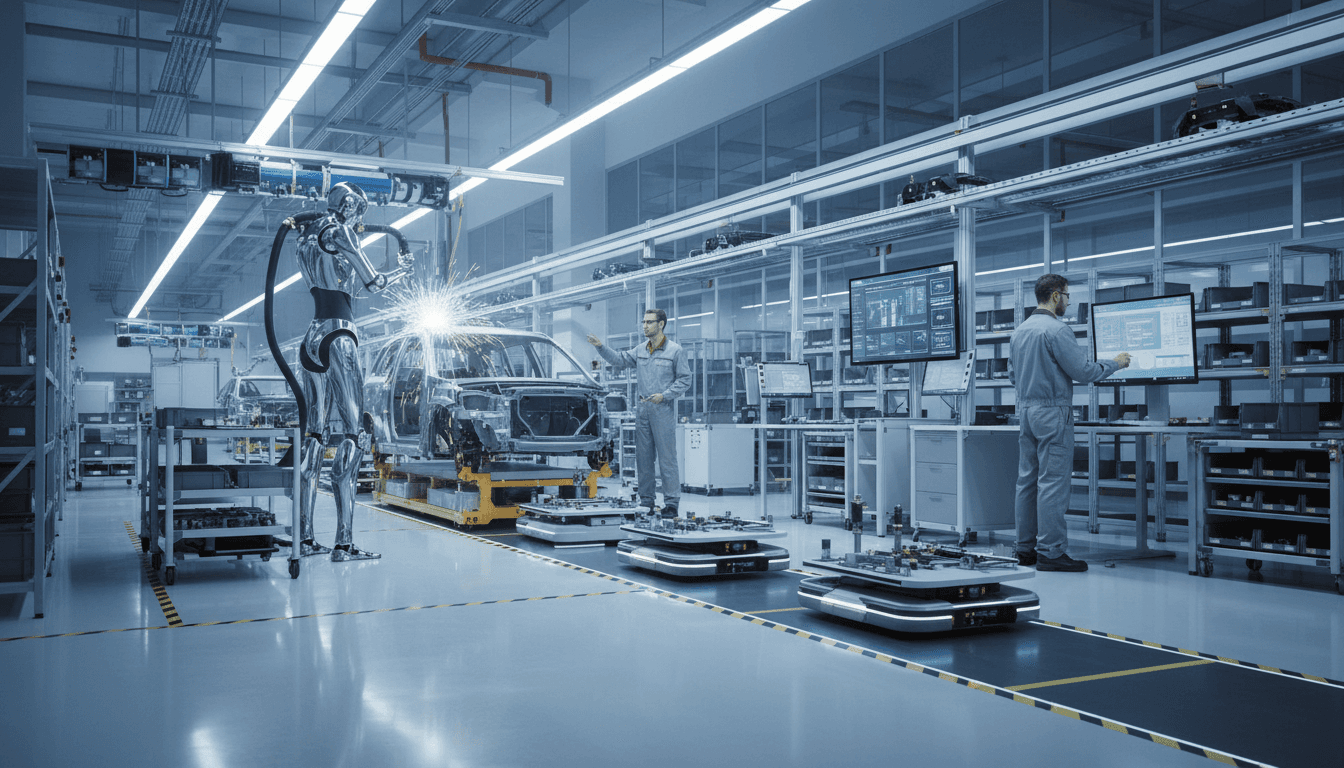
AI Robots for Supply Chains: Hyundai’s Playbook
Tariffs don’t just raise prices—they force operational decisions. Hyundai Motor Group’s move to deploy AI-powered humanoid robots at its U.S. plants starting in 2026 (with plans that scale to 30,000+ units over time) is a clean example of what happens when margin pressure meets modern automation.
If you’re a startup building or running anything that touches logistik dan rantaian bekalan—from warehouse ops to last-mile delivery to manufacturing support—this matters. Not because you’re about to buy humanoid robots tomorrow, but because Hyundai is showing a pattern: when costs become unpredictable (tariffs, labor, lead times), the winners standardize processes and automate the bottlenecks.
This post is part of our “AI dalam Logistik dan Rantaian Bekalan” series, so I’ll frame Hyundai’s announcement as a practical playbook for teams expanding across APAC (or supplying into APAC): what to automate first, how to justify it financially, and what “physical AI” changes in day-to-day operations.
Why Hyundai’s robot move is really a supply chain strategy
Hyundai isn’t deploying humanoid robots as a PR stunt. It’s responding to a direct business constraint: tariffs squeezing North American profit. When your unit economics get hit externally, you either raise prices, re-route supply, renegotiate sourcing—or remove cost from operations.
Humanoid robots (like those from Boston Dynamics, acquired by Hyundai Motor Group in 2021) signal something specific: the company wants automation that can handle variable tasks across a plant, not just a single repetitive motion behind a cage.
The lesson for startups: automation is the hedge against policy risk
Startups often treat automation as “phase two,” after growth. I disagree. For expansion, automation is your hedge against:
- Regulatory shocks (tariffs, customs rules, new compliance steps)
- Labor volatility (availability, wage inflation, turnover)
- Service-level expectations (faster delivery windows, higher fill rates)
In supply chain terms, the goal isn’t “more robots.” The goal is more predictable throughput at a lower cost per unit.
A useful way to think about it: tariffs raise your cost from the outside; automation reduces your cost from the inside.
What “AI robots” actually change on the ground
AI in logistics gets discussed like it’s only software—route optimization, demand forecasting, inventory planning. That’s part of it. But Hyundai’s story sits in the next layer: physical AI.
Physical AI is when models don’t just recommend actions; they power machines that perform actions—moving parts, transporting bins, handling materials, checking quality.
24/7 capability isn’t the headline—variance control is
The article notes humanoids can run 24 hours a day. The deeper point is: 24/7 operation reduces the painful spikes in:
- Work-in-progress (WIP)
- Cycle time
- Missed cut-off times
- Expediting costs
For logistics and supply chain teams, variance is expensive. It forces buffer stock, premium shipping, and firefighting. Automation pays back fastest when it reduces variance, not just labor hours.
Where humanoids fit (and where they don’t)
Humanoid robots are most valuable where facilities have human-designed environments and tasks that change. They’re less compelling where a simple conveyor + fixed robot arm already dominates.
Practical task buckets where “human-shaped” automation can make sense:
- Material handling and kitting in mixed workflows
- Line-side replenishment (moving bins, parts, tools)
- End-of-line packing where SKUs vary
- Routine inspections using vision systems
For startups, you can translate that into a simpler rule:
- If the work requires humans mainly because the environment is human-centric (stairs, doors, narrow aisles, mixed SKUs), you’ll eventually see mobile automation win.
Cost pressure playbook: what startups can copy without buying robots
You don’t need 30,000 humanoids to borrow Hyundai’s strategy. You need the same sequencing: standardize → instrument → automate → scale.
Step 1: Standardize the workflows (before you “AI” anything)
Most ops teams try to automate messy processes and then act surprised when the system fails.
Start with:
- Standard pick/pack steps (one “best known method” per process)
- Defined exception paths (what happens when inventory is missing?)
- Standard labeling and bin locations
If you want a quick diagnostic: if two supervisors describe the same process differently, you’re not ready for automation at scale.
Step 2: Instrument the bottleneck with simple data
In AI dalam logistik, the lowest-hanging fruit is often instrumentation:
- Scan events (inbound, putaway, pick, pack, dispatch)
- Dwell time per station
- Rework rate and reasons
You’re building the dataset that makes automation safe.
Step 3: Automate the “least flexible” work first
Hyundai’s robots may be humanoid, but the ROI logic is old-school: remove cost where tasks are frequent and predictable.
For a startup expanding in APAC, that usually means:
- Warehouse automation: pick-to-light, barcode validation, packing weight checks
- Transport optimization: dynamic routing for multi-stop delivery
- Forecasting & replenishment: demand signals + reorder policies
Then you move into the more complex “physical AI” layer:
- AMRs (autonomous mobile robots)
- Automated palletizing
- Vision-based QC
Step 4: Scale through training, not heroics
Nikkei reports Boston Dynamics will open a U.S. training center this year for robots working at Hyundai plants. That’s not a nice-to-have; it’s the scaling mechanism.
The startup translation: scaling automation requires operational training infrastructure:
- SOPs that match the system
- Onboarding that reduces “tribal knowledge”
- A maintenance and escalation playbook
If your automation relies on one ops lead who “knows how it works,” it’s not scalable. It’s fragile.
How this applies to APAC expansion (especially from Singapore)
Singapore startups often expand into neighboring markets with very different operational realities: labor supply, fulfillment density, infrastructure, and compliance.
Hyundai’s tariff-driven decision highlights a broader truth: cross-border operations punish inefficiency. Every extra touch, exception, and delay gets amplified when you add customs, multi-node inventory, and longer lead times.
The APAC expansion risk most teams underestimate: process drift
When you enter a new market, the local team adapts workflows fast. Some adaptation is good. But unmanaged adaptation becomes process drift:
- Different labeling standards by country
- Different definitions of “shipped” or “delivered”
- Different handling rules for returns
Process drift kills your ability to automate because automation loves consistency.
A simple control mechanism I’ve found effective:
- Define global minimum standards (scan points, labeling schema, exception codes)
- Allow local variation only behind a clear “why” and a measurable KPI
What to automate first for APAC scalability
If you’re choosing where to start (and you should choose), here’s a practical order that tends to produce ROI without massive capex:
- Demand forecasting for the top 20% SKUs that drive 80% volume
- Inventory placement logic (where to stock what, and how much)
- Warehouse scanning discipline (to stop phantom inventory)
- Route optimization (especially for multi-drop B2B)
- Returns triage (automation + rules to reduce manual sorting)
This isn’t glamorous, but it’s how you get cost per order down while maintaining service levels.
People also ask: “Is automation only for big companies?”
No. Big companies deploy more hardware, but startups can still win with narrower automation focused on bottlenecks.
Here’s the filter I use:
What’s a good first automation project?
Pick something with:
- High frequency (daily)
- Clear input/output
- Measurable success metrics
- Painful errors (mis-picks, late dispatch, inventory mismatch)
Examples:
- Automated cartonization rules (reduces shipping cost)
- Scan-to-verify picking (reduces returns)
- Slotting optimization (reduces pick time)
How do you justify automation ROI?
Use a blended model, not just labor savings:
- Labor hours saved n- Error reduction (returns, rework)
- Throughput increase (orders/hour)
- Reduced expedited shipping
- Lower safety stock (less cash tied up)
Hyundai’s tariffs are a reminder that ROI isn’t static. When external costs rise, automation payback gets faster.
The stance: automation is becoming the default cost-control tool
Most companies get this wrong: they treat AI in supply chain as an innovation project. It’s increasingly a finance project—a way to stabilize margins when the outside world won’t.
Hyundai is effectively saying, “If policy risk compresses profit, we’ll redesign operations so the business still works.” That’s the same posture startups need when expanding across APAC markets with uneven costs and uncertain disruptions.
The next question is practical: which operational constraint is most likely to break your unit economics this year—labor, transport, inventory accuracy, or compliance? Your automation roadmap should start there, not with whatever tech is trending.