AI robotics partnerships are reshaping APAC supply chains. Learn what SoftBank and Fanuc’s strategy means for Singapore startups scaling logistics AI.
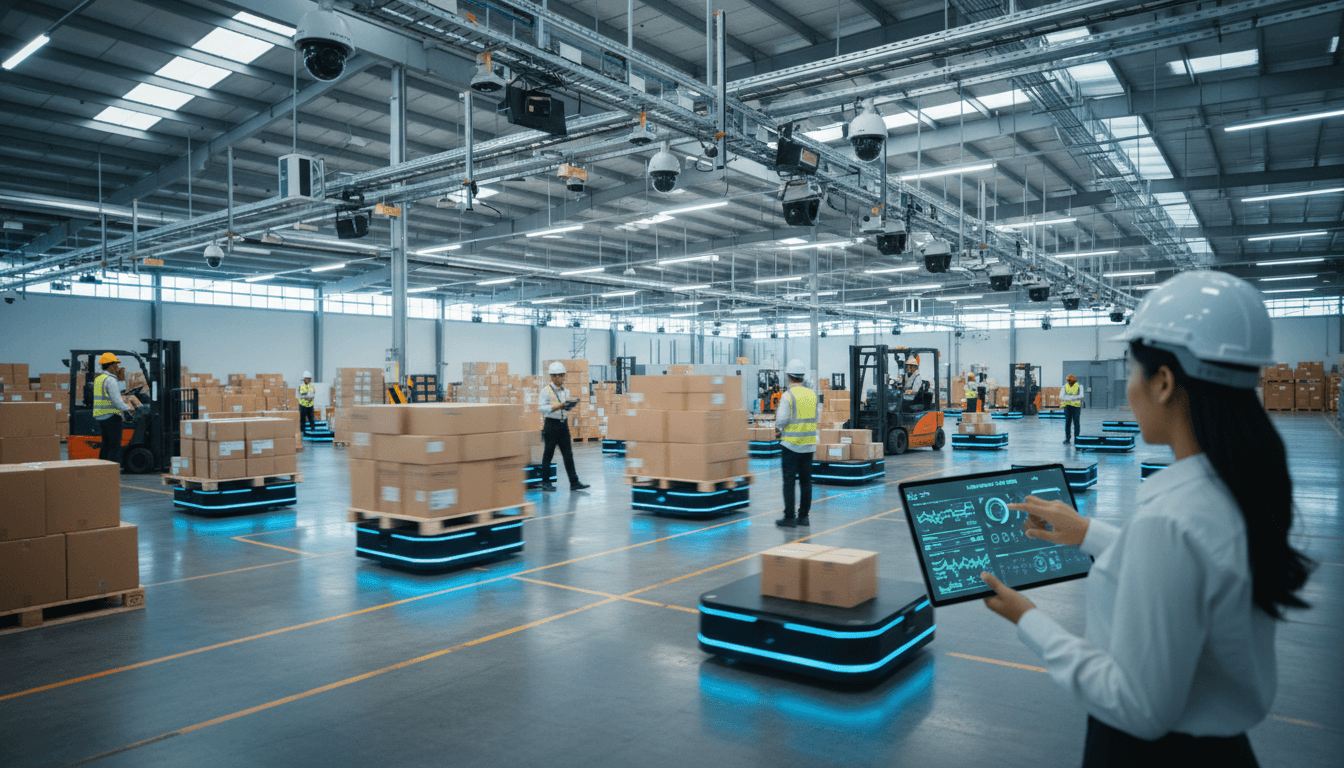
AI Robotics Partnerships for Smarter Supply Chains
A quiet shift is happening in industrial automation across Asia: the companies winning in robotics aren’t trying to build everything themselves anymore. They’re assembling partner ecosystems—robot makers, AI platforms, chip vendors, and software integrators—because “physical AI” (AI that perceives and acts in the real world) is too complex for any single team to master end-to-end.
That’s the big signal in the recent news about SoftBank and Fanuc turning to partners as robotics and AI merge. For Singapore startups building in AI dalam Logistik dan Rantaian Bekalan—warehouse automation, route optimization, demand forecasting, and real-time visibility—this isn’t just Japan industry news. It’s a playbook.
Here’s the stance: partnership strategy is now a product strategy in AI + robotics. If you’re a Singapore-based startup aiming for APAC growth, your go-to-market will live or die on who you integrate with, how quickly you pilot, and whether you can prove ROI in messy, real-world operations.
Why “physical AI” forces partnerships (not hero builds)
Physical AI is expensive, data-hungry, and operationally unforgiving—so partnerships are the fastest route to a shippable system. Traditional industrial robots thrived on predictability: fixed programming, controlled environments, repetitive tasks. Logistics doesn’t look like that.
Warehouses and supply chains are dynamic:
- A pallet arrives wrapped differently than usual.
- Aisles are blocked.
- Labels are torn.
- Demand spikes change picking patterns.
- Humans and robots share space.
To make robots useful here, you need more than a robot arm. You need a stack: perception, localization, task planning, safety, fleet orchestration, simulation, and continuous learning.
The hard truth: logistics is where demos go to die
Most robotics demos look great in a lab. In a real fulfillment center, they face:
- Edge cases (odd packaging, mixed SKUs, reflective surfaces)
- Downtime costs (one stalled robot can jam a process)
- Safety constraints (humans, forklifts, narrow aisles)
- Integration work (WMS/ERP, scanners, conveyors, IoT)
That’s why large players like SoftBank and Fanuc are leaning into partners and open ecosystems. They’re acknowledging that the advantage is shifting from “we build the robot” to “we ship outcomes in real operations.”
Lessons from SoftBank and Fanuc: ecosystems beat closed stacks
The headline lesson is simple: when robotics and AI converge, the center of gravity moves to collaboration. Fanuc is known for industrial robots; SoftBank has pursued robotics initiatives for years. Yet the new battleground—AI-enabled autonomy and adaptability—requires capabilities that span multiple domains.
From the Nikkei report’s framing, Japanese firms are trying to catch up in physical AI by:
- Acquiring partners (to buy time and capability)
- Opening software (to attract developer ecosystems and integration partners)
That approach mirrors what we’ve already seen in the broader market: AI platforms, chip providers, and robotics OEMs forming alliances because model performance depends on data, compute, and deployment feedback loops.
What Singapore startups should copy (and what to avoid)
Copy this:
- Co-sell with hardware channels: If you’re building AI for warehouse automation, partner with AMR/AGV vendors, system integrators, and material-handling firms that already have procurement relationships.
- Treat integrations as a product: Your WMS connector, telemetry pipeline, and exception-handling workflows are not “services”—they’re how you scale across sites.
- Pilot like a scientist: Define baseline metrics, run controlled trials, and publish results internally to the customer’s CFO and ops lead.
Avoid this:
- Building proprietary everything (hardware + models + fleet + UI) unless you’re very well-funded and can tolerate long sales cycles.
- Selling “AI” as a feature. Logistics buyers purchase throughput, accuracy, and labor productivity.
What “AI dalam Logistik dan Rantaian Bekalan” looks like in 2026
In 2026, the most valuable logistics AI isn’t a chatbot—it’s decision automation that ties directly to physical flow. When robotics and AI merge, supply chain value shows up in three places:
1) Warehouse automation that handles variability
The near-term winners focus on repeatable but high-friction tasks:
- Pick assistance (vision-guided picking, pick-path optimization)
- Automated sortation exception handling
- Trailer/container unloading assistance
- Cycle counting via computer vision
Physical AI enables systems to adapt to changing layouts, SKU mixes, and seasonal peaks.
2) Route optimization + real-time execution
Route optimization used to be “night-before planning.” Now it’s a loop:
- Demand signals update
- Traffic conditions shift
- Driver/vehicle availability changes
- Delivery windows get renegotiated
Startups that connect planning to execution (and measure service-level outcomes) earn budget.
3) Demand forecasting that’s operational, not academic
Forecasting matters only when it changes actions:
- reorder points
- labor scheduling
- slotting decisions
- replenishment frequency
A practical stance: forecast accuracy is less important than decision quality (stockout reduction, waste reduction, on-time performance).
The Singapore angle: how to build regional partnerships that actually convert
Singapore is a great control tower for APAC, but pilots are won on the ground—at sites in Malaysia, Thailand, Indonesia, Vietnam, and beyond. Your partnership plan should reflect that.
A partnership map that fits logistics reality
If you’re a startup, you typically need three categories of partners:
-
Deployment partners (system integrators / MHE firms)
- They bring installation capability, safety certifications, and on-site support.
- They help you avoid becoming a “services-heavy” company by productizing common work.
-
Data partners (WMS/ERP, IoT, telematics)
- Access to events like pick confirmations, scan logs, dwell times, and inventory movements.
- Without these, you can’t measure impact credibly.
-
Hardware partners (AMR/AGV, sensors, cameras)
- Physical AI needs reliable sensing.
- Hardware reliability becomes your brand whether you manufacture it or not.
The partnership pitch that resonates with operators
What works in APAC logistics sales is blunt and operational:
- “We reduce mispicks by X per 10,000 order lines.”
- “We increase picks per hour from A to B on this zone.”
- “We cut travel distance by Y% in peak shifts.”
- “We recover Z hours/week from exception handling.”
If your partner ecosystem can’t help you instrument these metrics, the deal stalls.
A practical 90-day playbook for startups (leads-focused)
You don’t need a huge partner network. You need one repeatable wedge into one workflow. Here’s a 90-day structure I’ve found realistic for Singapore startups selling AI/robotics into logistics.
Days 1–30: pick a narrow workflow and design the measurement
Choose one use case where:
- the customer already feels pain weekly
- you can access data with minimal politics
- improvement is measurable within a month
Define your scorecard:
- throughput (units/hour)
- accuracy (error rate)
- cycle time (minutes/order)
- labor hours saved
- downtime / exception rate
Snippet-worthy rule: If you can’t measure it on the warehouse floor, you can’t sell it at renewal.
Days 31–60: land a pilot via an integration-first offer
Offer an “integration sprint” that produces something tangible:
- WMS events into your dashboard
- exception taxonomy
- baseline performance report
- safety and process mapping
This de-risks the buyer and creates internal champions.
Days 61–90: convert the pilot by packaging ROI
Build a simple ROI narrative:
- baseline vs pilot results
- cost to scale (hardware, licenses, support)
- payback period (months)
Procurement doesn’t approve “AI.” Procurement approves payback.
Common questions logistics teams ask about AI robotics partnerships
“Should we partner with a big robotics OEM or stay vendor-neutral?”
Stay vendor-neutral unless the OEM is your primary distribution channel. Logistics environments vary, and being locked to one hardware line can cap your addressable market.
“What data do we need to start?”
Minimum viable data for supply chain AI usually includes:
- order lines and SKU master
- inventory movements
- scan events and exceptions
- labor/shift schedules
- location mapping (bins, zones)
For robotics-specific deployments, add:
- robot telemetry
- safety events
- map updates and congestion hotspots
“What’s the biggest implementation risk?”
Integration and change management. Not model accuracy.
If the workflow changes aren’t owned by operations leaders—and if frontline staff aren’t trained on exceptions—performance decays fast.
Where this is heading in APAC (and why it matters now)
APAC supply chains are under pressure from labor constraints, e-commerce expectations, and tighter margins. Physical AI is becoming the practical answer because it can adapt to variability rather than forcing every warehouse to behave like a factory line.
The SoftBank/Fanuc pivot toward partners is a signal that even incumbents see the new requirement: build ecosystems that shorten time-to-value.
For Singapore startups, the opportunity is clear: be the specialist that plugs into a regional partner stack and ships measurable improvements in warehouse automation, route optimization, and demand forecasting. The open question is execution.
If you had to pick one workflow where you can prove ROI in 30 days—picking, replenishment, sortation exceptions, or last-mile routing—which would it be?