Shein’s $500m logistics hub shows how AI in logistics and smart distribution design help brands stay competitive as tariffs tighten. Apply the playbook to APAC.
AI + Logistics Hubs: What Startups Can Learn From Shein
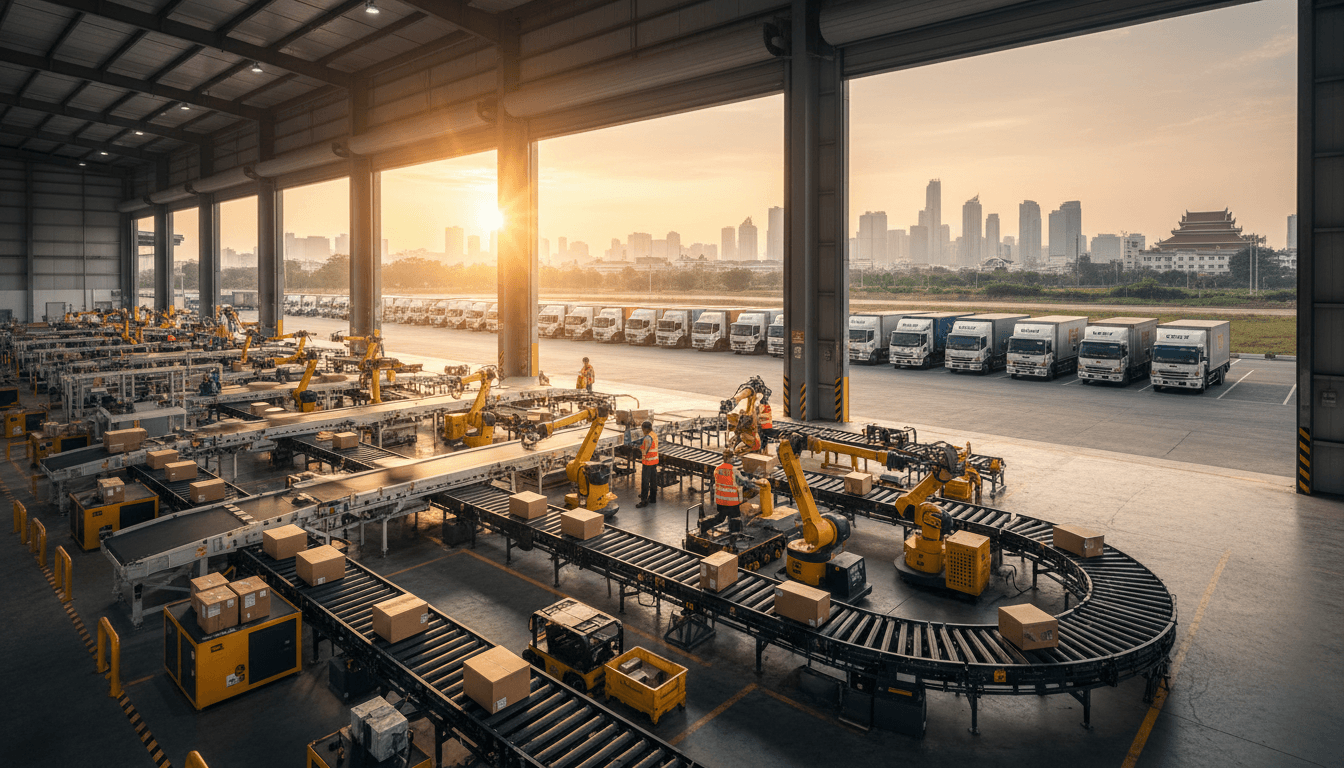
Shein is putting 3.5 billion yuan (about $504m) into a new distribution hub in Zhaoqing, Guangdong, with 600,000 square meters of facilities across 14 two‑storey buildings. That’s not a vanity project. It’s a direct response to a problem that’s hitting every cross‑border brand in 2026: the logistics advantage you built on yesterday’s trade rules can disappear overnight.
For Singapore startups trying to expand across APAC, this matters more than the headline number. Shein is demonstrating a simple truth: when the market changes (tariffs, duties, compliance, shipping constraints), operational design becomes a growth strategy—not a back-office task.
This post is part of the “AI dalam Logistik dan Rantaian Bekalan” series, where we look at how AI improves routing, warehouse automation, demand forecasting, and end-to-end supply chain efficiency. Here, we’ll treat Shein’s move as a case study: when does it make sense to build logistics infrastructure, when should you outsource, and how does AI in logistics turn a cost center into a competitive moat?
The real headwind: cross-border e-commerce is losing “easy mode”
The key point: Shein’s logistics hub is a hedge against rising friction in Western markets.
For years, many cross-border sellers benefited from de minimis rules—tariff exemptions for low-value parcels. That cushion is shrinking fast:
- The U.S. ended its de minimis rule on goods from China in May (per the source article).
- The EU starts charging duties on small parcels in July (per the source article).
- Japan is working to revise tariff rules for cross-border e-commerce purchases (per the source article).
This shift hits the exact business model that made Shein famous: shipping huge volumes of small parcels directly to consumers, keeping prices low.
Why startups in Singapore should care
Even if you’re not selling fashion, the pattern is the same:
- Regulatory and duty changes add cost per order.
- Delivery promises get harder to meet reliably.
- Customer acquisition gets more expensive when prices rise.
So the question becomes: Can you remove enough operational waste to absorb those costs without killing demand? Shein is betting the answer is “yes”—if you control more of the distribution machine.
Why a logistics hub is a pricing strategy (not just a warehouse)
The key point: better logistics can be a substitute for discounts.
When duty exemptions disappear, brands often respond with marketing: “free shipping,” “bigger promos,” “new bundles.” That works until it doesn’t. The more durable option is to reduce unit economics pressure through operational efficiency.
Shein’s new facility will sort and package goods from contracted manufacturers for global shipping. That sounds basic. But a purpose-built hub can improve four things that directly impact margin:
- Pick/pack speed (higher throughput, fewer bottlenecks)
- Packaging accuracy (lower returns, fewer reships)
- Consolidation logic (fewer parcels per order where possible)
- Carrier handoff efficiency (better cut-off times, fewer delays)
And there’s a telling detail in the source: Shein chose to develop the hub in-house rather than lease. That’s a strong signal they want “maximum efficiency,” meaning the building design, automation, and workflows are tuned to their model.
The APAC expansion parallel
For a Singapore startup expanding into Southeast Asia, you usually start with 3PLs (and you should). But once you cross a volume threshold, your logistics design becomes a product feature:
- “Next-day delivery in Kuala Lumpur” is a feature.
- “Predictable returns and exchanges” is a feature.
- “Accurate delivery windows in Jakarta traffic” is a feature.
This is why regional logistics hubs matter. They let you design consistency into the customer experience.
AI in logistics: Shein’s supply chain is built for speed, not just scale
The key point: AI trend analysis only works if the supply chain can execute at the same tempo.
Shein’s model is often described as “AI-driven fast fashion.” The overlooked part is that AI doesn’t ship parcels. Operations do.
The source highlights metrics that explain why Shein’s system is hard to copy:
- Minimum lot size: Shein ~100 pieces vs Zara 500 pieces (Sealand Securities via the article)
- New product cycle: Shein 7 days vs Zara 14 days
- Inventory turnover: Shein’s turnover period is about half Zara’s operator
Those numbers aren’t marketing lines. They’re system design choices.
How AI dalam logistik dan rantaian bekalan fits here
When companies say “AI in supply chain,” I look for specific workflows. For Shein-style speed, AI is typically applied in four areas:
- Ramalan permintaan (demand forecasting): predicting what will sell, at what price, in which market
- Perancangan inventori (inventory planning): deciding how much to produce and where to position it
- Automasi gudang (warehouse automation): slotting, routing inside the warehouse, and labor planning
- Pengoptimuman laluan (route optimization): selecting carriers, line-haul timing, and last-mile options
A distribution hub can be the physical layer that makes those AI decisions real. Without that layer, AI forecasts become “nice dashboards” while customers wait.
Snippet-worthy truth: “AI forecasts don’t create advantage unless your warehouse and shipping network can move at the same speed as the model updates.”
Build vs outsource distribution: a decision framework for startups
The key point: start with outsourcing, then selectively internalize the parts that create differentiation.
Shein can justify a $500m hub. Most startups can’t—and shouldn’t try. But the logic of the decision is transferable.
Here’s a practical framework I’ve found useful for APAC expansion planning.
Step 1: Outsource until you understand your “repeatable routes”
Use a 3PL while you’re still learning:
- Which SKUs drive 80% of orders
- Which lanes cause the most delays (e.g., SG→MY, SG→ID)
- Which return reasons are operational (wrong pick) vs product (wrong sizing)
Rule of thumb: don’t build infrastructure until your order patterns are stable enough to optimize.
Step 2: Internalize the constraint, not the whole stack
Startups often overbuild. A better approach is to bring in-house one constraint at a time:
- If your bottleneck is packing accuracy, build a small in-house QC + packing line.
- If your bottleneck is customs paperwork, build an internal compliance ops team.
- If your bottleneck is forecasting, invest in demand planning and better data pipelines.
Shein’s choice to build suggests their constraint is end-to-end distribution efficiency at massive scale.
Step 3: Use AI where it reduces cost per order (not where it’s trendy)
A lot of teams pick AI projects because they sound impressive. Pick them because they move numbers:
- Lower cost per shipment (carrier selection + parcel consolidation)
- Higher on-time delivery (line-haul planning + cut-off optimization)
- Lower returns (better picking + better product information)
- Lower stockouts (forecasting + replenishment cadence)
If you can’t tie an AI initiative to one of those outcomes, it’s probably not a priority.
What Shein’s Guangdong strategy says about cluster advantage
The key point: regional clusters reduce lead time more reliably than “supplier lists.”
The source notes that Guangzhou is home to “Shein village,” a dense network of contract manufacturers that supply the company. Shein is likely placing distribution close to production for a straightforward reason: shorter internal lead times mean more agility.
In APAC, cluster advantage shows up everywhere:
- electronics supply chains concentrated in specific corridors
- packaging suppliers near manufacturing parks
- fulfillment operators near airport cargo hubs
For Singapore startups, the play isn’t to replicate Guangdong. The play is to choose your clusters deliberately:
- If you’re hardware-adjacent, you might optimize around manufacturing ecosystems in nearby markets.
- If you’re D2C, you might optimize around air cargo accessibility and last-mile reliability.
A quick “cluster checklist” for APAC expansion
Before you commit to a hub (or even a long-term 3PL contract), validate:
- Time to replenishment from suppliers (not just shipping time to customers)
- Labor availability for peak periods
- Carrier diversity (you don’t want a single point of failure)
- Return handling capability (reverse logistics is where margins go to die)
People also ask: does a hub really protect you from tariffs?
The key point: a hub can’t remove tariffs, but it can reduce the pain by lowering operational cost per parcel.
If duties raise your landed cost, you have three levers:
- raise prices (often hurts conversion)
- reduce product cost (often hurts quality or supplier stability)
- reduce fulfillment and shipping cost (often the least visible to customers)
Shein is pulling hard on the third lever. That’s smart because it’s the lever customers don’t “feel” directly—unless you mess up delivery.
A well-run hub also improves compliance control (labeling, restricted items checks, documentation), which matters when regulators are watching cross-border platforms more closely.
What Singapore startups should do next (especially in 2026)
The key point: treat logistics and AI as one roadmap, not separate projects.
Here’s a practical next-step plan that doesn’t require a $500m budget:
- Map your end-to-end lead time (supplier → inbound → storage → pick/pack → line-haul → last mile → returns). Put numbers on each step.
- Pick one KPI to protect during expansion—on-time delivery, cost per order, or return rate. You can’t optimize everything at once.
- Implement lightweight AI where data already exists: demand forecasting by SKU/market, warehouse slotting rules, carrier performance scoring.
- Design a “hub strategy” in phases: 3PL now, shared fulfillment later, dedicated nodes only when volume and predictability justify it.
Shein’s Guangdong hub is a reminder that infrastructure is a strategic response to headwinds. If your plan for expansion is “marketing harder,” you’ll eventually hit a wall. If your plan is “operate smarter,” you can keep growing even when the rules change.
The next year will be brutal for any cross-border player relying on exceptions and loopholes. The companies that win in APAC will be the ones that can answer a simple question confidently: when regulations tighten and costs rise, what part of your logistics system gets better fast—because you designed it to?