Malaysia’s 635 automated border gates by 2028 offer a practical blueprint for resilient AI operations—less manual work, better security, faster flows.
AI Border Screening Lessons for Singapore Businesses
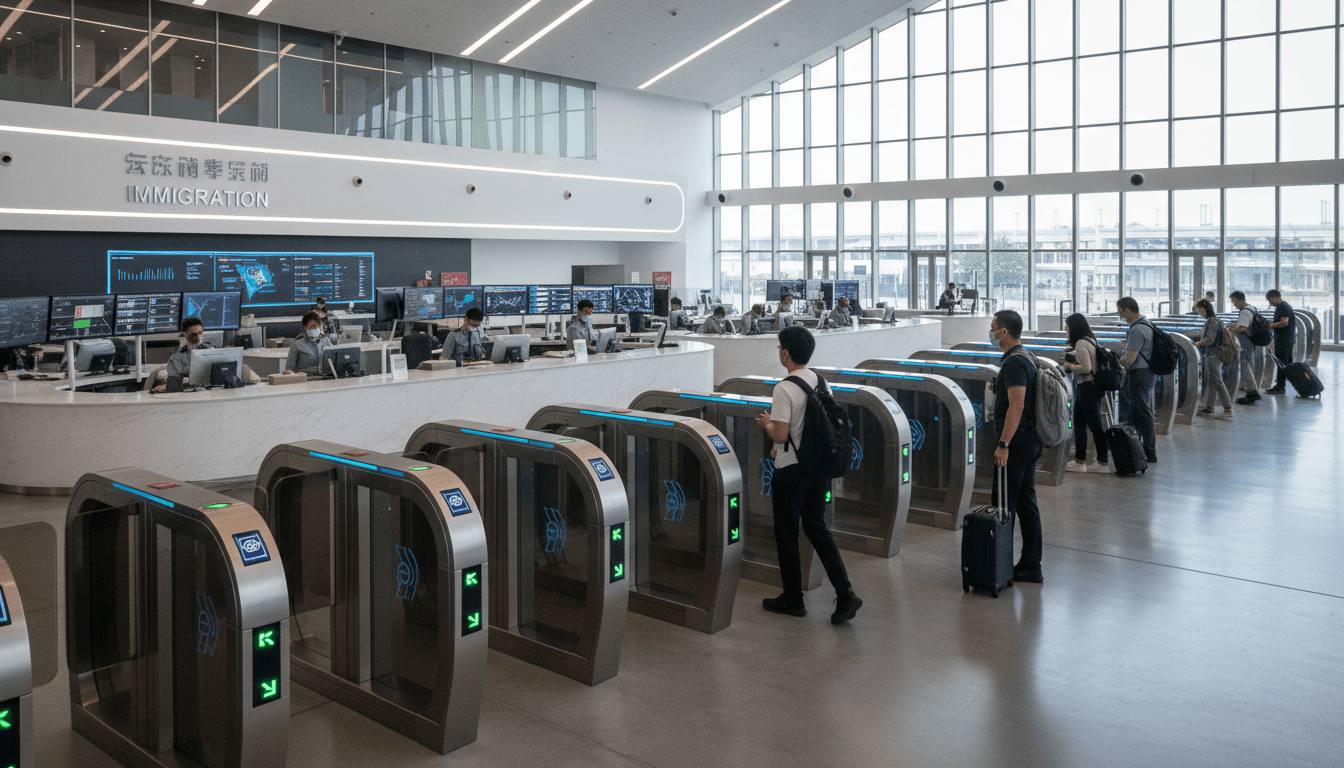
Malaysia’s plan to install 635 automatic immigration gates across 125 entry points by 2028 isn’t just a government tech upgrade—it’s a clean, real-world example of how AI systems should be rolled out when speed, security, and reliability all matter at once. Border control is basically a high-stakes logistics operation: unpredictable demand, strict compliance, constant exception-handling, and zero tolerance for downtime.
For Singapore businesses—especially those in logistics and supply chain, travel, e-commerce, and customer-heavy operations—Malaysia’s approach is a useful regional benchmark. Not because “biometrics are cool,” but because the execution choices (resilience, offline mode, human backup counters, and redeploying staff to higher-value work) mirror what actually works in enterprise AI.
This post sits in our “AI dalam Logistik dan Rantaian Bekalan” series for a reason: a border is a supply chain chokepoint. If you can modernise that, you can modernise warehouse dispatch, customer onboarding, fraud detection, and service operations too.
What Malaysia is building (and why it matters)
Malaysia is modernising border screening with automated gates and biometric verification—including tools like facial recognition and an automated biometric identification system—with a nationwide target by 2028. The rollout spans Immigration, Customs, Quarantine and Security Complexes (ICQS) under the Malaysian Border Control and Protection Agency (AKPS), with the Immigration Department continuing to lead screening tech and operations.
The important part isn’t the headline. It’s the operating model:
- Automation for routine checks, so staff can focus on enforcement and investigations
- Backup manual counters for continuity
- Resilient systems that can run independently/offline during network disruption
- Infrastructure upgrades (local and central servers) to support reliability and transparency
That’s a mature pattern: automate the boring, protect the edge cases, and engineer for failure.
Borders are a logistics problem in disguise
Border clearance behaves like a real-time queueing system. Demand spikes around holidays, long weekends, and school breaks. Identity verification is a “pick/pack/ship” equivalent—except the “item” is a person and the cost of a mistake is huge.
If you’re in supply chain or operations, this should feel familiar:
- High volume + variability
- Strict SOPs and audit requirements
- Fraud/adversarial behaviour (smuggling, identity spoofing, document tampering)
- A constant need to balance throughput vs risk
That’s why border modernisation is a useful case study for AI in logistics and supply chain—it shows what happens when AI meets messy, real-world constraints.
The real win: shifting humans to exceptions, not replacing them
Malaysia’s Director-General of Immigration highlighted a practical goal: reduce dependence on manual inspection for routine matters so officers can focus on higher-value enforcement work.
That’s exactly how companies should think about AI operations.
AI doesn’t create value when it “does everything.” It creates value when it:
- Clears routine volume fast (triage)
- Flags anomalies consistently (risk scoring)
- Routes edge cases to skilled staff (human-in-the-loop)
Singapore business parallel: customer ops and fulfilment
In Singapore, plenty of teams try to automate customer engagement or warehouse workflows and end up with a brittle system that breaks the moment something unexpected happens.
The border model suggests a better stance:
- Use AI to handle standard flows (e.g., repeat customers, standard shipments, known suppliers)
- Keep trained staff for exceptions (e.g., suspicious orders, high-value consignments, unusual routing)
- Measure performance by exception resolution time, not just automation rate
A memorable way to put it: “Automation should shrink your backlog, not your accountability.”
Biometric verification as a template for identity and trust in business
Malaysia’s plan uses biometrics to speed up verification while reducing identity fraud. In business terms, this is a trust infrastructure upgrade.
You may not need facial recognition, but you absolutely need the same idea: reliable, low-friction verification that scales.
Where this maps to logistics and supply chain
Identity and trust show up everywhere in the supply chain:
- Driver and rider verification (last-mile delivery)
- Warehouse access control (prevent theft and shrinkage)
- Vendor onboarding (KYC-like checks for suppliers)
- High-value shipment release (proof-of-authority at handover)
- Returns fraud prevention (confirming legitimate customer identity)
AI systems can help by combining signals:
- Device/location patterns
- Purchase and shipping history
- Document verification results
- Behavioural anomalies (unusual order composition, timing, repeated address changes)
The border analogy is useful because it reminds teams: verification isn’t a single check. It’s a system of checks that must work under pressure.
A stance worth copying: speed with oversight
Malaysia explicitly frames the goal as faster processing and stronger oversight at legal checkpoints. That dual objective matters.
If your AI project only optimises speed, you’ll eventually pay for it in fraud, chargebacks, compliance issues, or reputational damage.
Resilience is the part most AI projects get wrong
One line in the source is the tell: Malaysia expects the system to be highly resilient, with the ability to operate independently or offline during network disruption, and with traditional counters as backup.
Most companies don’t design AI like that. They treat AI as a cloud feature, not an operational capability.
What “offline mode” means for enterprise AI
For Singapore businesses running warehouses, fleet operations, retail, or field services, “offline mode” translates into:
- A process that still works during Wi-Fi outages
- Local fallbacks when APIs fail
- Clear procedures when models are unavailable or degraded
Practical resilience checklist for AI in operations:
- Define a minimum viable manual process (what happens when AI is down?)
- Use graceful degradation (fall back to rules-based checks, not total shutdown)
- Monitor model drift and data quality (bad inputs create confident wrong outputs)
- Log decisions for audit (especially for security/fraud-related decisions)
- Stress test on peak days (your system must survive spikes, not demos)
If Malaysia is building for border peak loads and hostile actors, your business system should at least survive a double-order day on a flash sale.
A practical playbook: applying “border AI” patterns to Singapore operations
Malaysia’s rollout hints at a structure Singapore businesses can copy when adopting AI business tools.
1) Start with the queue, not the model
Border modernisation is fundamentally about throughput: reduce queues, keep risk controlled.
In business, that means mapping:
- Where work items pile up (orders waiting, tickets unassigned, invoices pending)
- What “routine” looks like (high-volume, low-risk)
- What “suspicious” looks like (low-frequency, high-risk)
Then you pick AI techniques that match:
- Classification and routing for triage
- Computer vision for scanning and inspection
- Forecasting for staffing and capacity planning
2) Build SOPs that assume exceptions
Malaysia’s approach strengthens SOPs and keeps manual counters as backup. That’s not conservative—it’s professional.
For supply chain teams, write SOPs that answer:
- What triggers an exception?
- Who reviews it?
- What evidence is required to clear it?
- How fast must it be resolved?
AI should reduce exception volume, not create new confusion.
3) Treat infrastructure as part of the AI product
Malaysia is strengthening local and central server infrastructure for reliability and readiness. Translate that into enterprise terms:
- Reliable data pipelines (clean SKU master data, customer records, inventory accuracy)
- Secure identity and access management
- Low-latency systems where needed (e.g., gate-like decisions at loading bays)
Here’s my opinion: if your data is messy, adding AI just automates the mess faster.
4) Measure what matters: throughput, accuracy, and recovery time
Border systems have obvious KPIs: wait time, false accepts, false rejects, downtime.
For AI in logistics and supply chain, mirror those:
- Cycle time (order-to-ship, pick-to-pack, ticket-to-close)
- Error rate (mis-picks, failed deliveries, duplicate refunds)
- Fraud loss / shrinkage
- Mean time to recovery when systems fail
The best AI projects win because they improve operations, not because they ship a model.
People also ask: what should businesses watch out for?
“Does automation increase risk of mistakes?”
It can—if you remove human review entirely. The safer pattern is automation + verification + exception routing. Malaysia’s plan keeps human counters and focuses officers on higher-value work rather than eliminating oversight.
“Is biometric-style AI relevant outside government?”
Yes, as a concept: it’s about fast, reliable identity verification. In business, that becomes stronger customer verification, supplier onboarding checks, secure facility access, and fraud prevention in logistics workflows.
“What’s the biggest hidden cost?”
Integration and reliability work. The unglamorous parts—data quality, monitoring, and fallback procedures—are what determine whether AI improves service levels or creates new downtime.
Where this is heading for SEA—and what Singapore firms should do next
Malaysia’s border screening modernisation signals a broader SEA shift: governments are treating AI as critical infrastructure, not a side project. That mindset is the useful takeaway for Singapore businesses.
If you’re working on AI in logistics and supply chain—route optimisation, warehouse automation, demand forecasting, or customer engagement—copy the operational discipline:
- Automate routine volume first
- Engineer for outages and peak loads
- Keep humans for exceptions
- Measure speed and control
If you want to pressure-test your current AI roadmap, ask a border-style question: “What happens when our system is under peak load, data is imperfect, and someone is actively trying to exploit it?”
That’s where serious AI capability starts.