Deepfake detection is becoming a business standard. Learn how Singapore companies can protect trust with practical AI integrity tools and workflows.
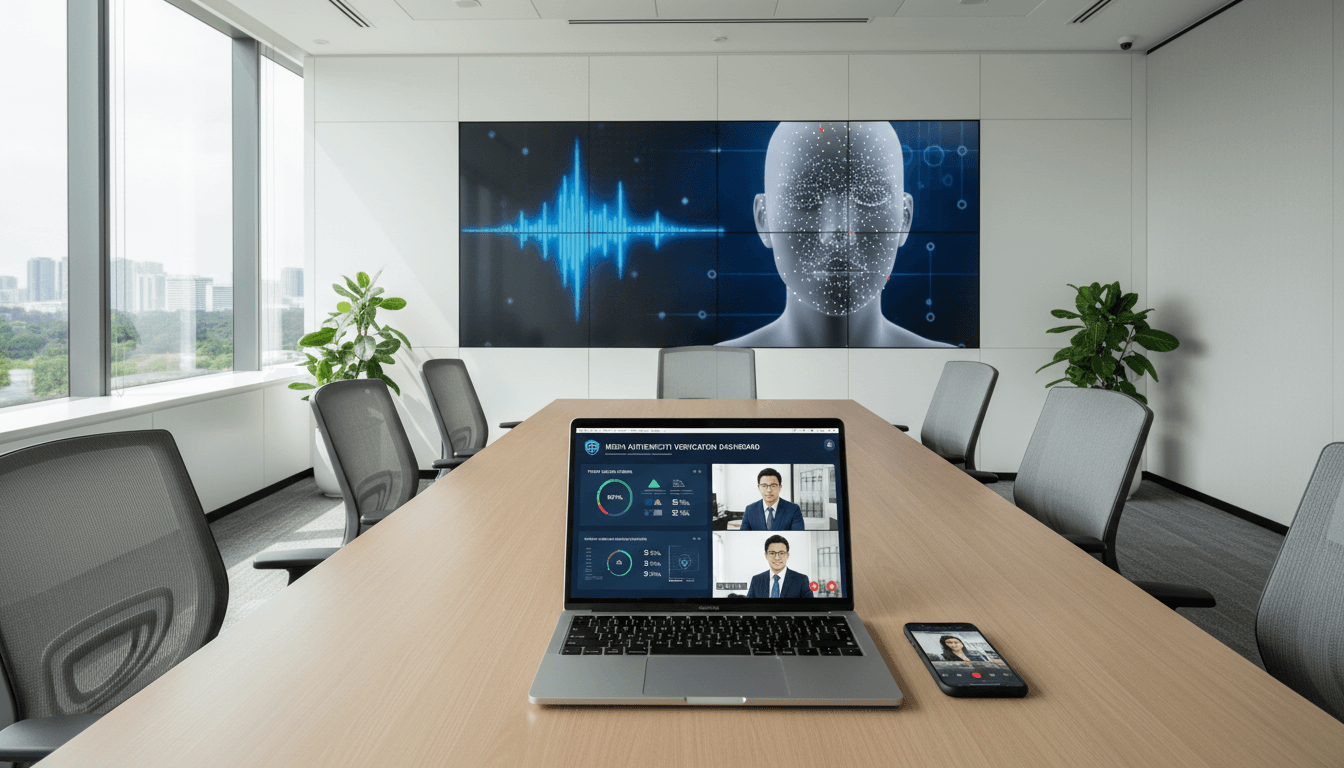
Deepfake Detection: A Trust Play for SG Businesses
Britain says 8 million deepfakes were shared in 2025, up from 500,000 in 2023. That’s not a “we’ll deal with it later” trend—it's a straight-line threat to brand trust, customer engagement, and even payment security.
Last week, the UK government announced it will work with Microsoft, academics, and experts to build a deepfake detection evaluation framework—a common yardstick for testing and comparing detection tools against real-world risks like fraud, impersonation, and non-consensual sexual content. The point isn’t to create one magic detector. The point is to create standards.
For Singapore businesses following the AI Business Tools Singapore series, this matters for a simple reason: your customers now treat “audio, video, and screenshots” as untrusted inputs unless you give them a reason not to. And trust is the real conversion metric in 2026.
What the UK–Microsoft initiative actually signals
The headline is “deepfake detection system.” The more important signal is this: governments are moving from ad-hoc moderation to measurable AI integrity standards.
The UK’s plan focuses on an evaluation framework that:
- Tests deepfake detection tools against specific threat types (sexual abuse, fraud, impersonation)
- Measures how tools perform in realistic conditions (not just lab datasets)
- Identifies where detection gaps remain
- Sets clear expectations for industry on what “good enough” detection looks like
That last bullet is the one businesses should care about. Once regulators standardise evaluation, companies will be expected to show they’ve taken reasonable steps to prevent harm.
A practical way to read this: Deepfake defence is becoming like cybersecurity—less about “do you have a tool?” and more about “can you prove your controls work?”
Why deepfakes are a direct business problem in Singapore
Deepfakes aren’t only a political misinformation issue. In commercial settings, they show up as loss of money, loss of reputation, and loss of customer confidence.
Here’s where Singapore businesses feel it first:
1) Customer support impersonation
Fraudsters can spoof:
- A “CEO voice note” asking finance to approve urgent transfers
- A “customer call” that sounds like your real customer to reset credentials
- A “support agent video” pretending to represent your brand
Once a deepfake slips into a workflow, your internal controls—not your staff’s intuition—decide the outcome.
2) Brand reputation attacks
A fake clip of a founder saying something offensive can travel faster than any clarification. The damage is immediate:
- Sales teams field objections they didn’t create
- Customer service gets flooded
- Social proof (reviews, UGC, testimonials) becomes suspect
3) Marketing compliance and proof
More brands are using AI-generated creatives. That’s fine—until customers can’t tell:
- What’s a real customer testimonial vs synthetic
- Whether a “product demo” reflects actual performance
- Whether an influencer endorsement is manipulated
The lesson: AI content without provenance becomes a liability, not an asset.
The myth: “Deepfake detection is a tech problem for big companies”
Most SMEs assume deepfake defence requires a dedicated trust-and-safety team. I don’t agree. The reality is simpler: it’s a process and tooling problem, and SMEs can cover 80% of the risk with the right controls.
Think of deepfake risk like payment fraud. You don’t need to be a bank to:
- Require verification steps
- Log suspicious activity
- Train staff on red flags
- Use automated checks
Deepfake defence works the same way. It’s a layered system.
A practical “AI integrity stack” for Singapore businesses
If you want something actionable, build your deepfake defence around four layers. This aligns well with where standards are heading globally.
1) Provenance: make authentic content verifiable
Goal: Make it easy to prove what’s real.
What to do:
- Keep source files for key brand assets (founder videos, ads, product demos)
- Store originals in controlled locations (versioned cloud storage, DAM)
- Use consistent publishing workflows (who can post, where, with approvals)
If you’re producing lots of content, this is where AI business tools in Singapore can help: asset management, approvals, and audit trails reduce chaos.
2) Detection: add automated checks where it counts
Goal: Detect likely manipulation before it spreads.
Where detection helps most:
- Inbound videos sent to your staff (e.g., “vendor invoice proof,” “CEO request”)
- Social media monitoring for brand impersonation
- Customer support channels (voice calls, video verification)
What “good” looks like:
- Triage automation: flag suspicious media for manual review
- Repeatable testing: do detection tools handle low-quality audio, compression, screen recording?
This is exactly why the UK’s evaluation framework matters. Detection tools vary wildly depending on:
- Language and accents
- Audio quality
- Compression artifacts
- Face angle and lighting
You don’t want to buy a tool that demos well and fails on WhatsApp-grade media.
3) Verification: don’t let high-risk actions rely on a single signal
Goal: Make it hard for impersonators to trigger irreversible outcomes.
Adopt “two-channel” verification for high-risk events:
- Any payment instruction from a senior leader: confirm via a second channel
- Any credential reset: require a second factor and identity check
- Any change to bank details: require written confirmation + verification call
A simple rule that works: No money moves and no access changes based on voice/video alone.
4) Response: prepare for the day it happens
Goal: Contain damage in hours, not days.
Minimum viable deepfake incident plan:
- Freeze: pause scheduled posts and ad campaigns if the brand is under attack
- Verify: confirm whether the media is authentic using internal source assets
- Document: capture URLs, timestamps, accounts involved
- Communicate: publish a short statement with what you know and what customers should do
- Escalate: report impersonation and fraud attempts through proper channels
If you’ve ever handled a cybersecurity incident, the rhythm is similar. The difference is reputational spread is faster.
What “standards” will mean for businesses (and how to get ahead)
As deepfake harms increase, regulators will keep tightening expectations. The UK’s move signals a shift toward measurable requirements such as:
- Documented evaluation of detection tools
- Defined thresholds for acceptable false positives/negatives by context
- Sector-specific expectations (finance, healthcare, education)
For Singapore businesses, getting ahead doesn’t mean predicting the exact regulation. It means building evidence that you operate responsibly.
Here’s the posture I recommend:
- Define high-risk workflows (payments, access control, public comms)
- Add verification controls (two-channel confirmation)
- Track incidents (how many impersonation attempts per month)
- Review quarterly (attack patterns will change)
One-line policy you can use internally:
If content can change a customer’s decision or move money, we treat authenticity as a control, not a judgment call.
“People also ask” (the questions business leaders are raising in 2026)
Are deepfake detection tools reliable enough to trust?
They’re useful for triage, not truth. Detection should trigger verification, not replace it. The best setup is automation + human review + workflow controls.
What’s the fastest win for SMEs?
Implement two-channel verification for payments and credential resets. It’s cheap, immediate, and stops the most damaging attacks.
Should we ban AI-generated marketing content?
No. But you should control it. Use AI where it helps, then add governance:
- approvals
- source retention
- claims validation
- clear separation between testimonials and synthetic demos
How this fits the “AI Business Tools Singapore” roadmap
Most AI adoption content focuses on productivity and growth: faster content, better targeting, cheaper operations. That’s real. But 2026 is also the year businesses must treat AI integrity as part of customer experience.
The UK–Microsoft framework is a reminder that trust is becoming measurable. The companies that win won’t be the ones producing the most content. They’ll be the ones customers believe.
If you’re investing in AI business tools in Singapore—marketing automation, chatbots, voice agents, content generation—pair that with a basic integrity stack: provenance, detection, verification, response. It’s the difference between “AI at scale” and “AI you can stand behind.”
Where do you see the biggest authenticity risk in your business right now—payments, customer support, or marketing claims?