Singapore AI adoption depends on reliable hardware. Here’s how the Renesas–SiTime deal points to edge AI growth—and what businesses should do next.
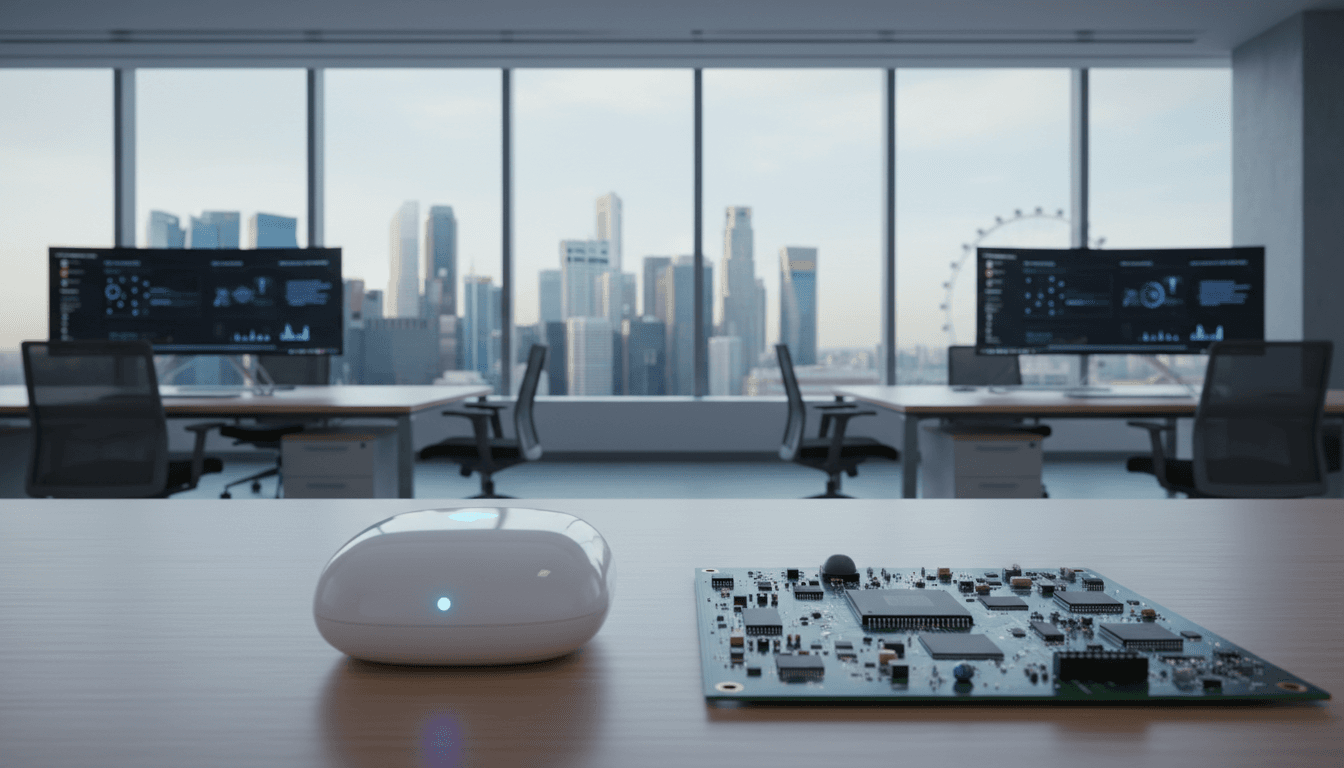
AI Business Tools in Singapore Start with Better Chips
A 17.9% jump in SiTime’s share price isn’t just a finance headline—it’s a signal that the “boring” parts of technology (timing, power stability, component count) are becoming strategic again.
On 6 Feb 2026, Reuters reported that SiTime signed a deal worth up to US$3.2 billion to acquire timing assets from Renesas, and that Renesas plans to integrate SiTime’s resonator technology into future chips. SiTime expects those acquired assets to generate US$300 million in first-year revenue after closing (anticipated by end-2026), nearly doubling its FY2025 sales of US$326.7 million. The headline-grabber, though, is what SiTime’s CEO said comes next: this integration could end up in “billions of units”.
If you run a Singapore business and you’re investing in AI business tools—for marketing automation, operations forecasting, customer service copilots, or fraud detection—this matters. Not because you’re buying microcontrollers. Because the reliability, size, cost, and power profile of the chips inside everyday devices determines where AI can realistically live: on the device, at the edge, or only in the cloud.
The unsexy truth: AI adoption speeds up when hardware becomes simpler, smaller, cheaper, and more dependable.
(Source article: https://www.channelnewsasia.com/business/sitime-tech-could-go-billions-renesas-chips-sitime-ceo-says-5911426)
The deal, in plain English: why timing components are a big deal
Timing is the heartbeat of electronics. Chips need a stable “clock” to coordinate operations. Traditionally, many systems rely on external timing components (often quartz-based) placed on the circuit board.
The Reuters piece highlights that Renesas will integrate SiTime’s resonator—described as smaller and more resistant to temperature swings than competing approaches—into its chips. The CEO’s key claim: these could become the first microcontrollers on the market that don’t need any external timing components.
Why removing external components changes adoption curves
When you remove external components, you usually get:
- Lower bill-of-materials (BOM) cost (fewer parts, fewer suppliers)
- Smaller device footprints (important for wearables, sensors, compact IoT)
- Better reliability (fewer solder joints and less board-level complexity)
- Faster manufacturing and simpler quality control
For businesses, this shows up as a more practical path to deploying AI-enabled devices at scale—especially in environments where heat, vibration, and long operational life are real constraints (think logistics, manufacturing, transport).
Why this matters for AI adoption in Singapore businesses
Answer first: This matters because edge AI (AI running on devices near where data is generated) needs hardware that’s dependable and efficient, not just “powerful.”
Singapore’s AI conversations often focus on models, governance, and talent—and that’s right. But day-to-day operational AI is increasingly an infrastructure story:
- Sensors that detect anomalies in equipment
- Smart cameras that count footfall or monitor safety compliance
- Wearables that track workforce safety or patient vitals
- Payment terminals and kiosks that flag fraud patterns in real time
All of these scenarios depend on devices that can run continuously, often in harsh conditions, with low maintenance.
Edge AI vs cloud AI: the business trade-offs
If you’re selecting AI business tools in Singapore, you’re implicitly choosing where AI runs:
- Cloud AI: easier to update; higher recurring compute costs; latency and connectivity risks
- Edge AI: faster responses; better privacy; lower data transfer; harder updates; tighter power/thermal budgets
- Hybrid: common in real deployments—edge for real-time decisions, cloud for training and reporting
Better integrated timing and more stable microcontrollers make edge deployments less fragile—meaning fewer “pilot projects” that never survive the move into production.
The hidden link: microcontrollers are the workhorses behind “AI in everything”
Answer first: Microcontrollers matter because they’re everywhere—and “everywhere” is where operational AI delivers ROI.
Renesas is strong in microcontrollers, and the Reuters story points specifically to automotive chips as a fit, due to temperature resilience. Automotive-grade requirements tend to be stricter than typical consumer electronics. When technology meets those requirements, it often trickles into adjacent markets: industrial systems, medical devices, and high-uptime IoT.
What “billions of units” means for businesses (not investors)
When a component is headed for billions of units, three things typically happen:
- Standardisation: hardware becomes a predictable platform for software teams
- Ecosystem growth: tools, libraries, reference designs, and trained engineers multiply
- Unit economics improve: more features for the same cost, or lower costs for the same features
In practice, this is how AI features stop being “premium add-ons” and become default expectations.
A Singapore-flavoured scenario: AI at the edge in real operations
Here’s a concrete example I’ve seen work in Southeast Asia: a retail chain starts with cloud-based analytics for footfall and queue time. It’s okay—until bandwidth spikes, cameras go down, and privacy reviews slow everything.
A stronger edge approach looks like:
- On-device models extract counts and events, not raw video
- Only summaries are sent to the cloud
- Store managers get near-instant alerts (queue threshold, unusual dwell time)
Hardware reliability (clock stability, thermal tolerance, fewer external parts) becomes the difference between a system that runs quietly for months and one that needs constant babysitting.
What to watch over the next 24 months (and what you can do now)
Answer first: The integration will take time—SiTime’s CEO openly said it’s likely “at least a couple of years” before meaningful revenue shows up—so businesses should prepare their AI roadmap now, not later.
Timing integration into microcontrollers doesn’t flip a switch overnight. Renesas has to design it in, qualify it, manufacture it, and ship it through customer design cycles. But this “slow” semiconductor timeline is a gift for operators: it gives you a runway to get your AI fundamentals right.
1) Audit where you’re paying an “AI tax” today
Common AI taxes in real deployments:
- Constant connectivity required to function
- Excessive raw data uploads (especially images/video)
- Hardware that fails in heat, dust, or vibration
- Too many suppliers/parts creating repair and procurement delays
If any of these sound familiar, you’re a candidate for a more edge-heavy AI architecture.
2) Choose AI business tools that support edge + hybrid deployments
When evaluating tools (for customer engagement, ops automation, or marketing analytics), ask:
- Can it run on-device or on an edge gateway when needed?
- Does it support privacy-by-design (send events, not raw personal data)?
- Are model updates manageable (OTA updates, versioning, rollback)?
- Can it operate in degraded mode if the cloud link is down?
This is where many Singapore SMEs get stuck: they buy an AI tool that’s “cloud-only,” then try to force it into edge realities.
3) Treat reliability as an AI KPI
Most teams track accuracy and response time. You should also track:
- Device uptime (%)
- Mean time between failures (MTBF)
- False alert rate per day/week (operator trust)
- End-to-end latency from event → action
If the AI tool can’t be trusted operationally, adoption dies—even if the model is good.
“People also ask”: quick answers for decision-makers
Will better chips automatically improve my AI marketing results?
Not directly. But they reduce friction for capturing real-time signals in-store, in-field, or on devices—signals that feed better segmentation and faster campaign responses.
Does this only matter for manufacturers and hardware companies?
No. Retail, logistics, healthcare, and property management all benefit from edge AI reliability. Even if you’re “just” a services firm, your next AI workflow may depend on sensors, kiosks, cameras, or mobile devices.
Should SMEs in Singapore care about Renesas and SiTime specifically?
You don’t need to track every semiconductor deal. But you should watch for platform shifts that make AI cheaper and more robust at the edge. This deal is one of those signals.
The practical takeaway for Singapore: infrastructure decides the pace of AI
The Renesas–SiTime story is a reminder that AI business tools in Singapore don’t exist in isolation. They sit on top of infrastructure choices that determine cost, privacy posture, latency, and reliability.
My take: companies that win with AI over the next two years won’t be the ones who chase the biggest models. They’ll be the ones who build boring, durable systems—hybrid architectures, measurable uptime, and deployment patterns that keep working when reality gets messy.
If you’re planning your 2026 AI roadmap, now’s a good time to identify one workflow where edge reliability would change outcomes (queue monitoring, predictive maintenance, field service triage, fraud checks) and design it so it can scale. When the next wave of integrated hardware platforms becomes mainstream, you’ll be ready to take advantage—rather than restarting yet another pilot.
What would your business automate tomorrow if the system could run 24/7 without constant connectivity or manual oversight?