SiTime–Renesas signals AI-ready chips at massive scale. Here’s what integrated timing means—and how Singapore firms can use AI tools to act faster.
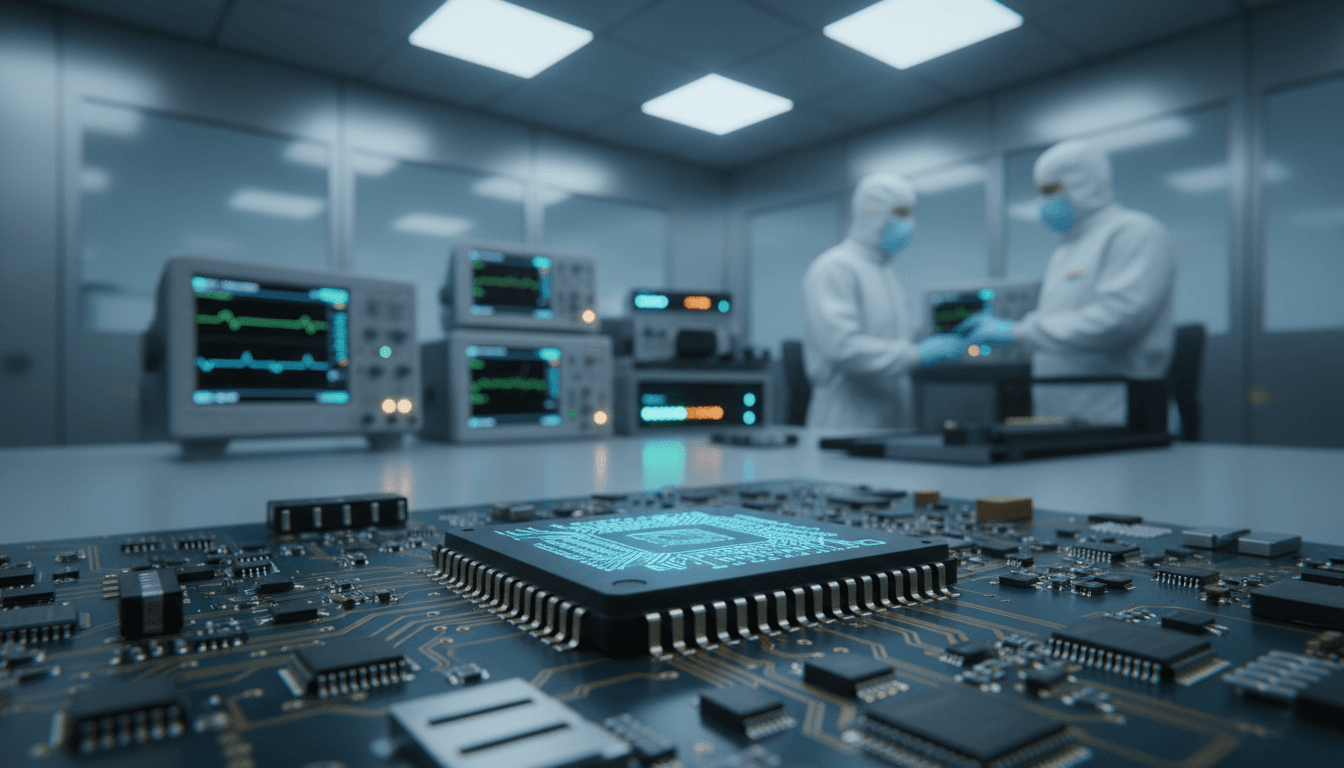
AI-Ready Chips: What SiTime–Renesas Signals for SG
SiTime’s CEO just described a future where its timing technology could be integrated into “billions of units” of Renesas microcontrollers. That’s not hype for the sake of it—it’s a statement about scale. When a component can ship inside the default chip choices of a major microcontroller supplier, the impact ripples across automotive, industrial, and IoT supply chains.
For Singapore businesses following the AI Business Tools Singapore series, this matters for a simple reason: AI doesn’t run on “AI software” alone. It runs on an infrastructure stack—sensors, microcontrollers, connectivity, and the reliability basics that keep real-world systems stable. Timing components are one of those unglamorous basics. Get timing wrong, and the entire system behaves badly.
This post breaks down what the SiTime–Renesas deal (announced Feb 2026) implies for AI readiness, why “no external timing components” is a bigger deal than it sounds, and how Singapore companies can use AI and automation tools to benefit from the next wave of embedded intelligence.
The deal, in plain English: why timing tech is suddenly headline news
Answer first: SiTime is buying timing assets from Renesas in a deal worth up to US$3.2B, while Renesas agrees to integrate SiTime’s resonator tech into its chips—potentially removing the need for external timing parts.
According to the Reuters report carried by CNA, SiTime expects the Renesas assets to generate about US$300M in first-year revenue after the deal closes (anticipated by end-2026). For context, SiTime’s fiscal 2025 sales were US$326.7M—so the acquisition nearly doubles its top line.
But the part that should catch an operator’s attention isn’t the M&A headline. It’s the integration clause:
- Renesas will integrate SiTime timing technology (a resonator) into certain chips.
- The CEO expects the resulting microcontrollers to be the first on the market that don’t need external timing components.
- Integration takes time—“at least a couple of years” for design-in, qualification, and commercialization.
Why “integrated resonator” changes the economics
Answer first: Integration reduces parts, board space, and failure points—improving reliability and potentially lowering total system cost.
Most businesses don’t buy a timing device directly. They buy a finished product—an industrial controller, a fleet telematics unit, a wearable, a payment terminal. But in every one of those devices, engineers fight the same constraints: bill of materials (BOM), board area, power, and reliability.
If a microcontroller no longer needs an external timing component, a manufacturer can:
- simplify procurement (fewer line items, fewer supplier risks)
- speed up assembly (fewer placements on the PCB)
- reduce points of failure (fewer solder joints, fewer components exposed to vibration)
- improve manufacturability (better yield, fewer rework cycles)
That’s how small components create big outcomes.
Why timing matters to AI in the real world (yes, even for “software” teams)
Answer first: AI systems that touch the physical world—vehicles, machines, wearables—depend on precise timing for sensing, communications, and safety.
AI adoption conversations in Singapore often start with software: chatbots, analytics, marketing automation, and workflow tools. That’s sensible—those are the quickest wins.
But the AI economy is also moving into embedded and edge AI:
- predictive maintenance (vibration + current + temperature sensing)
- smart logistics (tracking + cold chain + condition monitoring)
- robotic automation (motion control + safety interlocks)
- automotive and mobility (ADAS, ECU coordination, sensor fusion)
In these environments, timing is not an “electronics detail.” It affects:
- Sensor fusion: Aligning streams from cameras, radar, lidar, IMUs, and encoders depends on synchronized clocks.
- Connectivity stability: Protocols (wired and wireless) rely on stable timing references.
- Safety + compliance: Automotive and industrial standards reward predictable behaviour under temperature swings, vibration, and long lifetimes.
The CNA piece notes SiTime’s resonator is smaller and more resistant to temperature swings than alternatives—traits that map directly to harsh operating conditions, especially in automotive.
Singapore angle: infrastructure is the quiet competitive advantage
Answer first: Singapore wins when it plugs into global supply chains with high-reliability components and operational excellence—AI tools help local firms do that faster.
Singapore isn’t trying to out-volume everyone in manufacturing. The strength is in precision, process, and integration: regional HQ functions, engineering services, advanced manufacturing, test, logistics, and regulated industries (finance, healthcare, aviation, maritime).
When global chip platforms standardise around more integrated, more reliable parts, Singapore firms that build systems on top—OEMs, contract manufacturers, solution integrators—get a chance to:
- shorten product cycles
- improve quality KPIs
- reduce warranty costs
- expand into stricter markets
This is where AI business tools in Singapore stop being “nice productivity apps” and start becoming the operating system for growth.
“Billions of units” doesn’t happen by magic: design-in, qualification, and automation
Answer first: Semiconductor adoption is a pipeline—design-in → qualification → production ramp—and AI tools help teams manage the messy middle.
SiTime’s CEO was blunt about timelines: revenue impact from integration likely takes a couple of years. That tracks with how embedded hardware works. A chip feature can be real today but economically meaningful only after it’s designed into products and survives qualification.
If you’re running product, operations, or procurement in Singapore, here’s the important shift: the bottleneck is rarely “the idea.” It’s coordinating the work across functions and suppliers.
Where AI and automation tools actually help (practical use cases)
Answer first: The best ROI comes from applying AI to coordination—requirements, quality, supplier management, and forecasting.
A realistic stack many mid-sized firms can adopt (without building custom AI models) looks like this:
-
Requirements and change control
- Use AI assistants to summarise engineering change requests (ECR/ECO) and highlight impacted assemblies.
- Automate document routing for sign-offs (quality, compliance, procurement).
-
Supplier risk and procurement intelligence
- Build automated alerts for component lead-time changes.
- Use AI to classify supplier emails and extract key fields (price breaks, MOQ, delivery dates) into structured tables.
-
Quality analytics
- Apply anomaly detection to test logs and RMA data.
- Correlate failures with lot codes, operating temps, and production shifts.
-
Demand planning and scenario modelling
- Use forecasting tools that can incorporate promotions, seasonality, and customer behaviour.
- Run “what if” scenarios: alternate part qualification, second-sourcing, logistics disruptions.
-
Customer support for technical products
- Deploy AI support copilots trained on manuals and troubleshooting flows.
- Route cases by likelihood of hardware defect vs configuration issue.
The point: if chip platforms are getting more integrated, your business advantage shifts to how quickly you operationalise change.
What Singapore SMEs should do in 2026: a simple playbook
Answer first: Treat hardware platform shifts as an operations opportunity—tighten your data, automate cross-team workflows, and be qualification-ready.
Most SMEs miss platform transitions because they wait for certainty. The better approach is to prepare your organisation so you can move when the supply chain moves.
Step 1: Map where “timing” shows up in your product or operations
If you ship devices, identify:
- which microcontrollers you standardise on (Renesas, ST, NXP, etc.)
- whether you use external oscillators/resonators today
- failure modes tied to temperature, vibration, or aging
If you don’t ship devices, you still have exposure through vendors: automation equipment, sensors, access control, POS terminals, asset trackers.
Step 2: Instrument your qualification pipeline
Qualification is where timelines slip. Put these in place:
- a single source of truth for test plans and evidence
- automated reminders for qualification gates
- dashboards that track cycle time: sample arrival → test complete → approval
Step 3: Use AI tools to reduce “coordination tax”
Coordination tax is the hidden cost of growth—meetings, status chasing, version confusion.
I’ve found the fastest wins come from automating the boring but frequent tasks:
- summarising weekly project updates into a single format
- extracting key numbers from PDFs and supplier messages
- creating structured issue logs from chat threads
Step 4: Align with customers who care about reliability
Automotive and industrial buyers pay for reliability, traceability, and predictable supply. If your offerings touch those markets, start building:
- traceability workflows (batch/lot tracking)
- evidence packs (test results, process controls)
- service analytics (failure trend reporting)
These are exactly the areas where AI business tools in Singapore can reduce manual load.
People also ask: what exactly is a resonator, and why does it beat alternatives?
Answer first: A resonator provides a stable frequency reference (a clock source). SiTime’s version is positioned as smaller and more temperature-stable, making it attractive for harsh environments like automotive.
Microcontrollers need a clock. Many designs add an external component to provide it. If the clock source can be integrated and still meet performance requirements—especially across temperature swings—the overall system gets simpler and more robust.
The CNA report specifically highlights:
- smaller form factor
- resistance to temperature swings
- suitability for automotive chips, a core Renesas market
If you operate in sectors where devices live outdoors, in factories, in vehicles, or near heat sources, temperature stability isn’t a minor spec. It’s often the difference between a product that ships and a product that becomes an RMA nightmare.
Where this heads next: “AI everywhere” needs dependable basics
SiTime’s acquisition and Renesas integration plan is a reminder that the next phase of AI adoption isn’t just more software subscriptions. It’s AI embedded into everyday hardware—often invisibly.
For Singapore businesses, the opportunity is to become faster at turning global platform improvements into local advantage. That means:
- choosing AI business tools that reduce operational drag
- improving the quality of your data (so automation doesn’t create chaos)
- building a qualification and compliance muscle you can reuse
If Renesas microcontrollers really do ship with integrated timing at massive scale, the winners won’t be the companies that noticed the headline. They’ll be the ones whose teams can absorb the change quickly—without breaking quality, delivery, or margins.
Forward-looking question: when your suppliers ship a “simpler, more integrated” platform, does your organisation get simpler too—or do your workflows make every improvement feel harder than it should?