Bangladesh’s automation data shows where productivity grows fastest. Here’s how Pakistan’s textile and garments teams can apply AI + automation for quality and speed.
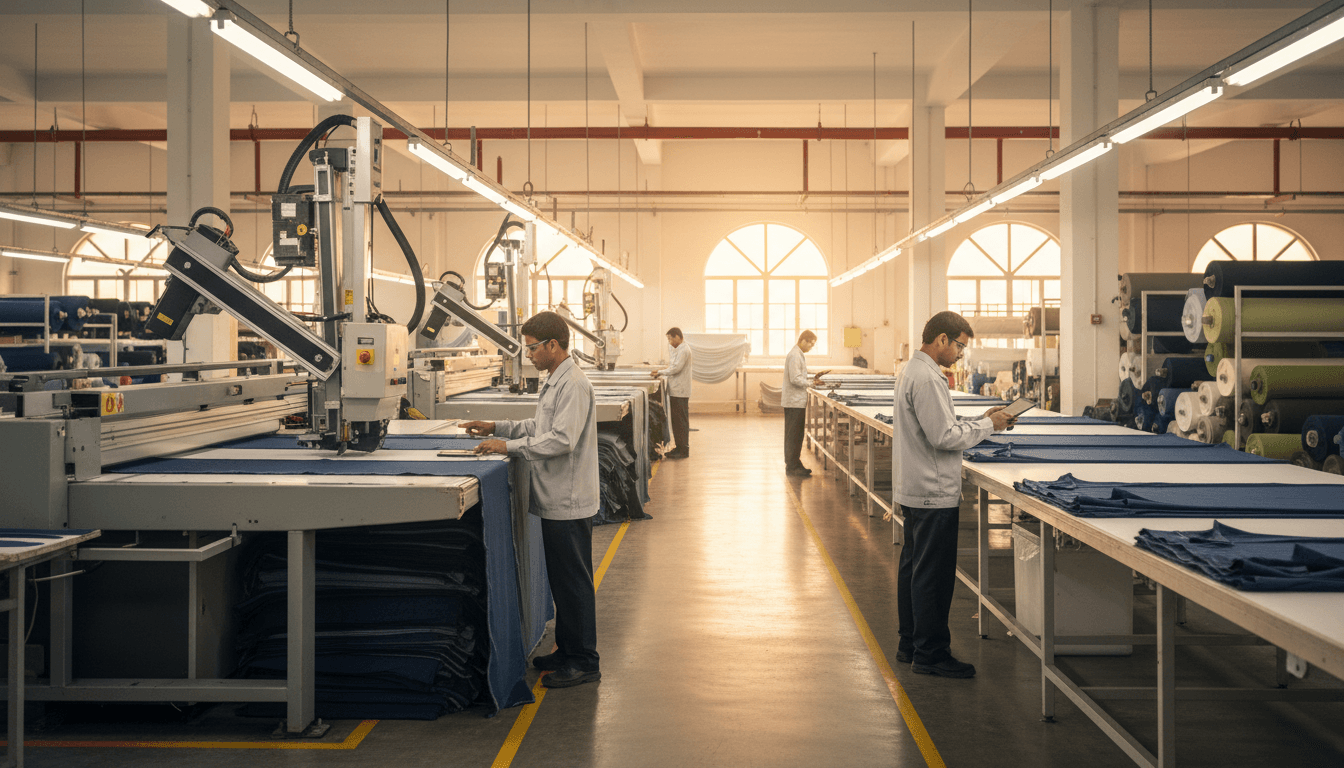
AI + Automation: Pakistan Textile Productivity Playbook
Bangladesh’s garment industry didn’t get “faster” by pushing people to work harder. It got faster by changing the work itself. A recent Bangladesh Institute of Development Studies (BIDS) study puts numbers behind what many factory floors in South Asia already feel: automation is the most reliable path to measurable productivity growth—especially in the parts of the value chain where machines can standardize and speed up repeatable tasks.
Between 2014 and 2023, Bangladesh’s readymade garments (RMG) sector saw average annual productivity growth of 4.19%, driven largely by automation and technology upgrades. The headline isn’t just that productivity improved. The real story is where it improved: cutting and knitting surged, while sewing lagged because it remains the least automated step.
For Pakistan’s textile and garments industry, this is less “news from next door” and more a mirror. If you’re an exporter, a mill manager, a production head, or running a mid-sized stitching unit, the takeaway is direct: automation proves the gains; AI multiplies them. This post is part of our series, “پاکستان میں ٹیکسٹائل اور گارمنٹس کی صنعت کو مصنوعی ذہانت کیسے تبدیل کر رہی ہے”, and it’s focused on practical moves you can make in 2026 planning cycles—budget, buyers, and compliance realities included.
What Bangladesh’s data says (and why Pakistan should care)
The clearest lesson from the BIDS study is that automation-intensive processes deliver higher productivity growth over long time horizons. Bangladesh’s process-level numbers are unusually specific—and that specificity matters because it tells you where the ROI typically sits.
Here’s what the study reported for annual productivity growth by process:
- Cutting: 11.13%
- Knitting: 9.85%
- Wet processing: 6.11%
- Weaving: 4.43%
- End finishing: 4.78%
- Sewing: 3.57% (lowest, because it’s still labor-heavy)
At the product level, Bangladesh saw stronger growth where product/process standardization is easier and automation is more mature:
- Jackets: 6.59%
- Knit lingerie: 6.43%
- Sweaters: 6.05%
- Home textiles: 5.58%
- T-shirts: 4.39%
Woven shirts (3%), woven trousers (1.15%), and denim (1.81%) were weaker—again pointing to lower automation penetration.
The Pakistan connection: same pressure, similar constraints
Pakistan’s export environment faces many of the same pressures: tight delivery windows, buyer audits, rising expectations on traceability, and increasingly unforgiving quality standards. The difference is that Pakistan often debates AI as a “future” project, while competitors are already using automation as the baseline.
A stance I’ll defend: Pakistan doesn’t have an “AI problem.” It has a sequencing problem. Most factories will get better results by first stabilizing data + processes (automation, SOP discipline, digital capture), then layering AI where it can actually learn from clean signals.
The productivity math that should change your capex priorities
The BIDS study includes a detail that every production head should sit with for a minute: in earlier decades, 10–12 workers using manual cutting processed 4,000–5,000 pieces/day. With modern automated setups (CAD, CNC, ERP, RFID, auto spreaders), 2–3 operators cut 8,000–10,000 pieces/day.
That’s not a small improvement. That’s a structural shift:
- 3–5× faster
- More accurate cutting (less rework, less fabric loss)
- Lower dependency on “hero operators”
What this means for Pakistan’s mills and garment units
If your factory is still thinking of cutting as a cost center, you’re leaving money on the table. In most Pakistani export setups, fabric is one of the largest cost components. So the real win isn’t only speed.
It’s fabric utilization + reduced rework + fewer shade/lot mix-ups + fewer short shipments.
AI comes in right after you digitize this stage. Once cutting plans, marker data, and actual consumption are captured, AI can forecast consumption variance, flag abnormal wastage by style, and identify operator/shift-level anomalies before they become “month-end surprises.”
Where AI fits after automation (and where it doesn’t)
A lot of teams pitch AI like it will magically fix messy production environments. It won’t. AI is strongest when your factory already collects consistent data. The Bangladesh story reinforces this: automation created repeatability; repeatability created measurable gains.
Here’s a pragmatic mapping for Pakistan.
AI in quality control: stop relying on end-line firefighting
Most companies get QC wrong by putting the best people at the end of the line. That turns QC into a rejection machine instead of a prevention system.
Once processes are digitized, computer vision QC can:
- detect fabric defects early (before cutting)
- catch stitching faults consistently at inspection points
- produce defect heatmaps by line, operator, style, and time window
Even without naming brands or tools, the operating model is clear: capture images + label defects + train models + integrate alerts into line routines. The goal is fewer “surprise” buyer claims and fewer urgent rework marathons right before shipment.
AI in production planning: realistic dates beat optimistic dates
Pakistan’s garment exporters often struggle with planning accuracy when style changes are frequent and line performance varies.
With basic digitization in place (line output, downtime reasons, changeover times), AI can:
- predict line efficiency by product type
- suggest line balancing options
- flag delivery risk earlier (days, not hours)
This matters because buyers don’t reward effort. They reward OTIF (on-time in-full).
AI in compliance reporting: make audits less painful
The BIDS study also notes a broader shift in Bangladesh toward sustainability and resource-saving tech. Pakistan is in the same buyer climate: traceability, chemical compliance, energy, and water reporting are increasingly non-negotiable.
AI won’t replace your compliance team, but it can reduce the grind:
- auto-extract evidence from SOPs, logs, and checklists
- detect missing records before an audit
- summarize corrective action trends across factories
If your compliance paperwork is still mostly manual, you’re paying a hidden tax every audit season.
Why sewing is still the bottleneck—and how Pakistan can respond
The BIDS findings show sewing had the lowest productivity growth (3.57%) because it’s the least automated, most variable stage.
This is where Pakistan needs a more realistic strategy: don’t chase full automation in sewing first. Chase assistive automation and AI-driven decision support.
Practical “assistive” upgrades that pay back
- semi-automatic sewing heads for repeat operations
- digital work instructions at the operation level
- real-time defect tagging tied to operator training
- SMV (standard minute value) and method engineering discipline
Then bring AI into the loop:
- predict defect risk by operation type
- recommend targeted training (not generic training)
- identify changeover patterns that kill throughput
The reality? Sewing improves fastest when you treat it like a system, not a collection of talented individuals.
A 90-day adoption plan for Pakistan’s textile & garments teams
If you’re trying to generate quick wins (without destabilizing production), here’s a sequence I’ve found works better than “big bang” transformations.
Days 1–30: Stabilize data capture
- pick 1–2 pilot lines (or 1 product family)
- digitize output, defects, and downtime reasons
- standardize codes (defects, reasons) so reports aren’t nonsense
Days 31–60: Automate the highest-leverage steps
- prioritize cutting room workflows (marker, spreading, bundling trace)
- integrate RFID or barcode scanning where mis-bundling happens
- introduce simple dashboards for supervisors (not fancy, just useful)
Days 61–90: Add AI where signals are clean
- defect image capture + basic computer vision POC
- delivery-risk scoring based on line performance trends
- fabric consumption variance alerts by style
If you can’t explain the business metric you’re improving—wastage %, DHU, rework %, OTIF, claim rate—don’t start the AI project yet.
What Bangladesh did right that Pakistan can copy (and improve)
The study points to technology convergence: automation spreading from large factories to medium-sized ones. That’s crucial for Pakistan because the industry isn’t only a few giants; it’s also a long tail of mid-sized units doing real export volume.
Bangladesh’s experience also highlights a constraint that Pakistan must address head-on: financing and buyer support. Large factories can fund capex; SMEs struggle.
My view: Pakistan’s fastest path is a stack approach:
- shared service models (centralized CAD, QC labs, training centers)
- vendor financing tied to measurable productivity KPIs
- buyer-backed pilots focused on OTIF + quality, not “innovation theater”
And one more uncomfortable point: ignoring labor displacement planning is a mistake. As automation expands, jobs change. The right response isn’t denial—it’s reskilling plans tied to actual roles: machine operators, maintenance, data entry discipline, QC labeling, and industrial engineering.
Pakistan’s 2026 advantage: go from automation to AI faster
Bangladesh’s numbers validate the baseline: automation drives productivity gains. Pakistan can use that validation to move quicker—because the tool ecosystem is more mature now than it was in 2014.
If you’re building your roadmap for the next 12 months, here’s the simplest way to frame it:
Automation standardizes work. AI standardizes decisions.
That’s how you reduce defects, shorten lead times, and protect margins when buyers push prices down.
If you want to sanity-check where AI fits in your operation—cutting, knitting, wet processing, sewing, finishing—map your current data capture and I’ll tell you where the first pilot should live. What would happen to your export business if you could cut rework by 20% and ship one week earlier—without adding headcount?