Bangladesh’s 2025 turmoil shows why Pakistan textiles need AI for planning, QC, and compliance. A practical roadmap to reduce risk and protect margins.
Pakistan Textiles: AI Edge as Tariffs Hit Bangladesh
Bangladesh’s garment sector didn’t “lose demand” in 2025—it lost predictability. When US tariffs spiked in April and only partially stabilised by August, factories had to spend the year re-planning instead of producing. Even with stronger shipments to the US, margins got squeezed and operations were rattled by high interest rates, energy disruptions, logistics shocks, and tighter labour rules.
That matters for Pakistan because the pressure points sound familiar: volatile export markets, currency and financing stress, power reliability, compliance requirements, and buyers who want faster delivery with less waste. The difference is what you do next.
Here’s my stance: AI in textile and garment manufacturing isn’t “innovation theatre” anymore. It’s risk control. And Bangladesh’s turbulent 2025 is a clean warning sign of what happens when the operating environment changes faster than factory decision-making.
What Bangladesh’s 2025 turbulence is really telling the region
Bangladesh’s 2025 story is a case study in how quickly fundamentals can shift—and how expensive “manual management” becomes under stress.
The source report highlights several compounding shocks:
- US tariff uncertainty (sharp rise from April, settling later at higher-than-before levels)
- High domestic financing costs that squeezed working capital
- Gas and electricity inconsistency that disrupted production planning
- Logistics disruption tied to trade frictions with India and suspension of transhipment facilities
- A major airport fire (Dhaka, October) that destroyed samples and imported accessories/raw materials worth millions
- Tighter labour regulations later in the year
- LDC graduation in 2026 approaching—meaning preferential market access will reduce in key destinations
Despite all of that, export numbers still showed growth in pockets. For example, during January–August, US apparel imports rose 3.32% to US$ 53.01 billion, while Bangladesh’s exports to the US rose 19.82% to US$ 5.64 billion. Yet overall performance remained underwhelming relative to earlier “normal” growth expectations, with total exports up only 0.62% (July–November) to US$ 20.02 billion and garment exports up 1.67% (January–November) to US$ 35.28 billion.
The message is blunt: shipment growth doesn’t guarantee profitability when tariffs, costs, and disruptions rise faster than operational response.
Pakistan’s parallel risks (and why AI matters more in 2026 than 2024)
Pakistan’s textile and garments industry operates in the same global buyer ecosystem. If your competitor’s tariffs change, your buyer’s sourcing map changes. If the EU tightens traceability expectations, everyone feels it. If lead times shrink, “good enough” planning becomes a liability.
The shared risks Pakistan can’t ignore
Pakistan textile exporters face a similar cluster of issues:
- Margin pressure from tariffs, duties, and buyer negotiations
- Volatile input costs and supply constraints (energy and raw materials)
- Rising compliance expectations (social, chemical, traceability, audit readiness)
- Higher cost of errors: rework, claims, cancellations, air freight
This matters because AI is strongest when the world becomes noisy. It helps you make faster decisions from messy signals.
A simple way to think about it: AI turns disruption into a scheduling problem—before it becomes a profit problem.
Where AI is already delivering ROI in textile and garment factories
AI isn’t one tool. It’s a set of capabilities you can apply across the value chain. For lead generation (and real operational value), it helps to speak in factory language: waste, minutes, defects, delivery risk, compliance burden.
1) AI-driven demand, order, and capacity planning
The immediate pain in Bangladesh was order planning disruption. Pakistan can get ahead by applying AI to:
- Forecast order volatility by buyer/category
- Simulate “what-if” scenarios (tariff change, late trims, power outage)
- Optimise line loading based on SMV, operator skill, style complexity
Practical outcome: fewer last-minute changes, less overtime chaos, and better on-time delivery (OTD) confidence.
2) Computer vision for fabric and garment quality control
Most companies get this wrong: they treat QC as inspection rather than early detection.
AI-based vision systems can:
- Detect fabric defects (holes, slubs, stains) earlier than manual inspection
- Flag shade variation and pattern issues in near real-time
- Catch stitching defects and measurement deviations on line
When margins are under tariff pressure, reducing rework and claims is a direct margin defence.
3) Fabric utilisation and cutting optimisation
Tariffs and cost inflation expose a brutal truth: you can’t negotiate your way out of bad utilisation.
AI can help by:
- Improving marker efficiency
- Reducing end-bits and spreading errors
- Learning from historical lay plans and fabric behaviour
Even a small utilisation improvement compounds across thousands of metres.
4) Predictive maintenance for energy and machine stability
Bangladesh faced inconsistent utilities; Pakistan’s factories also know the cost of downtime.
Predictive maintenance uses sensor data and machine logs to:
- Predict likely failures in critical equipment
- Plan maintenance around production peaks
- Reduce unplanned stoppages that destroy delivery schedules
This is the boring side of AI—and it’s often the most profitable.
5) Compliance reporting that doesn’t eat your management time
Buyers want proof: traceability, labour compliance, chemical management, shipment documentation. Manual compilation is slow and error-prone.
AI-enabled document workflows can:
- Extract data from invoices, packing lists, test reports
- Auto-build audit-ready folders by PO/style
- Trigger alerts when approvals or tests are missing
Result: compliance stops being a fire drill and becomes a controlled process.
“Digital readiness” is now a buyer-facing advantage
The Bangladesh article points to how buyer behaviour and political stability will shape 2026 outcomes. That’s true—but buyers also reward suppliers who reduce their risk.
From what I’ve seen, global buyers increasingly prefer vendors who can provide:
- Transparent production status (not just weekly emails)
- Fast sampling and development cycles
- Lower defect rates and clearer corrective action trails
- Data-backed confidence on delivery
AI supports this—but only if it’s connected to how your factory runs.
3 buyer-facing AI moves Pakistan exporters can implement fast
- AI-assisted sampling and product development: reduce back-and-forth by standardising tech packs, measurement libraries, and revision control.
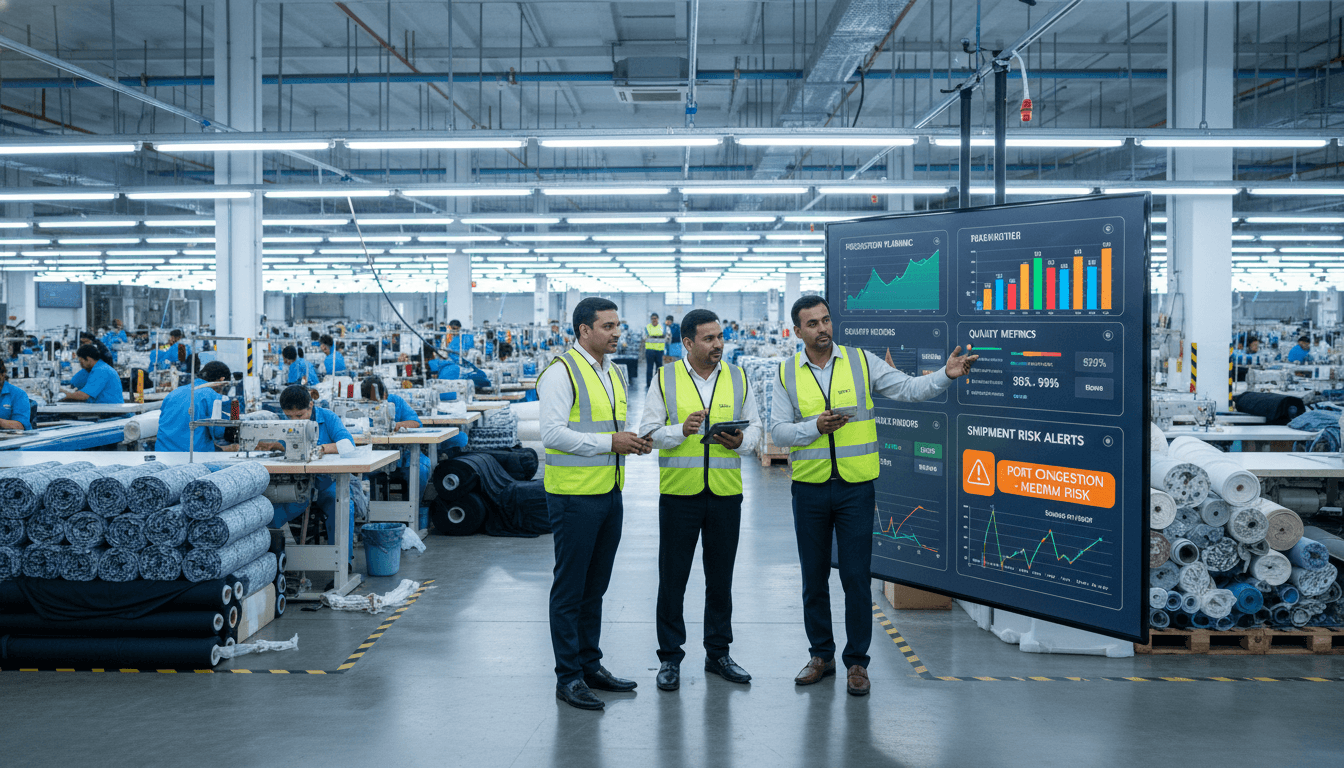
- Shipment risk scoring by PO: create a simple internal score (green/amber/red) based on delays, approvals, material readiness, and capacity.
- Quality intelligence dashboard: track defects by operator/operation/style and fix root causes, not symptoms.
These aren’t “big bang” transformations. They’re practical projects that show results within a season.
A realistic 90-day AI roadmap for Pakistani textile and garment firms
AI adoption fails when it’s treated like an IT purchase. It works when it’s treated like an operations program.
Days 1–15: Pick one problem that touches profit
Choose a use case tied to money and speed, such as:
- Reducing fabric defects escaping to cutting
- Cutting rework on two top styles
- Improving OTD for one strategic buyer
Define success with numbers (for example: reduce rework rate from X% to Y%, reduce final audit fails by Z%).
Days 16–45: Clean the data you already have
Most factories already have useful data in:
- ERP exports
- Excel production sheets
- QC checklists
- Maintenance logs
Centralise it, standardise naming, and fix missing fields. AI doesn’t require perfect data, but it does require consistent data.
Days 46–75: Pilot on one line, one fabric type, or one buyer
Contain scope. Train supervisors and QA teams. Build feedback loops.
The reality? The human process around AI decides the outcome more than the model.
Days 76–90: Scale what worked and document it for buyers
Turn pilot outputs into buyer-ready proof:
- Before/after defect charts
- OTD improvement trend
- Reduced claims or rework hours
- Updated SOPs and CAPA evidence
This is how AI becomes a commercial story, not just an internal project.
People also ask: Does AI mean fewer jobs in garments?
AI changes roles more than it removes them.
In apparel manufacturing, AI typically shifts work toward:
- Higher-skill quality analysis instead of repetitive checking
- Maintenance planning instead of emergency repair
- Line balancing and productivity improvement roles
- Data-driven compliance coordination
Factories that train their teams early get the upside. Factories that wait often face a painful transition under buyer pressure.
The warning from Bangladesh—and the opportunity for Pakistan
Bangladesh’s 2025 shows what happens when shocks stack up: tariff volatility, energy instability, logistics disruption, and regulatory pressure. Even with export growth to the US, the sector struggled to translate shipments into comfortable profitability.
Pakistan can take a different path. AI in Pakistan’s textile and garments industry is a practical way to stabilise margins, improve delivery confidence, and reduce quality risk—especially heading into 2026, when trade rules and buyer expectations will keep tightening.
If you’re running a mill, a garment unit, or an export business, here’s the question that decides your next 12 months: Are you building a factory that reacts to disruption—or one that predicts it?
If you want, I can map a simple AI adoption plan for your specific operation (spinning, weaving/knits, dyeing, cutting, stitching, finishing) and the buyers you serve—so you’re not guessing what to automate first.