AI-driven cyber resilience helps Pakistan’s textile exporters protect buyer trust, reduce downtime, and automate compliance proof—before disruptions hit shipments.
AI Cyber Resilience: Trust for Pakistan Textile Exports
84% of consumers say consistent quality is what makes a retailer trustworthy, and 81% point to clear value for money. That’s not a “soft” branding point—it’s a hard business metric tied to repeat buying and reputation.
Now add a second, less comfortable fact: even a highly trusted brand like Marks & Spencer can take a public hit from a major cyber incident and still keep its trust position—if it restores service quickly, communicates well, and proves reliability under pressure. For Pakistan’s textile and garments exporters, the lesson is simple: buyers don’t just audit your stitches and shade bands anymore. They’re watching your digital reliability too.
This post is part of our series “پاکستان میں ٹیکسٹائل اور گارمنٹس کی صنعت کو مصنوعی ذہانت کیسے تبدیل کر رہی ہے”—and today’s angle is blunt: AI in textile manufacturing isn’t only about productivity and quality control. It’s also about protecting trust through AI-driven risk management, cybersecurity, and compliance.
What M&S teaches exporters: trust survives when operations don’t collapse
Trust holds when three things happen fast: containment, continuity, and credibility.
M&S stayed at the top of a trust ranking despite a crippling cyberattack largely because customers couldn’t easily replace the brand’s own-label products—and because the company restored service and reinforced value after the outage. That combination matters for exporters because global brands judge suppliers in a similar way:
- Are you replaceable? If your quality, speed, and compliance are easy to find elsewhere, a disruption becomes a reason to switch.
- Can you keep shipping? A few days of downtime can destroy on-time delivery performance.
- Do you communicate like a mature partner? Silence during incidents is interpreted as incompetence or concealment.
For Pakistan’s textile sector—where margins are tight and buyer expectations are strict—cyber resilience is no longer “IT’s problem.” It’s a commercial capability.
The uncomfortable parallel for Pakistan’s garment industry
A ransomware incident at a mill doesn’t only hit ERP screens. It can freeze:
- order confirmations and shipment docs
- lab dip approvals and shade history
- machine maintenance schedules
- payroll and attendance systems
- buyer portals, EDI, and compliance records
If you can’t produce evidence quickly—test reports, chemical inventories, wage documentation, traceability records—buyers don’t just worry about delivery. They worry about compliance exposure.
Where AI fits: from “security tools” to risk management that buyers respect
AI’s most practical value in cybersecurity is not sci-fi hacking battles. It’s simple: detect weird behavior earlier, reduce downtime, and prove control.
In manufacturing environments (including textile mills), the attack surface is messy: old Windows machines, shared logins, vendor remote access, PLCs, OT networks, and rushed patching because “production can’t stop.” AI helps because it can spot patterns humans miss across thousands of events.
AI-driven threat detection that actually matters on the factory floor
The fastest wins typically come from:
- Anomaly detection in network traffic
- AI models flag unusual data flows (e.g., a dyeing workstation suddenly sending large encrypted files at midnight).
- User behavior analytics
- Detects compromised accounts (e.g., an office user accessing OT systems they’ve never touched).
- Email and invoice fraud detection
- Flags spoofed supplier emails and payment redirection attempts—common in export businesses.
The business outcome to aim for is measurable: shorter “time to detect” and “time to respond.” Buyers may not ask for those exact metrics yet, but they’re already punishing repeated disruptions through reduced volumes and stricter audit pressure.
AI for continuity: keeping production and shipments moving
Most companies get stuck thinking “cybersecurity = prevention.” Real resilience includes continuity.
AI can support continuity through:
- Predictive maintenance + security monitoring together: When your systems already monitor machines for failures, you can integrate alerts for abnormal behavior that indicates tampering or malware.
- Automated incident playbooks: When a specific alert fires (e.g., suspicious privilege escalation), your system can auto-isolate a device segment to keep the rest of the plant running.
- Backup integrity checks: AI can help detect abnormal encryption or mass deletion early—before backups get contaminated.
Here’s the stance I’ll take: for exporters, continuity beats perfection. Buyers forgive an incident faster than they forgive late shipments plus poor communication.
AI compliance automation: the quiet trust-builder buyers notice
Retail trust drivers in the M&S story were quality and value cues. In B2B apparel sourcing, the equivalent cues are:
- consistent quality performance (AQL, returns, complaints)
- documented compliance (social, chemical, environmental)
- traceability and transparency
- reliable communication and fast corrective actions
AI helps by making compliance faster to prove.
Practical AI use cases for textile compliance in Pakistan
Start with the work that wastes the most time:
- Document extraction and validation: AI reads test reports, certificates, and invoices, then checks for missing fields, expired dates, and mismatched batch/lot numbers.
- Chemical and restricted substances monitoring: AI systems can flag risky formulations based on historical non-compliances (e.g., repeated failures from specific chemical vendors or processes).
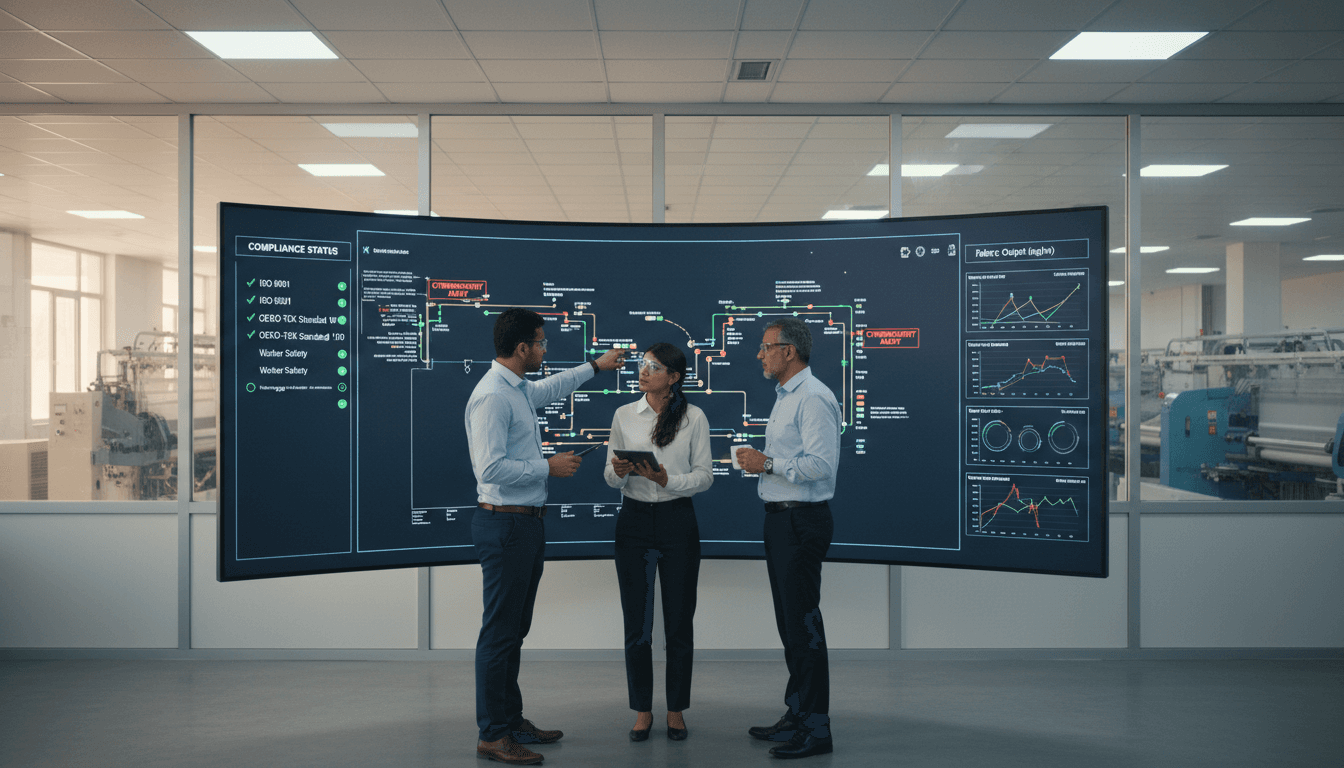
- Audit readiness dashboards: Instead of scrambling for PDFs, you maintain a continuously updated compliance “control room.”
A buyer doesn’t care whether you used AI. They care that when they ask, you can respond in hours, not days.
Linking cyber resilience to compliance (the bridge buyers make)
If your ERP, LIMS, or HR records go down during peak season, you may fail to provide:
- time and wage records
- worker age documentation
- chemical purchase logs
- calibration and test histories
That’s why cybersecurity is now a compliance issue. AI-driven risk management is becoming part of export credibility.
A simple maturity model for Pakistan’s textile and garments firms
If you’re trying to decide what to do first, don’t copy huge retailers or global brands. Build capability in layers.
Level 1: Make disruptions smaller (30–60 days)
Answer first: reduce the blast radius of common attacks.
- segment office IT and factory OT networks
- remove shared accounts on critical systems
- enable MFA for email, ERP, and remote access
- deploy AI-assisted endpoint protection on key devices
If you do only one thing: lock down vendor remote access. It’s a frequent weak spot in industrial environments.
Level 2: Detect early and respond fast (60–120 days)
Answer first: shorten downtime through visibility and playbooks.
- deploy centralized logging (SIEM) with AI correlation
- set alert thresholds for unusual file encryption / mass deletions
- define incident playbooks: isolate, preserve, restore, communicate
A practical KPI: aim for an incident response process that can isolate affected systems in minutes, not hours.
Level 3: Prove trust continuously (120–240 days)
Answer first: turn trust into evidence, not promises.
- compliance dashboards that pull from HR/ERP/LIMS
- automated evidence packs for buyer audits
- supplier risk scoring for chemicals, trims, and subcontractors
This is where AI starts paying twice: fewer incidents and faster buyer responses.
Crisis communication: the part most exporters get wrong
M&S benefited from restoring service and reinforcing value. In export manufacturing, the equivalent is structured, credible incident communication.
When something goes wrong (cyber or operational), buyers want clarity:
- What happened (high-level, not technical drama)
- What’s impacted (orders, lead times, data exposure)
- What you’ve done (containment steps + timeline)
- What’s next (recovery plan + preventive actions)
A line I’ve found works internally: “If we can’t explain it clearly, we probably don’t control it.”
AI can support this too—by generating standardized incident summaries from logs and task trackers, and by maintaining a real-time status view across production, IT, and logistics.
People Also Ask (and what I’d answer)
Do textile mills in Pakistan really need AI for cybersecurity?
Yes—because mills run mixed environments (legacy systems + modern cloud tools). AI helps detect anomalies faster than manual monitoring, especially with small IT teams.
Is AI compliance automation only for large exporters?
No. The best entry point is narrow: start with document extraction and expiry/consistency checks for certificates and test reports. That alone reduces buyer friction.
Will buyers pay more if we invest in AI-driven risk management?
Not directly. The payoff comes as fewer chargebacks, fewer urgent air shipments, fewer audit escalations, and more repeat orders. That’s profit, even without a price premium.
What to do next (if you want trust that survives disruption)
The M&S case shows trust is earned in normal times but tested in bad ones. For Pakistan’s textile and garments sector, AI adoption should be aimed at one outcome: reliable delivery with provable control.
If you’re planning your 2026 roadmap, I’d start here:
- Map your critical systems (ERP, LIMS, email, buyer portals, OT network)
- Identify your top 10 “single points of failure”
- Deploy AI-assisted monitoring on the assets that would stop shipments
- Automate compliance evidence packs so audits don’t depend on heroics
If your export business had a week-long IT outage in peak season, would your biggest buyer stay calm—or start calling alternatives? That’s the real test AI can help you pass.