Hands-on crime scene training shows how experiential learning builds job-ready skills, boosts retention, and helps grads get hired in skills-based hiring.
Hands-On Crime Scene Training That Gets Grads Hired
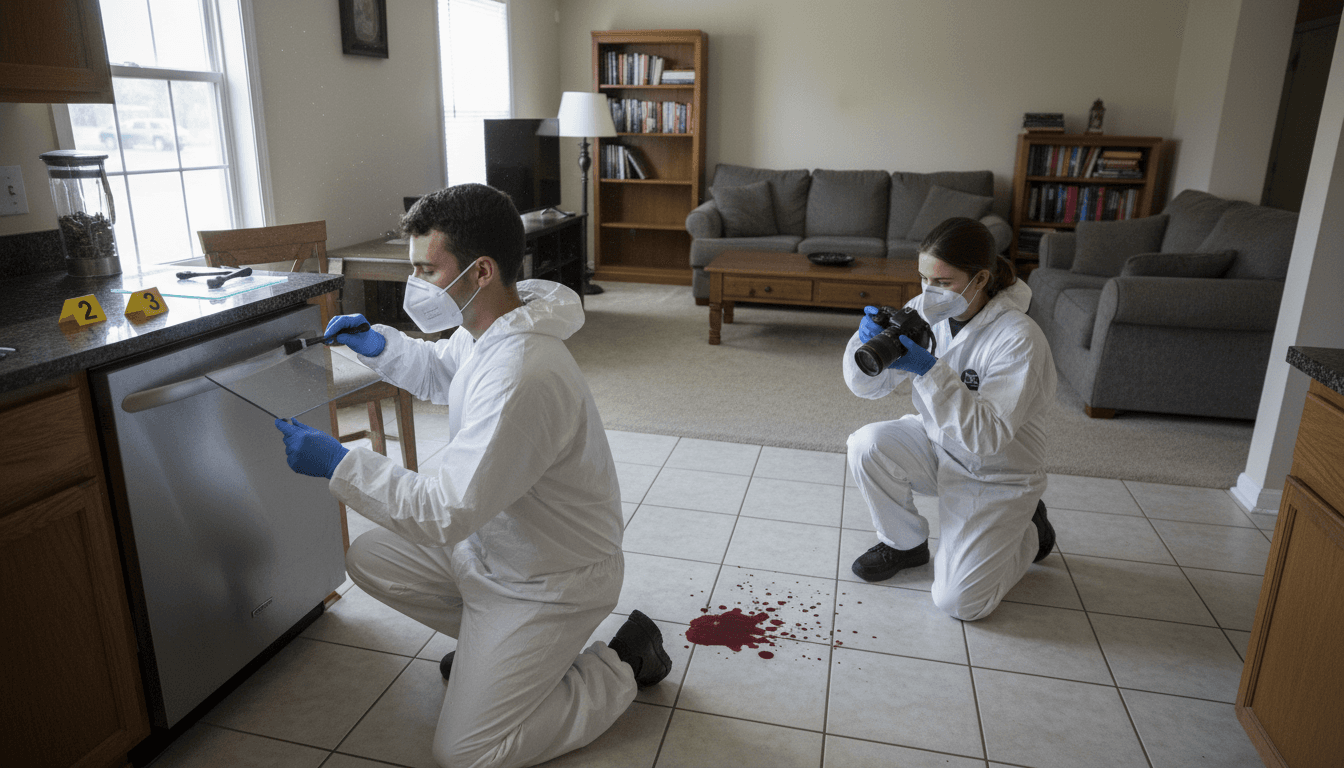
A typical suburban house doesn’t look like a workforce development strategy. But at Gwynedd Mercy University (about an hour outside Philadelphia), one pale-yellow Colonial is doing something many career-focused programs only talk about: turning classroom knowledge into job-ready skills.
Students don’t walk in with notebooks. They suit up in protective gear, step into staged scenarios with fingerprints and blood spatter, and get observed through a live camera feed. The point isn’t theater. The point is competence.
For the Education, Skills, and Workforce Development series, this is exactly the kind of case study that matters in late 2025—when students are scrutinizing ROI, employers are tired of paying for basic training, and AI is reshaping what “entry-level” even means. A “Crime Scene House” is a vivid example, but the real story is bigger: experiential learning is becoming the most credible bridge between education and employment.
Experiential learning works because employers hire for performance
If you want to close a skills gap, you have to measure skills in action. That’s the simplest argument for experiential learning, and it’s why simulations, internships, apprenticeships, and work-based projects keep expanding across higher education.
Employers in many sectors (criminal justice included) increasingly screen for evidence that a candidate can:
- Follow procedures under pressure
- Document work clearly and defensibly
- Communicate with teammates and supervisors
- Use job-specific tools correctly
- Make decisions when information is incomplete
A lecture can explain those things. It can’t prove you can do them.
Andrew Potter at the University of Georgia describes the problem as two “bubbles”—higher education and industry—that need to come closer together. I agree, but I’ll put it more bluntly: the cost of the gap is getting shoved onto students and employers, and both are pushing back.
Why this hits harder in criminal justice (and similar fields)
Criminal justice careers are skill-dense, process-heavy, and high-stakes. A rookie mistake isn’t just embarrassing—it can compromise evidence, harm a case, or put people in danger.
That makes criminal justice a useful “stress test” for workforce training design. If a program can prepare students for:
- chain-of-custody discipline,
- meticulous documentation,
- proper evidence collection,
- professional interviewing,
…it can likely strengthen outcomes in many other fields where errors are costly (healthcare, IT security, advanced manufacturing, aviation maintenance).
The Crime Scene House model: realistic practice, structured feedback
Gwynedd Mercy’s Crime Scene House is a controlled environment where students practice the work, not just study it. The house includes a kitchen, bedrooms, bathrooms, an office, and even a car outside—each of which can be staged as part of one continuous scenario or multiple separate incidents.
That flexibility matters because real investigations rarely happen in tidy lab conditions. Different rooms simulate different constraints:
- Tight spaces and mixed surfaces (kitchen)
- High-emotion contexts (bedroom scenarios)
- Cleanup attempts (bathroom sink used to wash away “blood”)
- Vehicle evidence (car staged as drug-transport)
Patrick McGrain, director of the criminal justice program, emphasizes what many programs struggle to deliver: front-to-back exposure to what investigators actually do.
“Answer-first” takeaway: Simulation beats explanation
A sentence worth repeating: The closer training looks like the job, the less expensive and painful onboarding becomes.
At GMercyU, instructors—many with law enforcement backgrounds—monitor students via camera feeds, record performance, and debrief afterward. That debrief loop is where the learning compounds.
This is the part many schools miss. They’ll build a “cool space,” run an activity once, and call it experiential learning. What makes it workforce-relevant is:
- Repeatable scenarios (students can run multiple cases)
- Observation and recording (performance is reviewable)
- Feedback from practitioners (not just academic grading)
- Reflection and iteration (students improve on the next run)
That’s skills training, not entertainment.
Confidence is a workforce outcome—especially before the academy
Experiential learning doesn’t just teach technique; it reduces shock. That matters in fields where the first real exposure can be emotionally intense.
A third-year student, Jerome Mathew, describes the Crime Scene House as a way to prepare mentally for the intensity of his intended state or federal law enforcement career—and to feel more ready for the police academy.
That “academy readiness” angle is more important than it sounds. In a lot of pipeline careers, the transition points are where people drop out:
- from classroom to practicum,
- from program to certification,
- from graduation to academy,
- from academy to field training.
If schools can reduce uncertainty and build competence earlier, they don’t just help graduates get hired—they help graduates stick.
What students actually gain (beyond the obvious)
Here’s what a well-designed crime scene simulation can build that doesn’t show up in a syllabus:
- Composure under observation (you’re being watched and recorded)
- Task prioritization (what do you document first?)
- Communication hygiene (clear notes, precise language)
- Professional skepticism (don’t overfit to a single theory)
- Ethical instincts (what you touch, move, or assume matters)
Those are “human” skills. AI can’t give you that by generating a study guide.
AI is pushing schools toward experiences it can’t replicate
Generative AI makes traditional coursework easier to complete, which makes it less useful as a signal. If a student can produce a polished report in minutes, the report alone tells employers less about capability.
Jay Roberts at Warren Wilson College makes a sharp point: AI can assist with reading and writing, but it can’t replace a study-abroad program, internship, or real-world simulation.
I’d extend that: AI increases the value of learning formats that produce observable behavior. That’s why experiential learning is trending across disciplines:
- History students doing museum apprenticeships
- Music students producing performances end-to-end (arrangement, logistics, venue)
- Business students running client-based consulting projects
- Cybersecurity students working in controlled “attack/defend” labs
The Crime Scene House is just a particularly visual example.
Retention and recruitment: the business case colleges don’t say out loud
Experiential learning improves student retention because it creates belonging and clarity. Edwin Blanton at UT San Antonio notes that when students feel connected and confident they’re on the right path, they’re more likely to persist to graduation.
That’s not just a “student success” story. It’s also how institutions survive a competitive market.
In December 2025, students are shopping for degrees the way they shop for subscriptions: What am I paying for, and what do I get back? Programs that can show tangible skill-building—portfolios, simulations, employer-aligned assessments—have a cleaner answer.
A stance: “Hands-on” isn’t a perk anymore
Most colleges still market experiential learning as an add-on. That’s backwards.
For career-linked majors, experiential learning should be the spine of the program, with lectures and readings supporting it—like film study supporting filmmaking.
And there’s another underrated benefit Blanton points out: if a student discovers a field isn’t right for them through a simulation, that’s a win. Better to pivot during training than after taking on debt and landing in a job you can’t stand.
How to build workforce-ready simulations without a huge budget
You don’t need a Hollywood set; you need intentional design. GMercyU made the Crime Scene House feasible by using an existing campus resource: a building that used to house the Sisters of Mercy and had been unused.
That’s a playbook worth copying across institutions and training organizations.
A simple framework: the 5-part simulation blueprint
If you’re designing experiential learning for workforce development—whether in a college, training provider, or employer-led academy—use this structure:
- Role clarity: Who is the learner being today? Investigator, analyst, supervisor?
- Artifacts and constraints: What tools, time limits, and documentation rules apply?
- Performance criteria: What does “good” look like? Create a rubric tied to real work.
- Observation: Live monitoring, recorded review, peer feedback, or all three.
- Iteration: The same skill must be practiced multiple times with rising complexity.
This is how you turn “project-based learning” into skills-based training that employers trust.
What employers can ask for (and what schools should offer)
If you’re an employer partnering with a program (or you’re choosing one), look for proof like:
- Students complete scenario-based assessments that mirror job tasks
- The program tracks competency progress (not just credit hours)
- Instructors include practitioners who can evaluate job realism
- Students graduate with work samples: case notes, photos, interview plans, evidence logs
On the school side, the ask to employers is straightforward: provide current procedures, anonymized case patterns, guest evaluators, and internship slots. The partnership doesn’t need to be fancy. It needs to be consistent.
People also ask: does experiential learning replace internships?
No—internships and simulations solve different problems.
- Simulations are repeatable, controlled, and safe for early practice. They’re ideal for building baseline competence.
- Internships expose students to the messiness of real operations, culture, and cross-team coordination.
The strongest workforce development programs stack them: simulation first, internship next, then a capstone that requires professional-level output.
What to do next (students, schools, and employers)
Experiential learning isn’t new, but the stakes are. As degrees get questioned and entry-level roles get redefined, hands-on learning is becoming the clearest proof of readiness.
If you’re a student choosing a program, ask to see the experiences—not the brochure:
- How many simulations or real projects do you complete?
- Who evaluates your work, and how often?
- What do graduates show in an interview besides a transcript?
If you run a program, borrow GMercyU’s mindset: build a place where students can practice “front to back,” then record, critique, and repeat. If you’re an employer, partner early and treat training programs as part of your talent pipeline, not a vendor you call after you’re short-staffed.
The question for 2026 is simple: Will your learning model produce graduates who can perform on day one—or graduates who need to be retrained from scratch?