Nigeria’s talks with Google on a new undersea cable could boost digital resilience—meaning fewer outages and stronger AI-powered creator workflows.
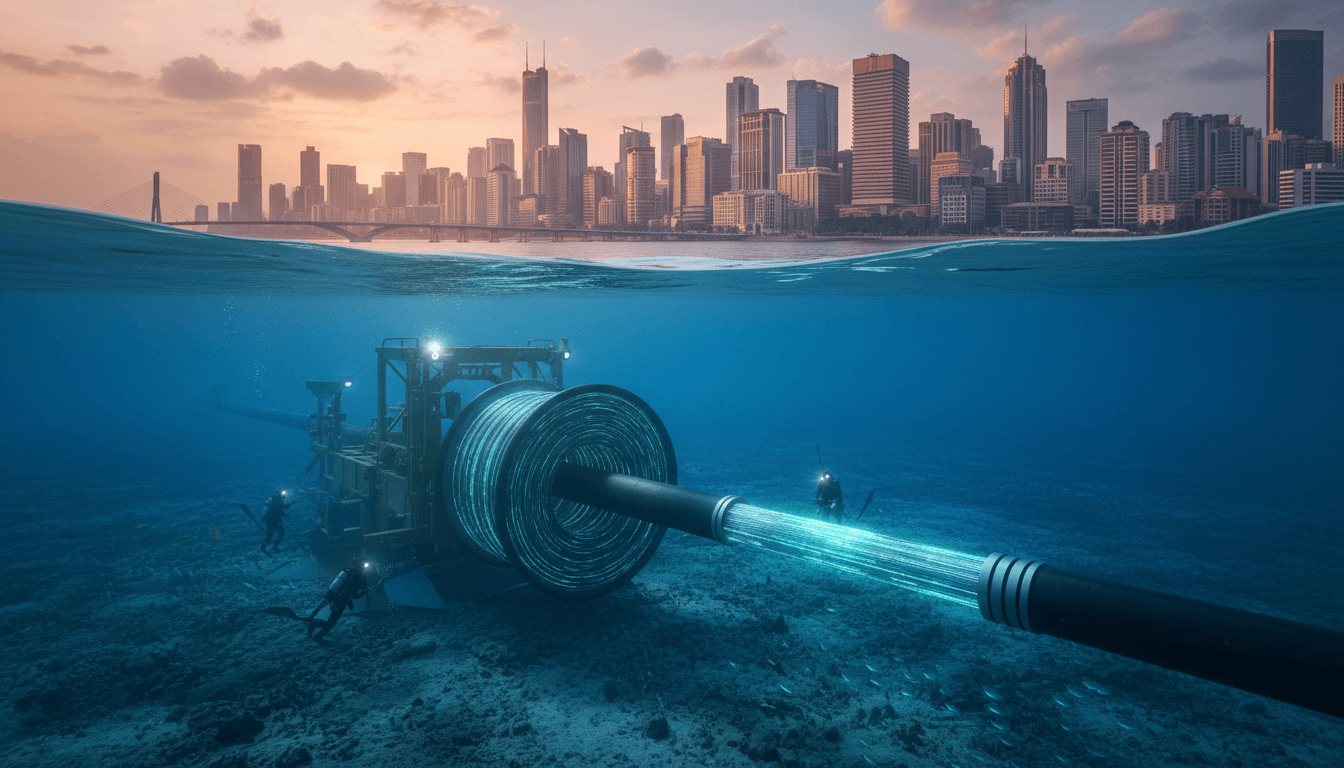
Google’s New Cable Talks: What Creators Gain
Nigeria’s creator economy doesn’t crash because someone ran out of ideas. It crashes because the internet does.
That’s why today’s news matters: Nigeria is in advanced talks with Google about deploying a new undersea cable to strengthen digital resilience—essentially, making sure the country’s internet doesn’t go dark when one route fails. The National Information Technology Development Agency (NITDA) is pushing for more capacity and alternative routes, after recent subsea cable damage showed how exposed the system is.
This post is part of our series on How AI Is Powering Nigeria’s Digital Content & Creator Economy, and I’ll be blunt: AI tools are only as useful as the network behind them. A more resilient internet backbone is one of the most practical “creator economy policies” Nigeria can pursue—because it reduces downtime, stabilizes workflow, and makes digital businesses easier to scale.
Nigeria’s internet problem isn’t speed. It’s fragility.
Nigeria already hosts at least eight major undersea cable systems landing primarily in places like Lagos and Akwa Ibom (including MainOne, SAT-3/WASC, Glo-2, ACE, WACS, Equiano, 2Africa, and NCSCS). On paper, that sounds like abundance.
But the real vulnerability is routing concentration. As NITDA’s DG, Kashifu Inuwa, put it, relying on undersea cables that follow similar paths becomes a “single point of failure.” When damage happens on a corridor shared by multiple systems, it doesn’t matter that Nigeria has several cables—businesses still feel the outage.
We saw this clearly in March 2024, when damage near Abidjan disrupted multiple cables feeding West Africa, and Nigeria experienced widespread service degradation that hit telcos, banks, and everyday users.
Here’s the key point: digital resilience is not a luxury feature; it’s uptime insurance for the entire economy.
What a “new route” actually changes
A new undersea cable project isn’t just another pipe. If designed with route diversity in mind, it can:
- Reduce correlated failures (not everything breaks at once)
- Improve latency consistency (fewer jitter spikes during congestion)
- Increase total available capacity (more room for video, cloud services, and AI workloads)
- Give ISPs better redundancy options (faster rerouting when a cable segment fails)
For creators, this translates into fewer “I can’t upload today” moments—and fewer brand deadlines missed because your network collapsed.
Why this matters specifically for Nigeria’s creator economy
Nigeria’s digital content economy is unusually sensitive to network disruption because it’s built on:
- Video-heavy platforms (TikTok, YouTube, Instagram Reels)
- Live formats (TikTok LIVE, IG Live, livestream shopping)
- Always-on engagement cycles (communities expect instant replies)
- Cross-border monetization (clients, ad networks, and platforms outside Nigeria)
When connectivity degrades, creators don’t just lose time. They lose money.
The hidden costs creators pay during outages
Creators and small media teams take hits in ways that don’t show up in national stats:
- Failed uploads and re-uploads burn data, time, and morale.
- Lower stream quality means viewers bounce, watch time drops, and algorithms punish reach.
- Missed posting windows break consistency—one of the strongest predictors of content growth.
- Delayed client approvals stall production schedules, especially for agencies and brand creators.
- Tool failures (cloud editing, asset syncing, AI tools) stop work completely.
A resilient backbone doesn’t eliminate every last-mile problem, but it reduces the catastrophic “everything is down” events that wipe out productivity across cities.
A creator economy can’t scale on “maybe the internet works today.”
Undersea cables are the foundation for AI-powered content workflows
AI isn’t only about chatbots. In Nigeria’s content market, AI is increasingly used for:
- Script ideation and outlining
- Captioning and translation (localization for diaspora audiences)
- Video editing assistance (auto-cuts, silence removal, smart reframing)
- Thumbnail generation and testing
- Audio cleanup (noise reduction, voice enhancement)
Most of these workflows depend on cloud compute—meaning your laptop or phone is often just the control panel, while the heavy lifting happens in data centers.
NITDA’s comments also point to this broader ambition: Nigeria wants more investment in cloud computing and high-performance computing capacity. That’s the right direction.
Why cloud + connectivity is the winning pair
Even if Nigeria gets more local data centers, creators still need reliable connectivity because:
- Creative teams collaborate across cities and countries
- Platforms (YouTube, Meta, TikTok) still rely on global networks
- Backups, distribution, and analytics often sit outside your physical location
So when you hear “undersea cable,” translate it to something concrete: the ability to use AI tools at scale without your workflow collapsing.
What Google’s talks signal (beyond the cable)
According to the report, Google earlier announced plans for four new infrastructure hubs in Africa to support its latest subsea fibre systems. If Nigeria becomes part of this plan, the upside is bigger than one project.
It signals three things:
1) Nigeria is still viewed as the demand center
Internet infrastructure follows usage. Nigeria’s population size, platform activity, fintech adoption, and entertainment exports make it the natural gravity well.
2) Big tech is optimizing for reliability, not hype
The most serious infrastructure spending is boring by design: redundancy, route diversity, more capacity, better peering. That’s what builds durable markets.
3) The creator economy is becoming “infrastructure-backed”
Creators often think growth is purely personal: content quality, consistency, niche.
The reality is structural too. When infrastructure improves, creators:
- spend less time troubleshooting
- post more consistently
- collaborate more easily
- deliver client work faster
- experiment with higher-quality formats
And that compounds.
What creators and digital businesses should do right now
A new undersea cable won’t appear next week. These projects take time: permitting, financing, landing stations, integration with terrestrial fibre, and commercial rollout.
But you can still make smart moves in anticipation.
Build a “no-outage” operating setup
If you earn money online, you should operate like downtime is inevitable.
- Run two networks: primary fibre + secondary 4G/5G router (different provider if possible)
- Keep an upload queue: schedule posts ahead (especially for holiday campaigns)
- Use offline-first tools for writing and rough edits, then sync when stable
- Maintain local backups of raw footage and project files (SSD + external drive)
Shift to lighter production where it makes sense
High production value is great, but reliability wins.
- Batch export versions at lower bitrates for emergency uploads
- Keep a “fast content” template for outage days (short-form, minimal effects)
- Pre-generate captions and thumbnails when you have stable internet
If you run a media team or agency, treat connectivity like payroll
I’ve found that small teams underinvest in network redundancy because it feels like overhead.
It’s not overhead. It’s delivery capacity.
Set a basic policy:
- Two connections minimum at the studio/office
- Defined fallback workflow when cloud tools fail
- A client communication template for service disruptions
Clients don’t mind delays as much as they mind silence.
“People also ask” questions creators have about undersea cables
Will a new undersea cable make my internet cheaper?
Not automatically. Prices depend on competition, last‑mile costs, power, FX pressures, and how capacity is sold. But more capacity and better redundancy can reduce scarcity-driven spikes and improve quality.
Will it fix poor connectivity everywhere in Nigeria?
No. Undersea cables bring international capacity to landing points; national impact depends on terrestrial fibre rollout, metro networks, and last‑mile delivery. Still, stronger international resilience reduces nationwide shock during major outages.
Why is “route diversity” such a big deal?
Because multiple cables on the same corridor can fail from the same incident—anchors, seabed shifts, construction, or accidents. Different routes reduce shared risk.
What this could mean for 2026 creator growth
December is peak season for online commerce and entertainment in Nigeria—brand campaigns, music releases, end‑of‑year recap content, influencer activations. It’s also when creators feel network strain the most, because usage spikes.
So a plan that improves resilience isn’t abstract policy talk. It’s the difference between:
- creators meeting holiday campaign deliverables or missing them
- livestream sellers closing deals in real time or losing buyers mid-stream
- AI-assisted production being “normal” or being “only when the internet cooperates”
Nigeria’s creator economy is already huge in cultural influence. The next phase is operational maturity: consistent delivery, scalable workflows, reliable monetization. Infrastructure is how you get there.
If the Google–Nigeria undersea cable talks turn into a signed buildout with real route diversity, it will be one of the most creator-relevant infrastructure moves we’ve seen in years.
Where do you think Nigeria will feel resilience gains first—livestreaming, cloud production, or everyday social media posting?