Starlink Direct-to-Cell is coming to Nigeria via Airtel. See what it means for creators, AI workflows, rural reach, and content businesses in 2026.
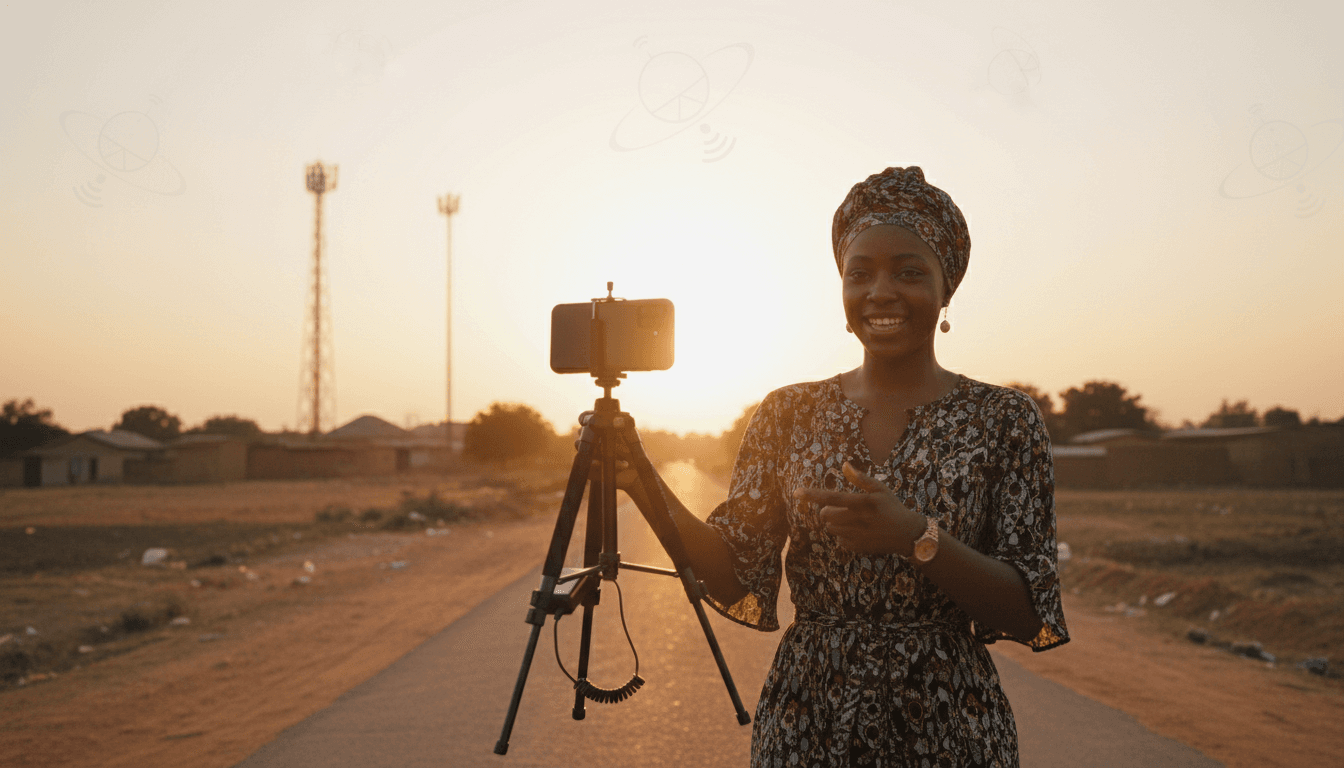
Starlink Direct-to-Cell: What It Means for Creators
Nigeria has 174 million phone users. That number matters for culture, business, and politics—but for creators, it means something simpler: your audience is already on mobile. The frustrating part has never been reach. It’s been reliable connectivity, especially once you step outside major urban corridors.
Airtel Africa’s agreement with SpaceX to introduce Starlink Direct-to-Cell satellite connectivity across Nigeria and 13 other Airtel markets points at a shift in what “being online” can mean in 2026: not “I hope there’s 4G here,” but “my phone still works, even when towers don’t.” And when connectivity stops being a daily gamble, Nigeria’s creator economy gets a structural upgrade.
This post breaks down what the partnership actually enables (and what it doesn’t), why it’s a big deal for Nigeria’s digital content and creator economy, and how creators can prepare—especially as AI tools become more bandwidth-hungry and more central to content production.
What Airtel + Starlink Direct-to-Cell is (and isn’t)
Direct-to-Cell is satellite connectivity designed to connect compatible smartphones in areas without terrestrial coverage. Think of it as a safety net that shows up when normal mobile networks can’t.
From the announced rollout details, the initial service slated for 2026 starts with:
- Text messaging
- Data for select applications
It also includes support for Starlink’s first broadband Direct-to-Cell system with next-generation satellites that are expected to deliver about 20x improved data speed compared to earlier capability claims in this category.
What this means in practical terms
- It complements, not replaces, mobile towers. In Lagos or Abuja, your everyday experience may not change much on day one. The early wins are for places where coverage is patchy or nonexistent.
- Creators working outside big cities benefit first. If you shoot travel content in Idanre, cover festivals in rural communities, or run a field interview series across states, the “dead zone problem” is your tax. Direct-to-Cell reduces that tax.
- Rollout depends on approvals. Timing and feature depth will be shaped by country-by-country regulatory clearance.
What it is not
- It’s not automatically “always-on broadband everywhere” from day one.
- It’s not guaranteed to make video uploads instant in every location.
But even the first phase—texts and select app data—changes workflows more than people realize, because it fixes coordination, payments, and publishing continuity.
Why satellite coverage matters to Nigeria’s creator economy
The creator economy runs on consistency. Algorithms reward regular posting, fast response times, and stable live interactions. When connectivity is unreliable, creators lose opportunities in ways that don’t show up neatly on a spreadsheet.
Here’s the straightforward chain reaction:
- More coverage → fewer “offline days”
- Fewer offline days → more consistent output
- More consistent output → better distribution and monetization
- Better monetization → more reinvestment in production
That’s how infrastructure becomes culture.
The real cost of “no signal” is missed momentum
Creators don’t just lose upload time. They lose:
- Collab speed: delayed responses kill partnerships
- Brand deal execution: late posting breaks campaign schedules
- Community management: unanswered DMs and comments reduce loyalty
- Operational control: if you can’t check analytics, payments, or ads, you can’t steer the business
If you’ve ever tried to run a content business while traveling between states (or even within a state), you know the feeling: you can create, but you can’t ship. Direct-to-Cell is about shipping.
Nigeria’s scale makes the upside bigger
Airtel reportedly has 59 million customers in Nigeria with 33.7% market share (as referenced in the source). When a major operator adds a satellite layer, it’s not a niche experiment—it’s a directional bet.
For creators, that means the “addressable creator market” expands beyond the usual hotspots because:
- more creators can publish reliably from underserved areas
- more audiences can participate in real time (comments, shares, payments)
Where AI meets connectivity: faster internet, smarter content businesses
AI is already powering Nigeria’s digital content engine, but the next phase of creator growth depends on being able to use AI tools in real production settings—on the road, in studios outside city centers, during live coverage, and inside small businesses.
Connectivity affects AI adoption in three ways:
1) AI creation tools depend on stable data, not just “some” data
A lot of the tools creators use daily are cloud-connected:
- caption and subtitle generation
- background noise removal
- thumbnail variations and creative testing
- automated translations for pan-African audiences
- scheduling and cross-posting
Even when you’re not generating huge files, these tools require reliable sessions—logins, uploads, previews, exports. Satellite fallback reduces the “I’ll do it later when I’m back in town” trap.
2) AI helps creators earn more when they can measure performance consistently
The most profitable creators I’ve seen treat content like a system:
- they test hooks
- track retention
- double down on formats that work
- stop producing what doesn’t
That requires regular access to analytics dashboards and ad managers. A connectivity layer that follows you into low-coverage zones makes it easier to run this system without pauses.
3) AI-powered community management needs speed
As audiences grow, creators rely on AI for:
- DM triage (sorting inquiries, separating spam)
- comment moderation
- FAQ responses for digital products
- lead qualification for brand partnerships
Those benefits collapse if you’re offline for long stretches. Direct-to-Cell won’t automate your community, but it can keep your operations from stalling.
What creators and digital entrepreneurs should do before 2026
Preparation is where the money is. When new connectivity options arrive, the creators who benefit fastest are the ones who’ve already tightened their workflow.
Audit your “offline failure points”
Write down the moments you lose time or revenue because of connectivity. Usually it’s one of these:
- uploading and scheduling posts
- receiving customer payments for digital products
- responding to brand or client briefs
- live reporting (events, politics, entertainment)
Once you see the pattern, you can design around it.
Build a low-bandwidth publishing stack
Even with better satellite coverage coming, smart creators plan for variable speeds. Here’s a practical setup that works:
- Create in batches: shoot and edit in blocks, publish in smaller daily pieces
- Compress intelligently: export multiple versions (high + mobile-friendly)
- Use text-first touchpoints: newsletters, broadcast channels, and community posts keep you present when video uploads are slow
- Pre-write captions and hooks: store them offline so you’re not blocked by loading issues
A creator who can publish reliably at 256kbps will outperform a creator who needs perfect 4G to function.
Treat your phone like production equipment
Direct-to-Cell is aimed at compatible smartphones. So creators should start thinking like operators:
- keep your OS updated (compatibility often lives in updates)
- use a power bank and manage battery health
- test eSIM or SIM setups that fit your travel pattern
- keep essential tools that work offline (notes, scripts, shot lists)
Upgrade your AI workflow now (so bandwidth boosts actually pay off)
Better connectivity doesn’t automatically create better content. Your workflow does. Two simple upgrades that pay quickly:
- Create a repeatable content pipeline
- idea capture → script template → shoot checklist → edit preset → upload checklist
- Use AI for “boring steps,” not the core voice
- AI for outlines, subtitles, repurposing, and research summaries
- your voice for opinions, storytelling, and cultural nuance
That balance keeps content authentic while increasing output.
The bigger picture: infrastructure partnerships shape creative opportunity
Airtel Africa is positioning itself as the first mobile network operator in Africa to offer Starlink Direct-to-Cell service, backed by a satellite network (the source references 650 satellites) and future next-gen expansion.
This matters beyond telecoms because it signals how Nigeria’s digital economy will grow:
- through partnerships, not one-company hero narratives
- through hybrid networks (towers + satellite)
- through practical inclusion (coverage where building towers is hard)
If you care about Nigeria’s creator economy, you should care about these deals. Creators don’t just need talent and hustle. They need rails—connectivity, payments, distribution, and tools.
And AI sits on top of those rails.
What people are asking (and direct answers)
Will satellite-to-phone connectivity reduce the digital divide in Nigeria?
Yes, it reduces one of the biggest drivers of the divide: lack of coverage. It won’t fix affordability by itself, but it expands where basic connectivity is possible.
Will creators in rural areas benefit more than urban creators?
In the near term, yes. Urban creators already have multiple connectivity options; rural creators gain the most from reliable fallback.
Does this mean livestreaming from anywhere in Nigeria?
Not immediately. Early phases focus on texts and select app data, with broadband capability tied to next-generation satellites and approvals.
How does this connect to AI-powered content creation?
AI tools work best with stable connectivity for uploads, cloud processing, analytics, and community management. A satellite layer reduces downtime, which makes AI workflows practical outside major cities.
Where this goes next for Nigeria’s creator economy
Nigeria’s digital content market is already loud—music, film, comedy, education, and micro-entrepreneurship are scaling fast. The missing piece has been consistency across geography. Direct-to-Cell satellite connectivity is a serious attempt to close that gap, starting in 2026.
If you’re building a content business, treat this as a cue: tighten your production system, make your workflow resilient, and get comfortable using AI for operational speed. When the rails improve, the creators who are ready don’t just post more—they build real companies.
What would your content look like if “no network” stopped being an excuse—and started being a rare exception?